Boruto: Naruto Next Generations Volume 1 Reread
Those of you who follow me on Bluesky will know that I recently obtained the full run of Boruto: Naruto Next Generations (NNG) manga as well as the first four volumes of Boruto: Two Blue Vortex (TBV). Those of you who have been following me for even longer than that may remember that I left Twitter halfway through posting a chapter-by-chapter reread of NNG. In honor of Boruto manga's 10th anniversary, I've decided to once again embark on a reread of the physical volumes, posting it here where it can be maintained for posterity (read: as long as I continue paying for this blog) and exist outside of social media sites, free from platform derogation.
The purpose of this reread is to refresh myself on the series, do a deeper dive into some of the themes of and moments in the story, and discover aspects of the manga in its physical form that I might have missed when reading it digitally. We'll touch on some of the fandom metanarrative that surrounds the Boruto series as well (e.g., Boruto is a brat, Naruto is an absent father).
For you, dear readers, I hope this reread will help deepen your appreciation of the series, strengthen your faith in the storytelling craft as TBV continues, and act as a general source of insight into the greater Boruto story. I aim not to be a completionist but an illuminator. There will be avenues of exploration we won't traverse and ground left unturned. It's also likely that I'll be incorrect a few times or that ways I read things won't ring true to you. When it comes to literary analysis, I think it's good intellectual hygiene to prioritize thinking over certitude. After all, talking about media isn't a practice that demands precision in the way that shooting a gun at a target prioritizes hitting the bullseye (if there is even a bullseye involved in reading). If you find me wrong, I hope it serves as tinder for you to light your own analytical fires.
With all that said, let's begin
Chapter 1: Uzumaki Boruto!!
As I mentioned earlier, part of the purpose of my reread is to experience reading the manga in its physical form, the craft that goes into devising page turns and positioning panels. The worth of this was proven to me almost as soon as I opened the manga.
The series begins with the notorious flash forward scene, Boruto and Kawaki standing on Naruto's destroyed face on Hokage Rock. With the benefit of knowing how NNG ends, we can see Kawaki standing on the part of Naruto that remains, protecting a facsimile of the Hokage's appearance built to honor his position as protector of the village, a symbolic stand-in for Naruto that fails to capture his wholeness as a person. Boruto kneels on the ruined side, his past forgotten as Naruto's true child. Their infamous exchange takes place, Kawaki promising to send Boruto where he sent Lord Seventh, their exchange, echoing back to the words exchanged between Naruto and Haku in the Land of Waves arc chapter 30. (I guess this was the only possible outcome. / That's right vs Is that the only way? No other outcome? / Yes!)
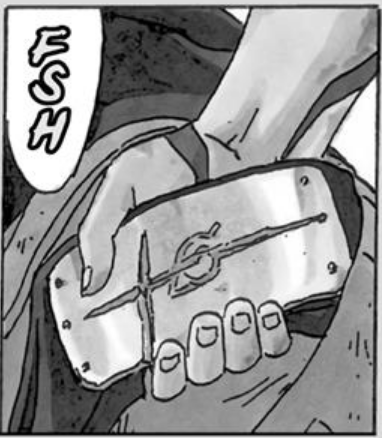
Kawaki prepares for battle, his karma spreading as he declares "The age of shinobi is over!" In turn, Boruto reaches into his pack, pulling out a battered headband and tying it on. "Even so," he says. "I'm... still a ninja!"
And here is the page turn we've been waiting for...
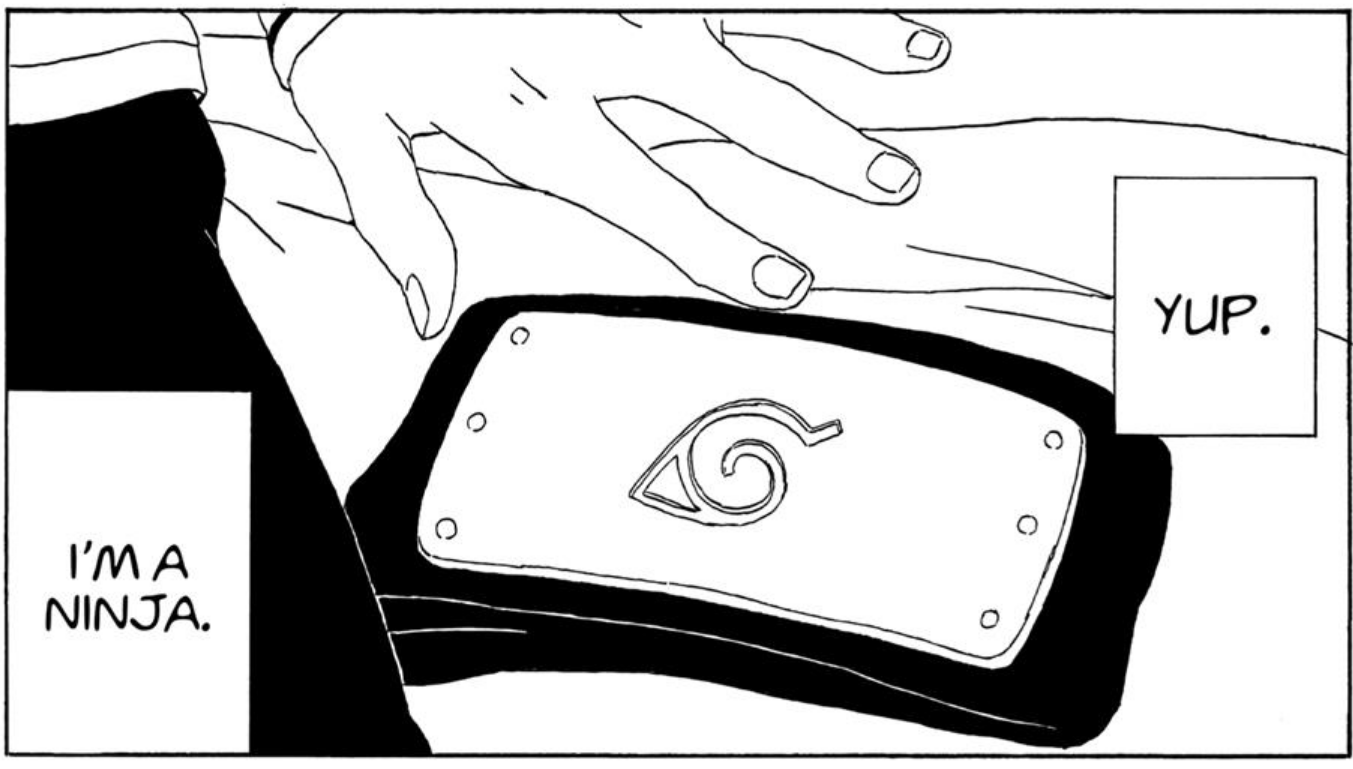
Sasuke wins the argument with Naruto before it even begins.
As readers, we go directly from seeing the scratched headband Boruto inherited from Sasuke (not to mention his sword and a very similar cape) to the headband he had as a genin, the surface unmarked as it lies safely on his childhood bed.
In the first chapter of Boruto, and throughout the entire first arc, Naruto and Sasuke debate what it means to be a ninja in the modern age, "Even if times change, the soul of a shinobi remains the same." Naruto's proof that Boruto is not like either of them lies in his clothes always looking as though they're brand new. But the flash forward has already proven Sasuke right to readers, the battered headband that Boruto straps on proof not only that he carried on Sasuke's legacy, but he received his own scars (quite literally) along the way as well.
Through this lens, the tone of the manga has always been an ominous one. As Boruto himself notes in the introduction, "...this isn't a tale about a boy who aims to become Hokage. That was my dad's story... The shinobi whose dream came true." Through this, readers can infer that not only is Boruto's goal not to be Hokage, but it's possible that any dreams he might have had fail to come to fruition.
Contrasting the opening of the Naruto manga with the opening of the Boruto manga, the original series sets a mythical tone as it launches into the tale of a young ninja, setting readers up for the beginning of an epic journey starting with the main character's father, the Fourth Hokage. Boruto's story begins by invoking his father as well, a father who lived instead of a father who died. However, the first-person nature of his story means that it's a personal history belonging to him alone—which is an excellent precursor to the events of Omnipotence, a world-altering event at the end of NNG that causes Boruto to lose his identity and past in everyone's memories.
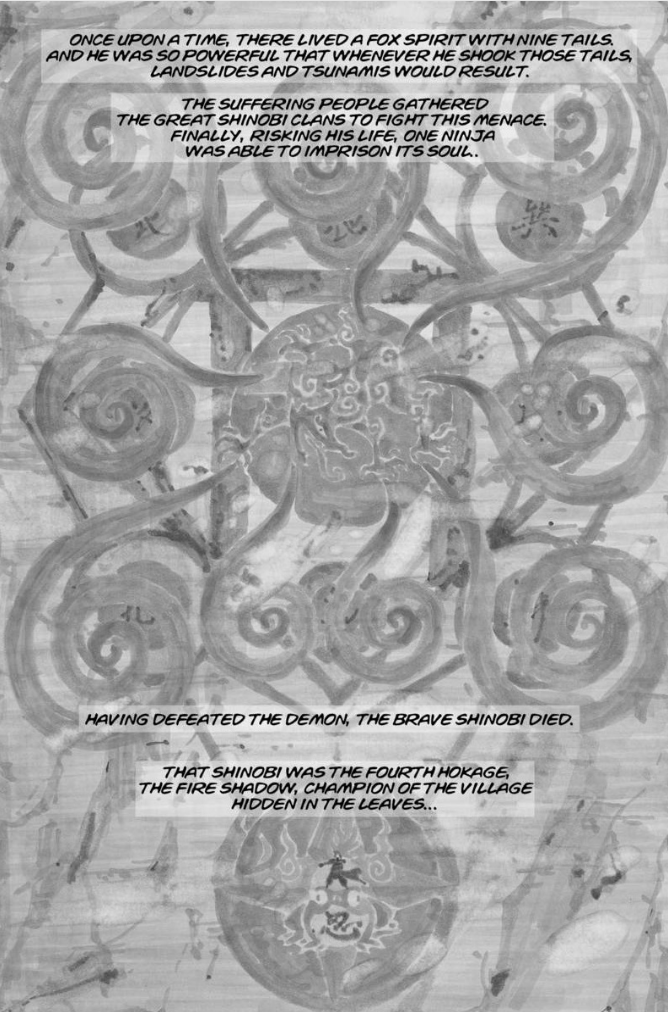
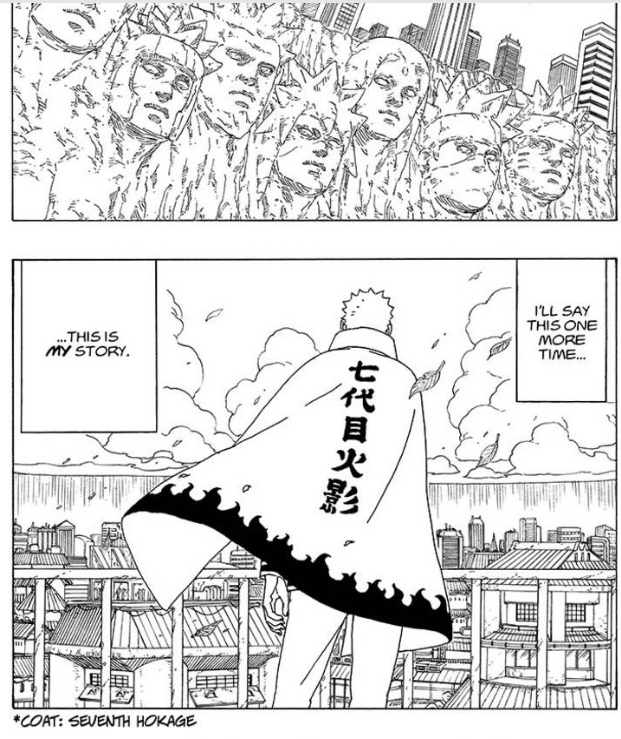
"Once upon a time" vs "My story"
I've extensively covered Naruto and Boruto's relationship in previous posts, but I want to note here how explicitly the first chapter handles their dynamic. From the very beginning, we see Boruto's feelings written on his face, his deep love and joy at seeing his father's presence in their home, followed by disappointment when he's barely acknowledged. His resentment toward the world of ninja and the office of the Hokage is based on that hurt a father who was present in his past, but who is now trapped in the demanding position of protecting the entire village as an extension of his family. As noted by Mitsuki, the only time he stops scowling is when he sees his little sister excited about her birthday, a birthday that Naruto ruins by sending a shadow clone in his stead. It's also Mitsuki who questions if Boruto wants to be Hokage, given his familial heritage.
For me, one of the criminally under-discussed lines in Boruto occurs after Konohamaru shows them the scientific ninja tool prototype he's testing as part of their mission, the same prototype Boruto later uses during the Chunin Exam. Konohamaru demonstrates putting his own Rasengan jutsu into a scroll, miniaturizing it, and launching it with the tool. When the Rasengan goes astray, destroying a villager's house, he says, "Since it's not tied to one's own chakra, one problem is that the jutsu can easily go astray." This sentiment applies to Boruto's behavior as the chapter goes on, relying on a tool rather than shinobi training, but I feel as though it also applies to other characters in the series. As we see with Eida and Koji much later on, because they are using shinjutsu that aren't their abilities, they wield them ineptly and with disastrous consequences. Similarly, Kawaki, who entered the shinobi world in an unconventional way also goes astray. When we combine Konohamaru's words here with Naruto's sentiment later in the series that chakra is a binding force, bringing people together, the implication is that power without connection is unpredictable and dangerous.
Again, we get another page turn moment here, from Konohamaru talking about how jutsu without chakra can go astray to Naruto telling a television host:
"What's important is that things are passed down properly... We enjoy peace and prosperity today thanks to those many incalculable sacrifices over our lengthy history of warfare. It can thus be said that it is our responsibility and duty to relay this history to the younger generation so that peaceful times may be sustained."
Like Konohamaru's words, Naruto's cut two ways. During this first arc, Boruto and Naruto learn to understand one another when Boruto feels the weight of his father's Rasengan, the past of everyone who touched his life to make him who he is today. And Boruto's request is that when Naruto has free time in the future, he's supposed to tell Boruto about his past. What Kawaki lacks when he's introduced is a past that's passed down properly, both in relation to his family and the shinobi world. Without that shared history, he sees the shinobi system as a threat to Naruto and shinobi themselves as weak humans who are doomed to die rather than individuals who endure.
On the subject of Kawaki, I want to note how frequently Boruto is manipulated in these early chapters, by Dr. Katasuke (under Ao's genjutsu) to use the scientific ninja tool to impress his father and by Sarada to sign up for the Chunin Exam. Young Boruto shares the trait with Kawaki that he's used by other people around him until he finds his ninja way with Sasuke.
This is not to be read as an indictment of Boruto, but twice in the first chapter, we see him physically lash out at two of the most important women in his life— his teammate, Sarada, and his mother, Hinata. In both instances, he's reacting to situations involving the office of Hokage, embodying an oft-used phrase I apply to this series—"hurt people hurt people," meaning those who have had harm done to them go on to harm others.
In the case of Sarada, he's playing video games with Shikadai and Inojin in Thunder Burger when the other two members of his team arrive to confront him about signing up for the Chunin Exam because all members of a three-man team must enter for any of them to compete. When Boruto rebuffs their attempt, Sarada grabs him by the collar and accuses him of interfering with her dream to be Hokage. Boruto slaps her hand away and declares, "I'd rather die than be Hokage."
Later when Naruto's shadow clone vanishes during Himawari's birthday party, Hinata grabs onto Boruto's wrist as he tries to storm off, the same whap sound effect occurs when he slaps her away as well. The exchange that follows is both fascinating and heartbreaking.
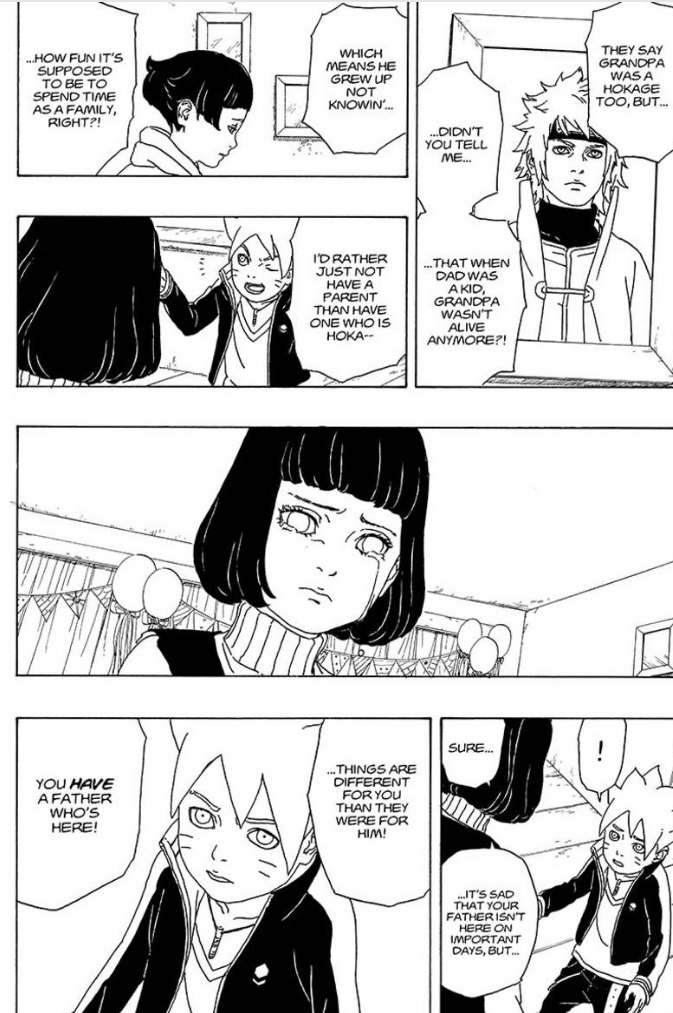
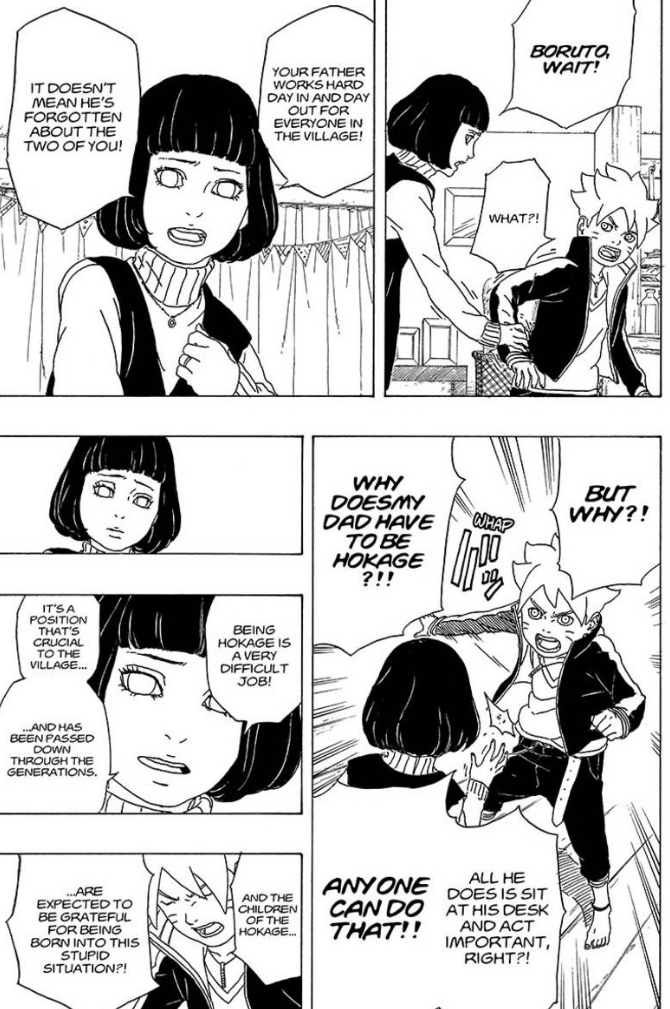
Panels and pages are arranged to read right to left.
In the face of her children's obvious disappointment, Hinata defends her husband's important role in the village. At this point, we see Boruto's perspective of Naruto's role through his own eyes as someone who sits behind a desk all day, not understanding his true purpose of protecting the village—which I think is a factor in the tension between a modern era of peace and the era when the role of Hokage was first conceived. Hinata invokes that history, telling Boruto that not only is it "crucial to the village" but it "has been passed down through the generations." Boruto, who has already repeatedly rejected the idea of generational inheritance in the story so far, focuses on the children of the Hokage who "are expected to feel grateful for being born into this stupid situation."
I want to pause here for a moment and focus on the children of other Hokage. We know the First Hokage, Hashirama, married and had children, but we only ever hear of his grandchildren, Nawaki who died and Tsunade who became Hokage and never married. As far as we know, his brother and the Second Hokage, Tobirama, never had children, which brings us to Hiruzen Sarutobi. Lord Third lost both his children, Konohamaru's parent and, later, Asuma. Both the father and his son die before the birth of his other grandchild, Mirai. When the panel shows Minato's face, we're reminded that Naruto is also the son of a Hokage who made the choice to seal the nine-tailed fox demon into his son on the day he was born before dying. Thus, when Boruto invokes the situation children of the Hokage are born into, Hinata knows it's historically been a tragic one.
Boruto continues to condemn his father. He's insightful for a moment, noting that because Naruto didn't grow up with parents, he probably doesn't know that it's supposed to be fun to spend time with your family. While I don't think his critique is wholly correct, I've previously noted in my post about the Uzumaki family that Naruto grew up without role models who showed him how to parent. That brief moment, however, is quickly washed away when Boruto says that he'd "rather not have a parent than have one who is Hokage," at which point Hinata begins to cry.
Hinata, who herself died during the Pain arc and is still mourning the sacrifice her cousin Neji made to protect Naruto and ensure this future, understands the weight of death in a way that Boruto doesn't. Her tears in this moment are significant as we later see them appear again near the end of the manga when Boruto is preparing to leave for the house-sharing mission and she frets that her son (who was already killed once) might leave and never return home again.
Confronted with the idea that Boruto has a father who is alive, unlike Naruto, he deflects his emotions onto Himawari, who is also hurt and disappointed in the moment, but not lashing out in the same way, saying that she needs Naruto to be there. This is a behavior pattern that arises again later in the series with Kawaki and Himawari's broken vase. She's much quicker to forgive Kawaki, accepting that the new replacement vase is enough, but Boruto insists he fix what he broke instead of deferring to his little sister's feelings as the individual who had been, at least in his framing of the situations, wronged.
Boruto goes upstairs to his room, but notices that his father's office door is open. Inside, he sees all the pictures Naruto has of his pride in being Hokage as well as his family, his presence in the latter fading as his children grow older. Seeing his father's old jacket hanging on the wall, Boruto's mind flashes back to Naruto in old Team 7's picture and declares the tattered garment "lame," throwing it out the open window.
When the doorbell rings, Boruto assumes it could be his father (though why someone who lives in the house would ring the doorbell is a mystery to me). He rushes down to fight Naruto, his fist instead meeting Sasuke's hand. Earlier in the chapter, Boruto and Sarada talk about their fathers, Sarada trying to convince him to be less harsh toward Naruto and Boruto telling her that he's heard her father, who Naruto says is like the other Hokage, is equally amazing. Sasuke immediately impresses Boruto. Sasuke, less impressed by everything, finds Naruto's old jacket lying on the ground outside the house, and takes it with him to deliver Kaguya's scroll to the Hokage's office.
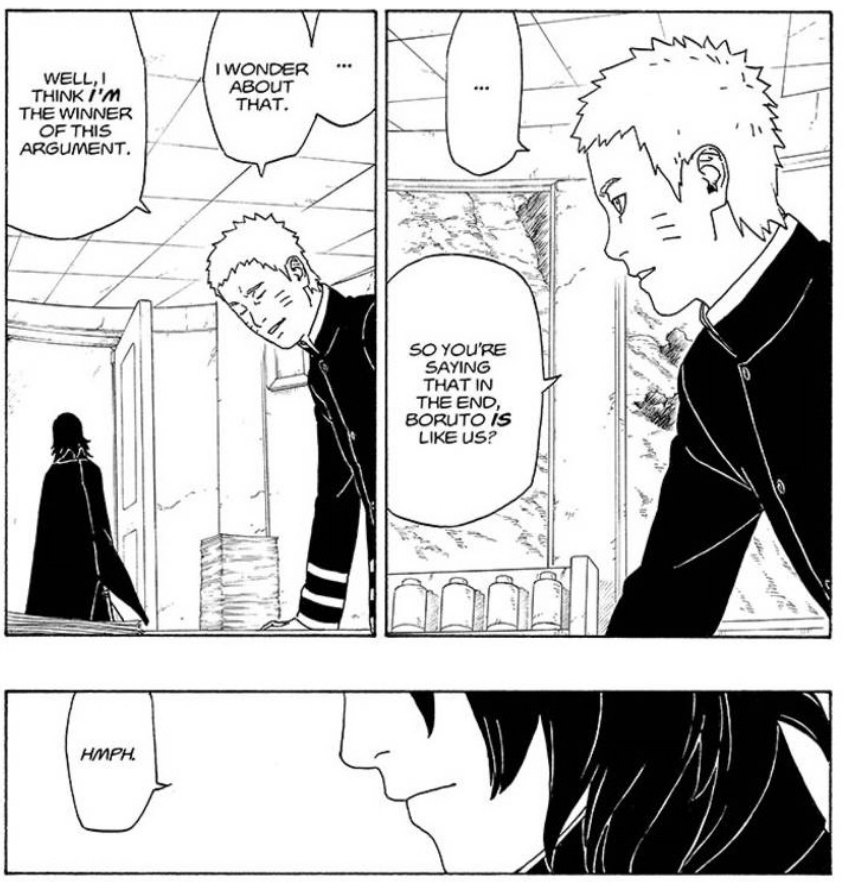
The story of part one of Boruto is very much the story of him becoming a shinobi in the model of Sasuke and Naruto, proving Sasuke correct. Though it's possible to read his early mentorship of Boruto as another fight he's trying to win against his childhood rival, I think Sasuke sees Boruto as an angry child in need of attention, not unlike young Sasuke struggling to get the attention of a father who is absorbed in the politics of their clan and struggles to connect with his son. Sasuke is well aware of the hard path he took to becoming the shinobi adult he is today and tries to prepare Boruto to take the higher road despite their similarities.
At the end of the chapter, Boruto confronts Sasuke and gets his ass happily whooped. As someone whose power rivals his father's, Boruto asks Sasuke to make him his student in order to "take down" his father.
Chapter 2: The Training Begins!!
The second chapter opens with Sasuke transposing his memory of young Naruto onto Boruto and agreeing to take him on as his student if he can master the Rasengan. I've mentioned elsewhere that Sasuke's pedagogical approach mirrors the conclusions he draws in chapter 699 of Naruto, that conflict can lead to understanding and understanding can lead to peace. By demanding that Boruto learn the Rasengan, Sasuke is forcing him live through the same experience as his father under the guise of training.
Sasuke then returns to the Hokage's office to discuss the fight he had in Kaguya's castle with Naruto. His encounter with Kinshiki and Momoshiki is told as a flashback. Because the flashback focuses on Sasuke in a one-vs-one battle and Boruto's later fighting style is heavily influenced by his master's training, comparing these panels to action in the contemporary TBV manga shows how Ikemoto's style has shifted and grown. I don't pride myself on being a visual media critic (it's one of my weak points, to be honest), but I've noted in the past that Ikemoto's early action art feels more fluid while TBV feels more composed. The later art features darker, starker lines with more focus on the character's bodies than the motion surrounding said bodies.
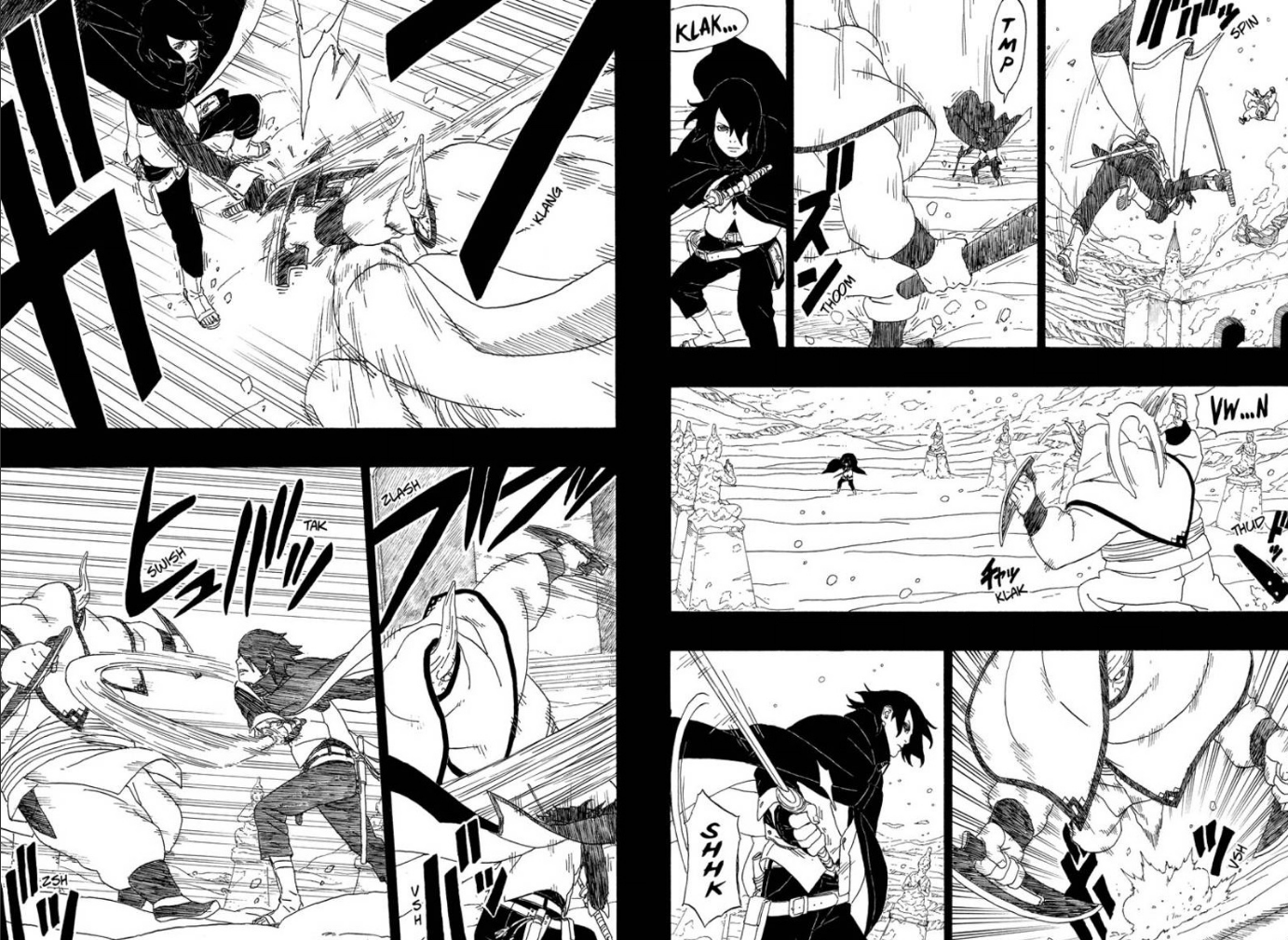
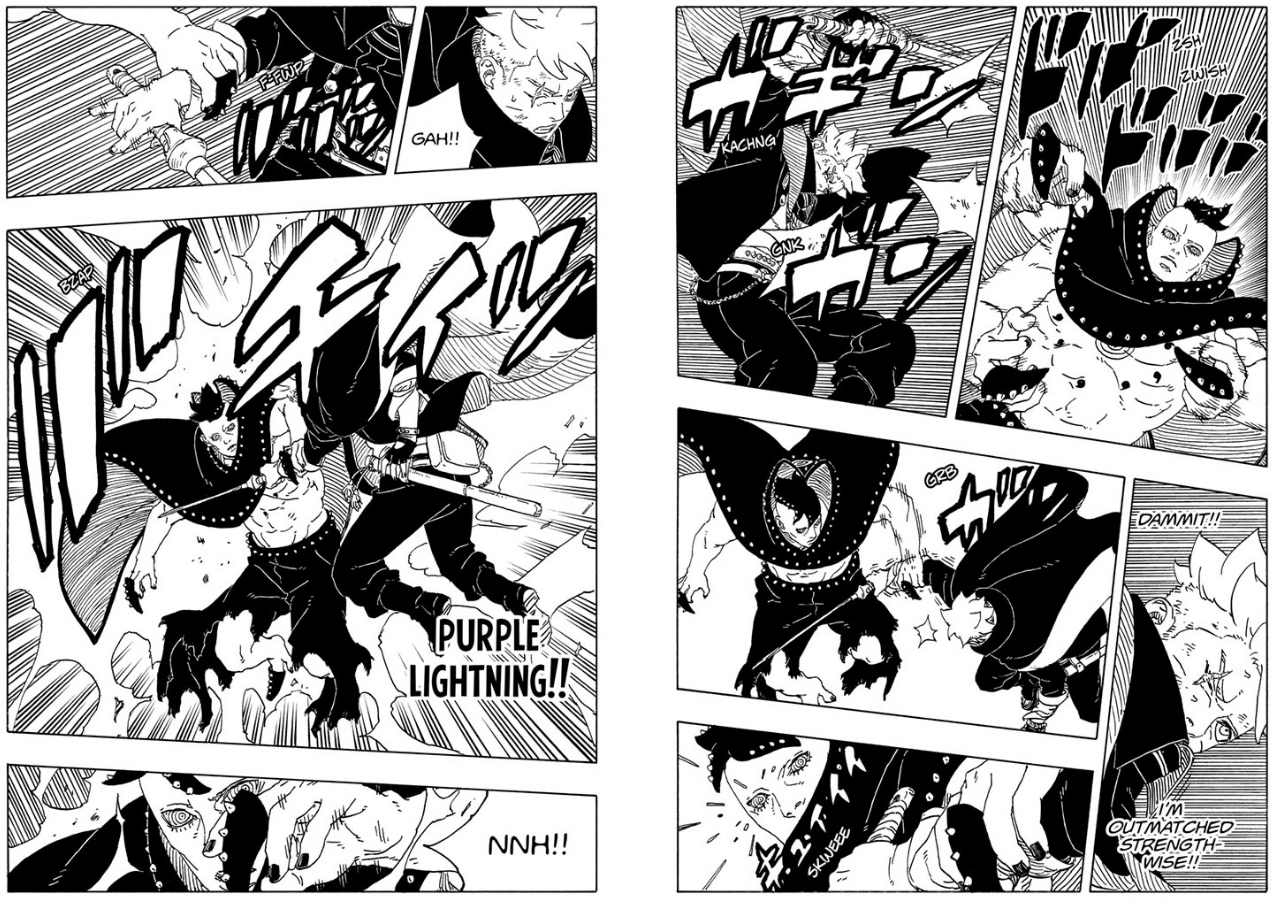
Ikemoto's shifting fighting art style.
The following morning, Boruto wakes up sexy bed-head Konohamaru to teach him the Rasengan. Konohamaru feels the weight of this request, recognizing that he's now responsible for passing down Lord Fourth's and Lord Seventh's familial jutsu to the current Hokage's son, once again putting the weight of a family legacy onto Boruto.
Boruto is dismayed by the water balloon Konohamaru hands him, saying "...why start with a water balloon, anyway? Isn't there a more efficient way to master it?" In this first arc, Boruto's statement reflects his low tolerance for traditional hard work and following tradition; however, we know that in recent TBV plot revelations, Koji is using his knowledge of the future to teach many members of the next generation a more efficient way to master jutsu. Boruto also engages in this pattern of behavior, directing both Kawaki and Sumire to accelerate their timeline to using scientific ninja tools in the fight against the Shinju, Sumire improving Boruto's sword and Kawaki going to Amado for increased power.
For a character who later asserts that she fears romantic love will distract her from the path of becoming Hokage, it's slightly puzzling to see her spending an entire day in a tree, watching Boruto train. I appreciate the narrative purpose of having someone who knows Boruto well witness him putting in dedication and hard work to master a jutsu when he'd previously been lackadaisical, but it also feels incongruent to see her snacking on an apple instead of training herself.
It takes a single day for Boruto to form a small Rasengan, a jutsu that took his grandfather three years to develop and six months to perfect and his father several weeks to learn with the assistance of shadow clones. Boruto's affinity for jutsu was hinted at in the previous chapter when he brags to his father about being able to make three shadow clones as well as using wind style, lightning style, and water style. Instead of recognizing his son's talents in that moment and trying to cultivate them, Naruto blamed Konohamaru for focusing on jutsu over "teamwork and guts."
Boruto rushes to show his new jutsu to Sasuke. Silently, Sasuke notes that Boruto's clothes are now dirty, resembling the hard work he and Naruto used to put into their training. But when he remarks that Boruto's Rasengan is small and notes that "I'd be hard pressed to call that a Rasengan." Frustrated, Boruto flings the tiny jutsu, which the disappears before he runs off in embarrassment.
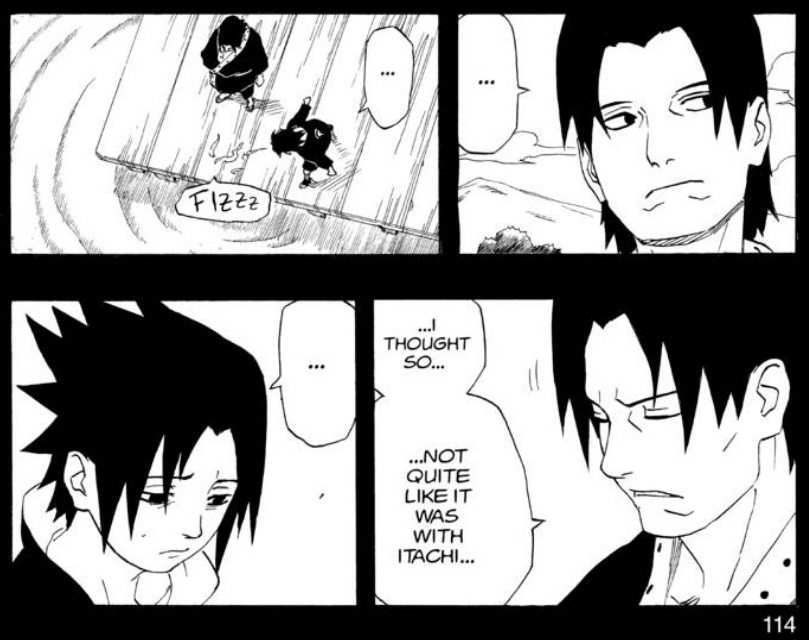
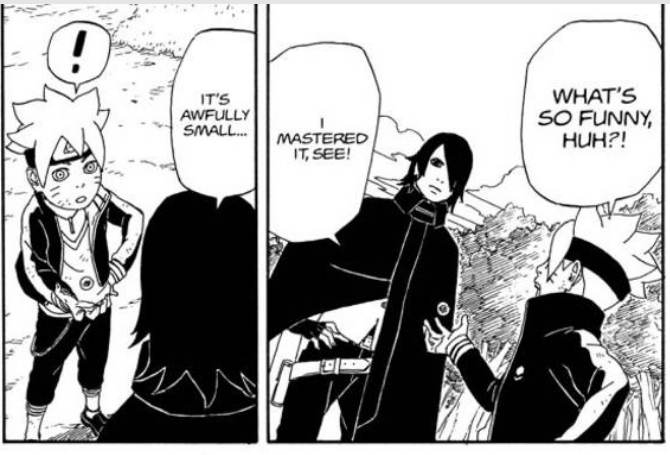
It's giving "like father, like son."
Sarada, still observing Boruto, joins her father and advocates for her teammate, saying that he usually doesn't try so hard. Staring at the spiral indent Boruto's Vanishing Rasengan left in a tree, Sasuke tells her that both of them are mistaken; he was planning to accept Boruto as his student.
On his way home, Boruto runs into Dr. Katasuke who does something that no other adult in the story has done thus far for Boruto. He asks, "What's wrong?" I agree that it's easier for children to unburden their souls to the adult who shares video games with them instead of their own parents and other authority figures, but Boruto had clearly been seeking a nonjudgmental person to unburden his soul to. This, of course, leads to Dr. Katasuke (temporarily evil under Ao's genjutsu, we must remember) to offer Boruto the scientific ninja tool to use in the Chunin Exam.
Ikemoto does a fantastic job of depicting Boruto's inner struggle when he notices the reflection of his filthy clothing in a window, pausing to dust himself off. However, before he can reflect on the value of getting dirty and training, he notices his father's face on Hokage Rock reflected beside him, a symbol of his frustration with his father's position in the village and the shinobi way as a whole.
With clean clothing, he returns to Sasuke to pass off the large scientific ninja tool Rasengan as his own. Sasuke immediately notices that he's cheating, comparing a flashback of Naruto's dirty clothes to the clean ones Boruto is now wearing, proof that he didn't even attempt to hone his skills through more training. When he questions Boruto's proficiency, Boruto claims that he's not like his dad when it comes to talent. "That's for sure," Sasuke responds. "You seem quite different from Naruto. Though I hoped that wasn't the case."
Despite the cheating, Sasuke accepts Boruto as his student, recognizing that Naruto's son has the potential to be a powerful shinobi but needs the type of mentor who can guide him when he inevitably falls on his face. Later that night, Boruto questions Sasuke about his father's weaknesses, and Sasuke tells him that there are many, that his father "Once was a quintessential loser full of weakness who. But he pulled himself up with his own strength and became Hokage. Instead of the Naruto of today, you should study who Naruto had been in the past..." As before with the Rasengan training, Sasuke is encouraging Boruto to learn about his father's history and the journey of suffering, pain, and endurance that made him into the type of person who could become Hokage. He's asking his newly-minted student to practice empathy to find understanding and peace.
The next morning, Sarada notes how cheerful her mother is now that Sasuke is home. Sakura notes that Sarada seems just as happy. Thus far, the story has focused in large part on the tension between Boruto and his father with just a few hints about Sarada's more absent parent. Sarada's feelings regarding Sasuke become more important as the story progresses, the affinity she feels for Naruto as the father-figure who tries to treat the entire village as a family while her father is more focused on his student than on her.
New Team 7 meets in Konoha, Boruto revealing that he's also signed up for the Chunin Exam. Their conversation reveals that Boruto still does not understand teamwork (or guts, as we'll see in the next chapter). He's fixated on defeating his father rather than the cohesion of their three-man team.
As the chapter concludes, we get our second glimpse of Momoshiki and Kinshiki who have trapped Killer Bee. They learn that the chakra fruit they have come to the planet to claim has been divided into tailed beasts. He destroys Gyuki, the Eight Tailed ox-octopus beast and consumes his chakra before turning his attention towards a larger target, Kurama, the Nine Tailed fox inside of Naruto Uzumaki.
Looking back on the stakes of this first arc, we can see that Jura's interest in Naruto is not dissimilar to Momoshiki's targeting of him. Both want to consume him. For both of them, the desire is related to his relationship with the tailed beasts, even though Kurama is now in Himawari rather than her father. While Momoshiki is seeking power through the chakra fruit, Jura is seeking knowledge and evolution. While Jura's quest to learn more about life seems like a more noble goal, it's not dissimilar to the way the Otsutsuki consume the life force of a planet and all knowledge associated with it, eventually evolving to transcendence and godhood.
Chapter 3: The Chunin Exam Begins!!
Young shinobi from other villages begin to arrive in Konoha ahead of the start of the Chunin Exam. The chapter opens with the genin and their mentors from the Sand on their way to Konoha. This is our first introduction to Shinki, the adopted son of the Kazekage, Gaara. In many ways, Shinki is a precursor to, and a reflection of, Kawaki, the adopted son of a Kage who venerates the father figure who rescued him from a life of pain to the point of excluding all others. We see that dynamic in play here when Shinki vows to win on behalf of all his teammates so as not to "sully" his adopted father. Gaara cautions his son to "focus on your soon-to-be rivals from the other villages, not me." Shinki responds that "the other villages won't be a problem," thus dismissing the point Gaara was trying to make—the Chunin Exam is an opportunity to grow from clashing with rivals and meeting friends who could one day save you.
Shinki's attitude here holds throughout TBV when we see him prioritizing the life of his father over the lives of his teammates despite Gaara telling him they are the future. In flashbacks, Araya tells Shinki he needs to pay more attention to Yodo, the girl who has feelings for him, but Shinki thinks only of protecting his father. Later, Yodo will sacrifice her life trying to obtain a Thorn Soul Bulb from Ryu to free the teammate who thinks so little of her.
The training montage eventually settles on Sasuke and Boruto practicing shuriken jutsu. Sasuke challenges Boruto to find a way to curve a shuriken around a tree to hit a target at a perpendicular angle, demonstrating one way of doing it but telling him, "There are likely countless ways. Use your own head a little. Don't covet immediate answers." Boruto goes home, frustrated, and looks at the scientific ninja tool hidden in his drawer, trying to choose between the difficult path his master has directed him to follow and the easy one offered by Dr. Katasuke. This training pays off later in TBV when we see him utilizing complex shuriken jutsu maneuvers paired with his Flying Raijin jutsu to unpredictably appear at different locations on the battlefield.
The first test in the Chunin Exam is fascinating in the larger context of the story. Participants are told that they have to answer a simple yes-or-no question, and those who choose err will not be able to move on in the exam. We find out later that there was no correct answer, indicative of the "hidden meaning in hidden meanings" theme in the Naruto universe. Rather, participants had to choose what was destined to be an incorrect answer, as so few dilemmas faced by shinobi will ever be black and white. The winners are the ones who didn't give up—to steal Sasuke's phrasing, the ones who endured—using their ninja training to not fall into a pool of ink at the bottom of the pit.
I think one of the fascinating differences between Naruto's story and that of his son is that Naruto was on a straight path of knowing what his dream was and chasing it. His rival, Sasuke, chose the wrong path and had to be saved by his friend. In this way, there was a clear yes-or-no answer to the plot of Naruto. All Sasuke needed to do to return to the light was accept an offer of friendship. Boruto's plot is much less clear-cut. The protagonist doesn't have as defined or recognizable of a goal, seeking instead a role that exists in the shadows. Likewise, his conflict with Kawaki, more a brother and an antagonist than a traditional rival he's competing against, doesn't have an easy answer. Due to the situation with Momoshiki and the threat of the Otsutsuki, the plot doesn't present us with a scenario in which either character can correctly choose a path that will guarantee a bright future (especially when the subject of the future is so fraught in Koji's visions). As with this test, solutions will have to be creative ones that utilize all the characters have learned rather than resolution stemming from a simple choice.
Sarada is the one who makes the ultimate choice for new Team 7. When all the participating genin are plummeting downward toward a pool of ink after being told those who turn black will fail the test, Boruto simply accepts his failure, thinking "Is this it for us?" His other teammates, Sarada and Mitsuki, choose action over failure, Mitsuki grabbing onto the edge of the pit, Sarada throwing a rope around Boruto, ensuring that their entire team passes.
This test demonstrated the guts and teamwork that Naruto was touting in chapter one. Participants needed guts to decide not to accept failure and act, and their team members needed to accept that they passed or failed as a team. All of the other genin teams we saw who passed had one teammate who acted to save them, Shinki using his iron sand and Shikadai using his shadow jutsu, but it's only Boruto who feels let down by himself. Sai reinforces this message in his speech aftward, telling the genin:
Those who lack courage when facing the impending pool of ink, simply accepting that you made the wrong choice and allowed yourselves to fall in. You aren't qualified to become Chunin. The real decision in this first round is the split-second one you make when cornered. Do you give up or not?!
Boruto appears downcast, knowing he made the incorrect choice and would have failed if it wasn't for the quick thinking of his teammates. However, the lesson Sai imparts here is one he embodies later in the arc when he cheats. As soon as his cheating is caught, he recognizes that he made the wrong choice, but he also chooses not to give up instead of allowing his error to doom him. This is the same attitude that carries him through the end of NNG after Omnipotence steals away his life. When he's cornered, he refuses to give up.
The story once again turns to the awkwardness between father and son, Naruto needing a nudge from Shikamaru to recognize Boruto's win via email and his obvious relief after hitting send. When Boruto receives said email, we see him smile despite cynically responding to the way his father decided to transmit his approval.
While preparing for the second round of the Chunin Exam, Boruto is once again training with Sasuke and frustrated by how hard it is to redirect a shuriken in mid-air. He defends his ineptitude by telling Sasuke "...shuriken jutsu are Sarada's specialty. Cuz she's your daughter and has Uchiha clan blood in her!" It's odd to see Boruto raising an argument about familial abilities after he's spent the past three chapters rejecting the concept of family as destiny. Sasuke is fast to push back on this, too, making more shadow clones than Boruto can and saying that if Boruto's argument is true, then the Shadow Clone jutsu should be his area of expertise.
Now that we're 33 chapters deep into TBV, this is fascinating to read in the context of the ongoing fandom conversation as to why we see Boruto using his shadow clones so infrequently. There may be some tactical reasons why they're not ideal—perhaps because he's always trying to preserve his chakra so Momoshiki won't be able to take over or perhaps his shadow clones fail to replicate his karma chest scar. But chapter 3 of NNG presents an alternative reading; Boruto doesn't have to use shadow clones because he's become skilled in other jutsu. Simply because they're a skill he has from his familial background doesn't doom him to use them. Instead, we've seen him rely more heavily on shuriken jutsu and in-battle movement through his Flying Raijin jutsu, similar to the way in which Sasuke utilized his Rinnegan. The lack of shadow clones can be read as Boruto putting the lessons he learned here into practice.
The second round of the Chunin Exam is a version of capture the flag in which three-man teams must compete against each other to protect their own flag while stealing one from another village. In this chapter, we get an early example of Team 10's teamwork that Jura so lauds later on, each member despite their indolent attitudes working together to win.
New Team 7 is the last to compete. Boruto has vowed to play an active role this time instead of allowing himself to be saved by others, taking the role of protecting the flag. Taking Sasuke's words the wrong way, he relies on his family's Shadow Clone jutsu against opponents who can make even more clones. As he gets his ass thoroughly kicked, he remembers his father's email. Knowing his team members are counting on him, he uses the scientific ninja tool to deploy a water jutsu followed by a lightning jutsu, thus defending his flag. An important point to note here is that Boruto knows both water style and lightning style. Given his skills, he might have been able to lay a similar trap for the opposing team if he'd thought of it sooner instead of relying on his shadow clones to win due to sheer numbers.
The chapter ends with Tenten, who is judging this round of the competition, noting that she missed Boruto performing hand signs for the jutsu. In the background, one of Dr. Katasuke's lackeys notes that not only did Boruto use the scientific ninja tool, but he was also able to capture video of him doing so.
Here ends my first volume reread. Mitsuki's story, The Path Lit By the Full Moon, is also in this volume. I will address it separately so as not interfere with the narrative flow of these posts. My intention is to complete at least one volume reread a week, perhaps more but hopefully not less. If you enjoyed this or have things to add, feel free to drop into the comments section or say hi on social media. If you didn't enjoy it, I hope you dropped it before getting this far instead of wasting twenty minutes of your precious life reading something that you don't like.
Want reread updates, chapter analyses and more? Sign up!