Boruto: Naruto Next Generations Volume 4 Reread
Volume 4 of Boruto: Naruto Next Generations (NNG) will comprise entirely of the Mujina Bandits arc with a new one beginning in volume 5. I find this arc fascinating for a lot of reasons, not the least of which is that Boruto more or less achieves his dream of being a ninja like Sasuke who supports the Hokage immediately after conceiving of it. This is much different than his father who states his desire to be Hokage early on but takes several arcs of growth until he's acting like a leader.
Something else exceptional about his arc is that it's the only time in the manga that we see the new generation (or anyone else for that matter) fighting an unenhanced human threat—and a formidable one at that. Returning to our previous excursion into power scaling as an aspect of plot, we get a sense of how Boruto, a Konoha genin, fares in battle against a "Bingo Book bigwig," to repeat Shikamaru's phrasing. This positions Boruto's strength in the story, a benchmark to compare both to the older generation and the increasing difficulty of the battles that lie ahead.
Chapter 12: Friends!!
Boruto arrives at the hotel where the Daimyo and entourage are staying, not just a suite of rooms, but the entire building and grounds. Tento is waiting outside to meet him, immediately insisting that his new bodyguard shows him some shadow clones. Unfortunately for Boruto, Tento is only temporarily impressed, comparing his measly output of four clones to the thousand his father can make. For his next request, the Daimyo's son demands that Boruto transform. He rises to the challenge, creating an aged up female version of himself through his father's Sexy jutsu, then layering it on by creating a harem out of shadow clones.
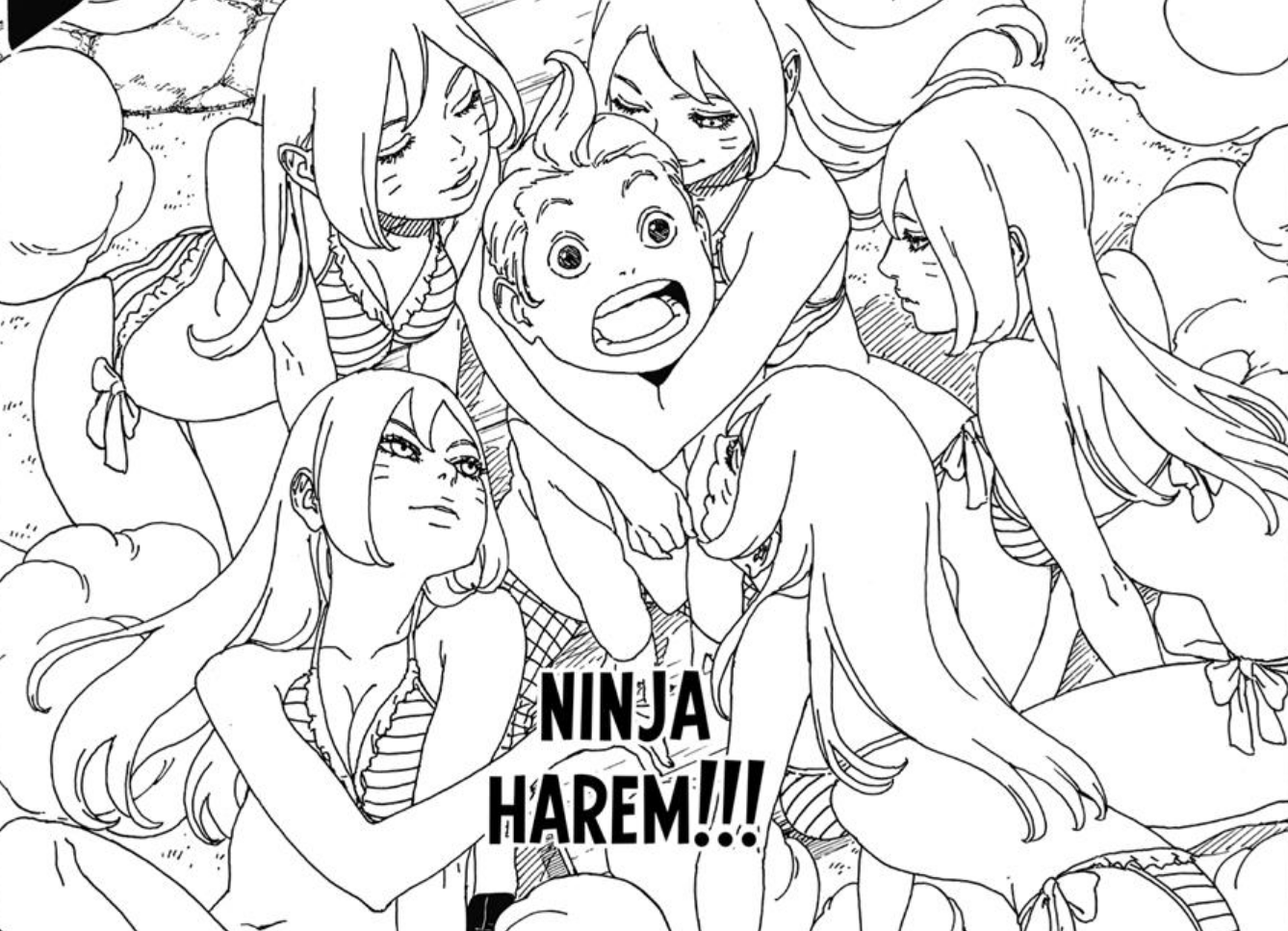
Having expected to shock and impress Tento, Boruto is enraged when the younger boy starts cracking up, informing Boruto that he's seen it all before in his home and prefers less flashy girls.
There are aspects of Boruto's character that are delightfully consistent through NNG, one of which is his rudeness to strangers. Here, he responds to Tento's laughing by yelling, "Hey, I bet you don't have any friends!" We begin to get a sense of how isolated the Daimyo's son is when he stares at Boruto in confusion, assuming they're already friends despite Boruto's bluntness and tone saying otherwise. Because they're friends—to Tento—he whips out his binder of X-cards, lamenting that he's always wanted to have a friend to play the game with in addition to just collecting them.
As Boruto pages through the binder, he learns that this is just Tento's collection of rare cards, which includes the one he's been coveting. When Tento asks if he wants it, Boruto replies "Want? That's an understatement. It's the only reason I keep buying 'em!" Tento offers to give him the card, saying that he has doubles of everything except the Lord Seventh card (which Boruto has gotten multiples of, if we recall). When Boruto asks how he got so many rare cards, Tento pulls out a black credit card given to him by his father for his birthday, telling him to get whatever he wants rather than knowing enough about his son to get him a real gift.
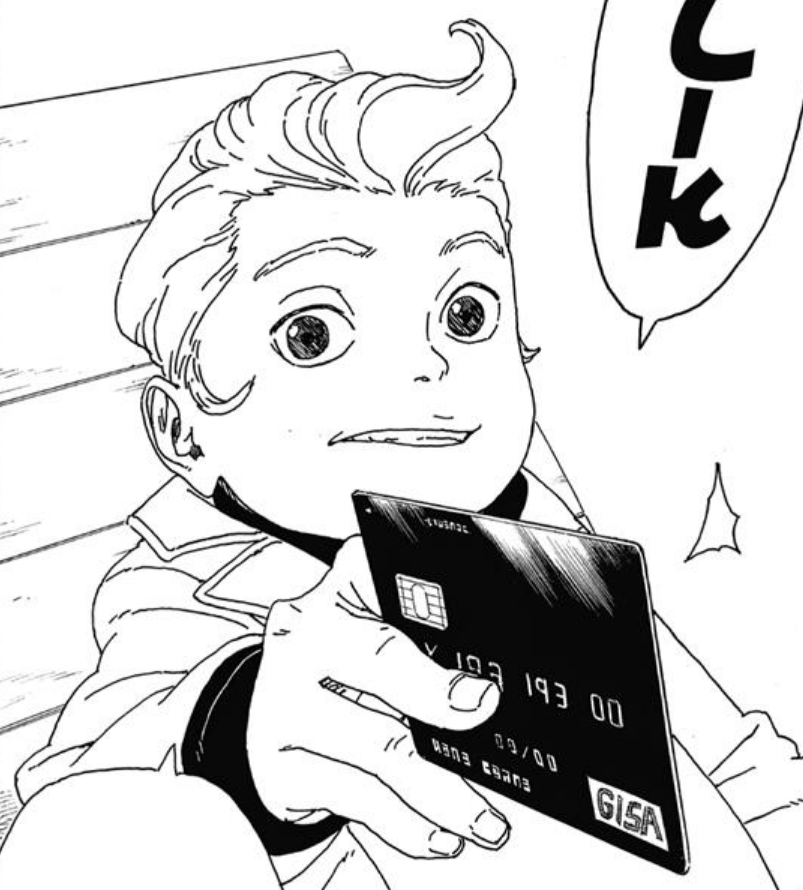
Boruto recognizes the sadness of Tento's eyes as the boy brags about being able to buy an entire store instead of a pack of cards, another son whose father ruined birthdays by not being present. When the Daimyo's son brags about buying an entire store instead of packs of cards, Boruto remembers a version of his younger self who was willing to cheat in video games instead of enjoying the struggle of leveling.
Tento decides they should make a deal: in exchange for the card Boruto wants, he'll have to teach the Daimyo's son ninjutsu. Remembering his hard-earned lessons, Boruto rejects the card, saying "I'm the type who has to get what he wants by his own strength no matter how hard it is," but also agrees to teach Tento.
As with Sasuke's training of Boruto, Tento eventually breaks down, whining that hitting a target with a shuriken is too hard. Boruto remains patient, asking him why he's interested in being a ninja. Tento replies that his father talks about shinobi as being trustworthy people, and after discovering his collectible card hobby, he decided that if he becomes a ninja worthy of getting on an X-card, his father might begin to pay attention to him. Boruto grips his chest, remembering how it felt when his own father finally acknowledged him after the second round of the Chunin Exam. He tells Tento that he'll stick with him through his training.
Something I noticed on this reread versus previous ones is that Konohamaru told Boruto part of his purpose in the mission from the Daimyo was to teach his son about the shinobi world, but when Yamaoka, Tento's butler, shows up, he's aghast that Tento is practicing ninjutsu and tells Boruto it's beyond his bodyguard duties. This shows us a commonality between father and son—both of them sharing an interest in the shinobi world, and Ikkyu paying enough attention to Tento that he thinks he'll enjoy having a ninja close to his own age to watch him and teach him.
Tento defends Boruto, saying that he asked to learn, and Boruto speaks up for Tento, saying that practicing hitting a target is a lot more fun than using a credit card. Yamaoka relents, leaving the boys alone for an all-night training session that results in Tento finally hitting the bullseye on a wooden target. Now the "master," Boruto tells his "student": Muscle memory can fade, and even with practice, you won't always hit the bullseye. But if you keep at it, I bet it'll lead to something. Tento looks down at his dirty hands, understanding the value of hard work the same way Boruto eventually did. Boruto hands him the shuriken he'd used to hit the bullseye, telling him what he's now gained is something unable to be bought with a credit card.
The boys return to the hotel for refreshments and X-cards, Tento's dream of actually playing rather than just collecting finally coming true. Boruto loses yet again, but while organizing his deck, he finds one of his Lord Seventh cards. Similar to later in the series with Kawaki, Boruto gives away a card representing his father to another boy who desires what Boruto has.
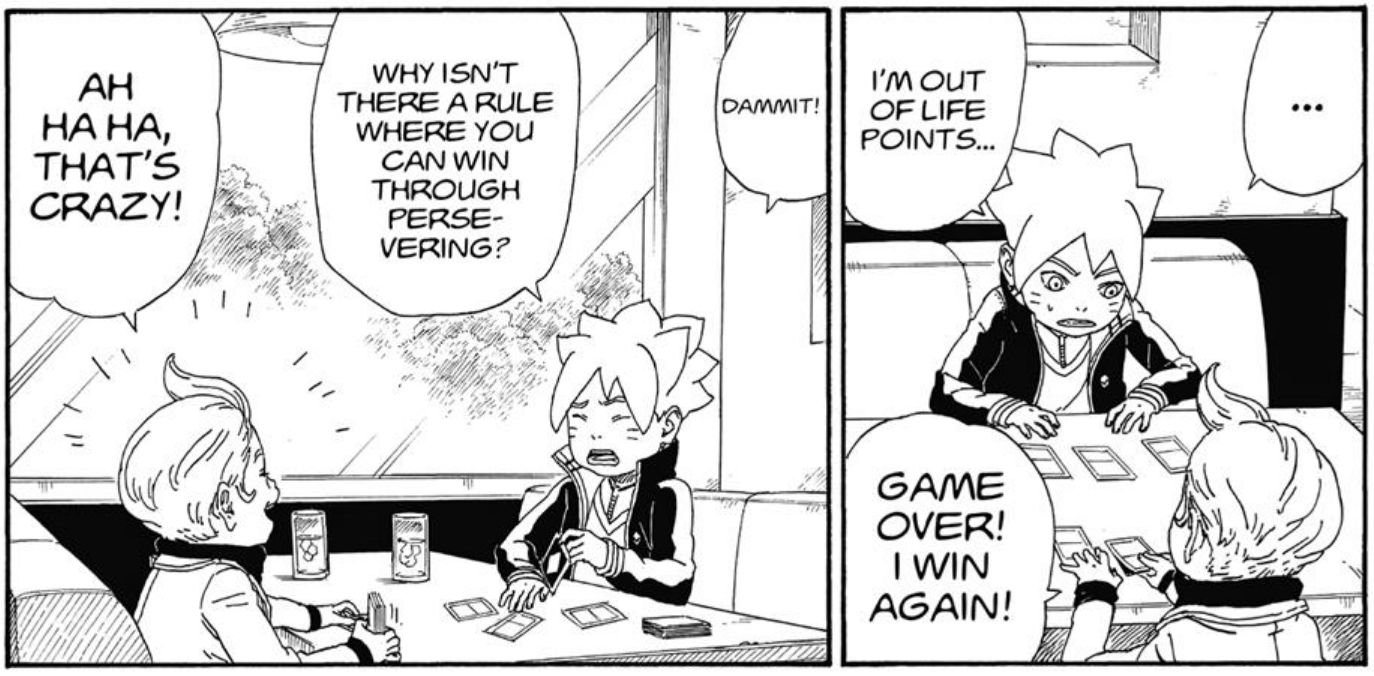
Boruto gives us a sincere moment of introspection as he empathizes with Tento, telling him that he once craved Naruto's attention, doing stupid things to get his attention to the point that he got banned from being a ninja at one point. He says he's only able to be a ninja now because everyone forgave him. Now, he has his own dream: to be an amazing ninja who supports the Hokage. As Boruto laughs over his dream, Tento realizes he's slightly envious of Boruto.
Boruto and Tento's days together have finally come to an end. When the Daimyo's son asks Boruto if they'll meet again, Boruto states that they're now friends, leading to a moist-eyed Tento hugging him.
From within the hotel, we see a shady, scarred individual watching the young men. He communicates via an earpiece the Mujina Bandits plot to kidnap Tento. In the final frame, we learn that Yamaoka has been replaced by Shojoji, the gang's boss.
Chapter 13: The Value of a Hidden Ace!!
Chapter 13 begins with Team 7 walking down a hallway in Hokage Tower on their way to see Konohamaru. There are a few small details in the first pages that make the story come alive, adding layers to characters and ongoing dynamics that occur off-page—Konohamaru's messy office, for example, and the mention of his younger chunin cousin, Mirai, scolding him for it. Boruto is abbreviated in scope compared to its predecessor, tightly focusing on the main cast instead of developing the greater shinobi world and its denizens. Little flourishes such as these keep us aware that there's a greater world beyond the plot we're focusing on—a touch the series loses as it goes on.
Our young shinobi team arrives in their sensei's scroll-ridden office and is handed their first ever B-rank mission, an assignment usually given to shinobi of a higher level than genin. When Mitsuki notes that other genin in the past have taken on missions of this level—such as the Kazekage—both his more ambitious team members lock in.
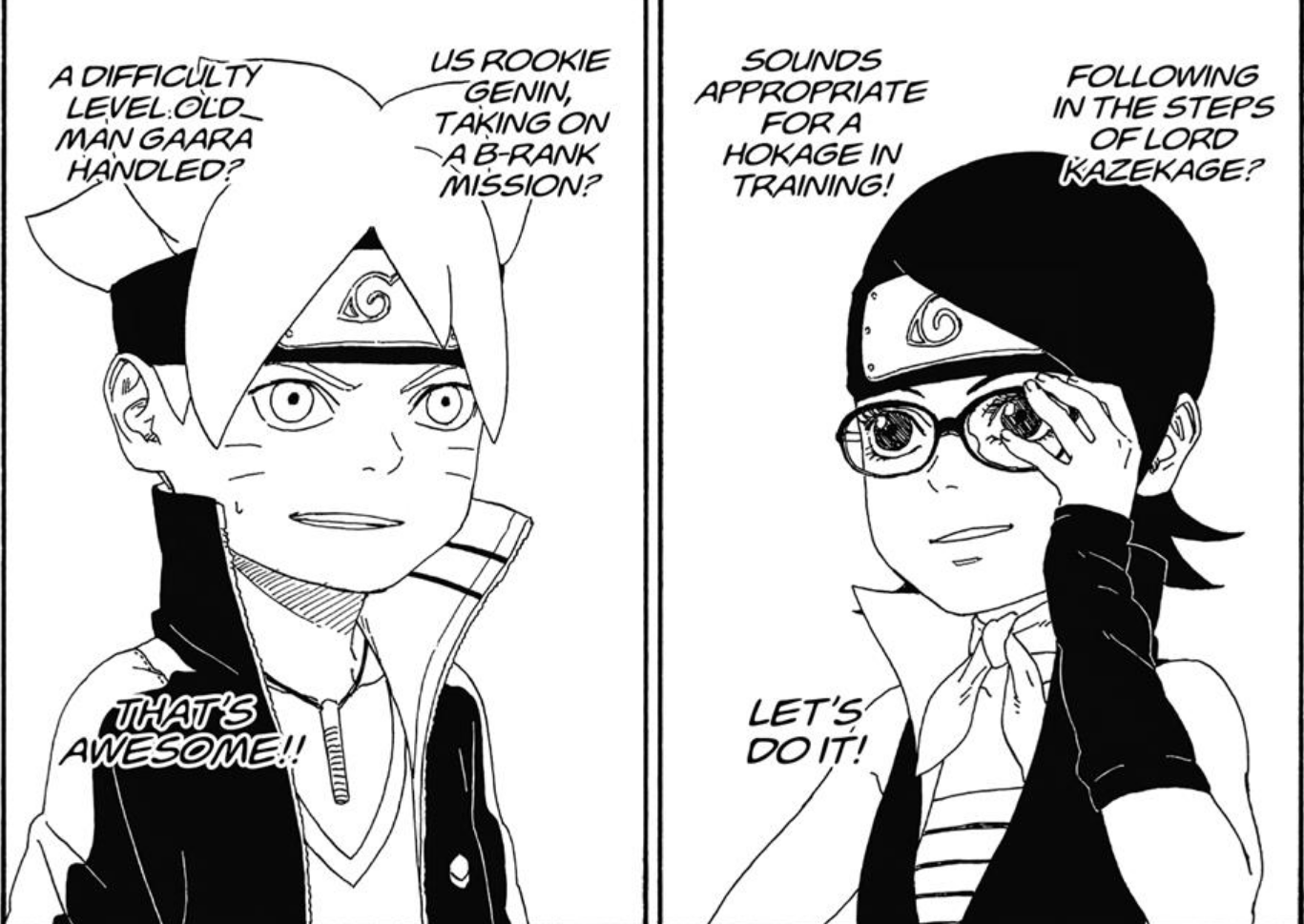
Konohamaru responds to their enthusiasm by giving his students the ninja equivalent of a "the bigger they are, the harder they fall" speech, reminding them that greater expectations mean "your cred will plummet that much lower if you mess up."
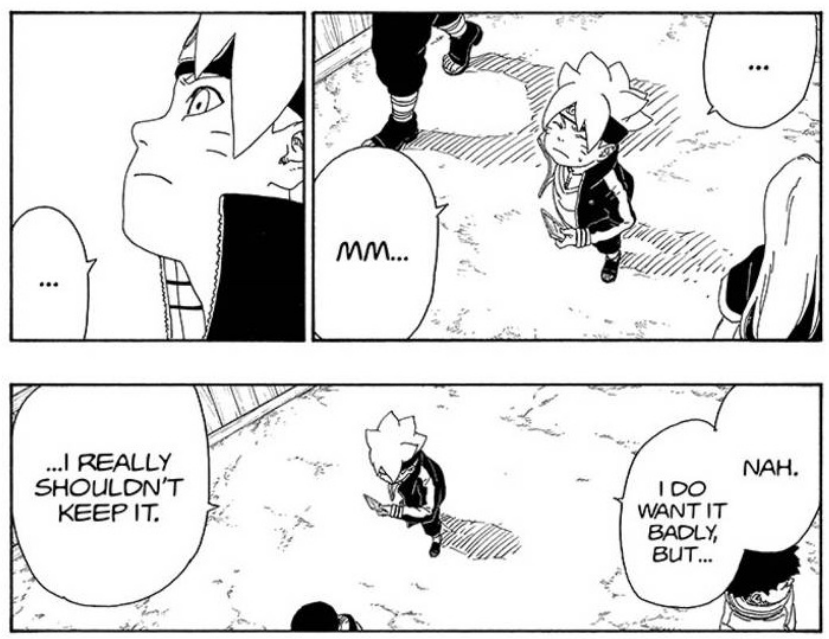
On the way home from their team meeting, Boruto reaches into his pocket and discovers that Tento managed to slip him the super rare card he's been searching for. We see how far Boruto has come from the boy who used Dr. Katasuke's video game data cheats without question to a young man who recognizes how much he wants something but decides he'd rather get it through his own hard work.
This idea—how to achieve what you desire—appears multiple times throughout the series. As noted in earlier volume reviews, training through Koji's Prescience is technically using hacks from the future to enhance the present, something not unlike using someone else's cheat codes. Yes, as a player, if you put enough hours in, you'll level up on your own, but when the fate of the world is at stake, Boruto and others cannot afford the time it would take to gain power in an incremental way.
We can also draw parallels between Boruto being given the card he wants, ultimately rejecting it as unearned, and Kawaki's response to the unintentional Omnipotence swap, immediately using it to his advantage rather than rejecting his unearned role. With the life of Lord Seventh and the village he protects both in danger, Kawaki's exploitation of the situation isn't dissimilar to Boruto's use of Koij's Prescience, both of them leveraging the Shinjutsu of a technologically-modified other to serve their larger goals. Future Boruto arcs (read: the next one) will explore the idea of whether the means itself is the problem or if the way it is used is what matters.
Now, if you're thinking a lone ninja shouldn't try to sneak into a hotel where only the Daimyo and his entourage are staying, then you're not Boruto Uzumaki. While trying to return the card to Tento, Boruto overhears that his new friend has been kidnapped by the Mujina Bandits who are attempting to ransom him back for a clean 5 million Ryu and the release of all the prisoners in Hozuki Castle. Under the (correct) assumption that the kidnapping couldn't have been executed without a spy in their midst, the Daimyo (incorrectly) assumes the traitor has to be among the ranks of the shinobi and makes the call not to inform Hokage Tower of his son's disappearance. Armed with his master's faith in him and the location of the ransom drop-off site, Boruto decides he needs to be the one to do it and rescue Tento.
But what about that B-rank mission?
The scene transitions to Sarada in her bedroom, our aspiring future Hokage's training for their upcoming mission interrupted by a knock on her balcony window. (Side note: At least manga Sarada eventually gets a new house after the demise of the original Uchiha residence.) She recognizes Boruto's voice when he speaks to her from the other side of her curtain, telling her he'll be unable to go with the rest of their team.
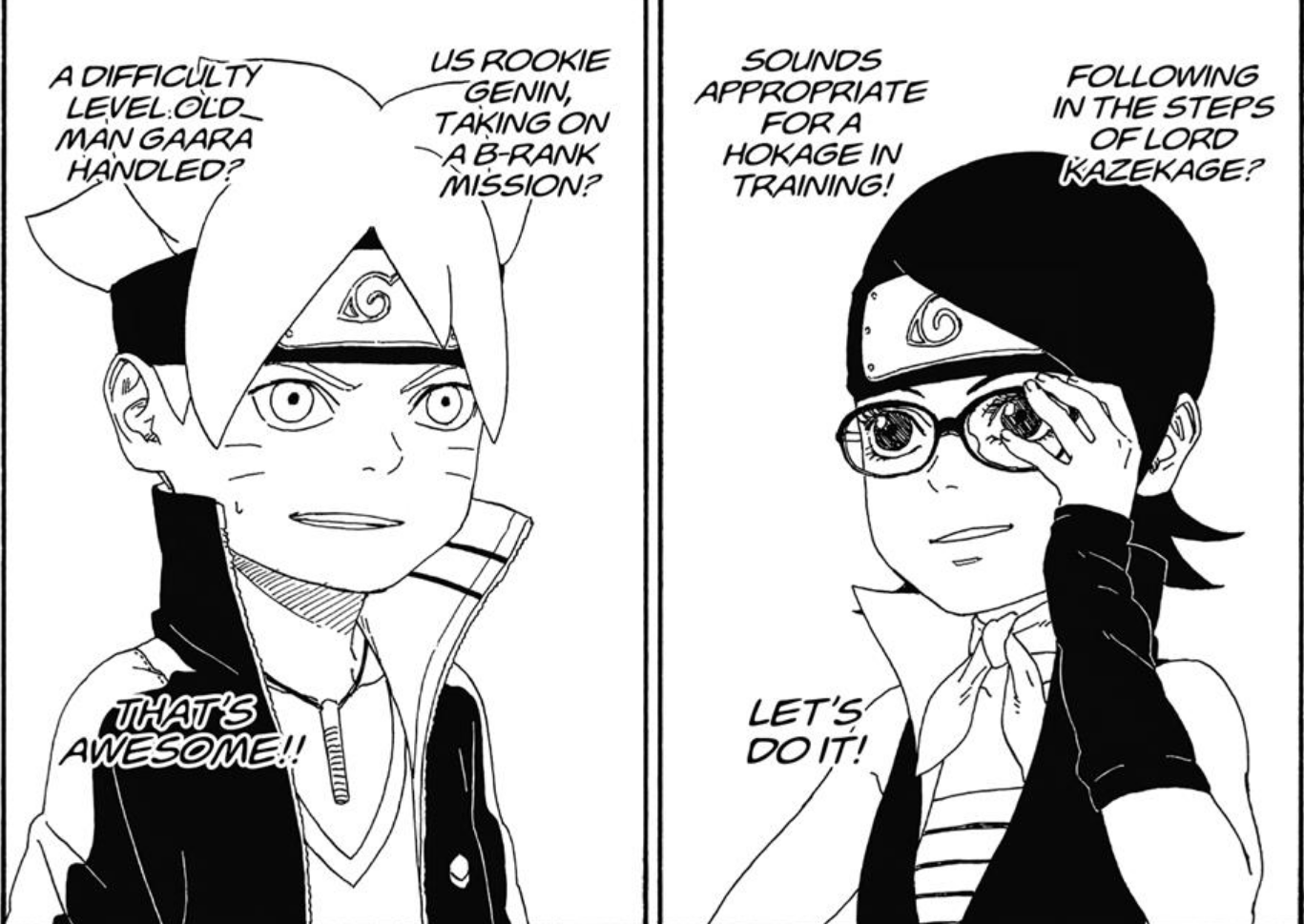
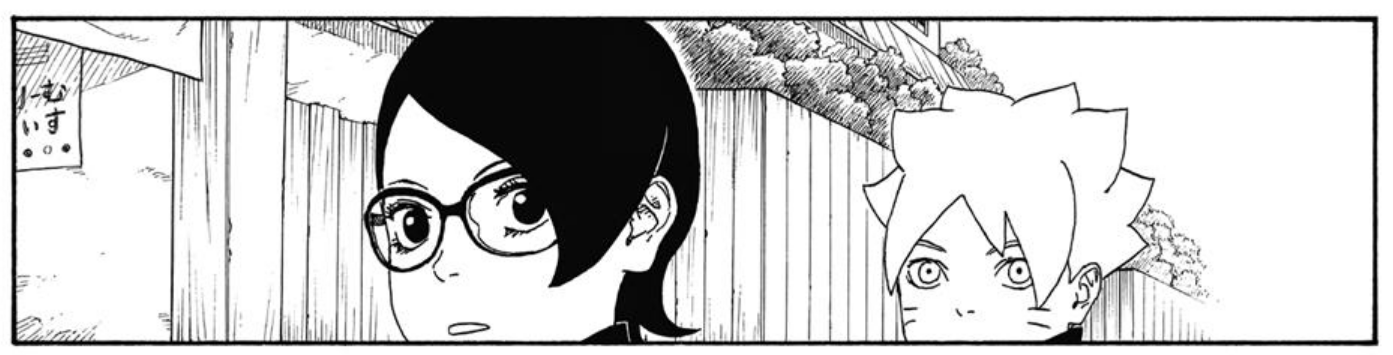
Let's quickly return to that pair of panels from earlier.
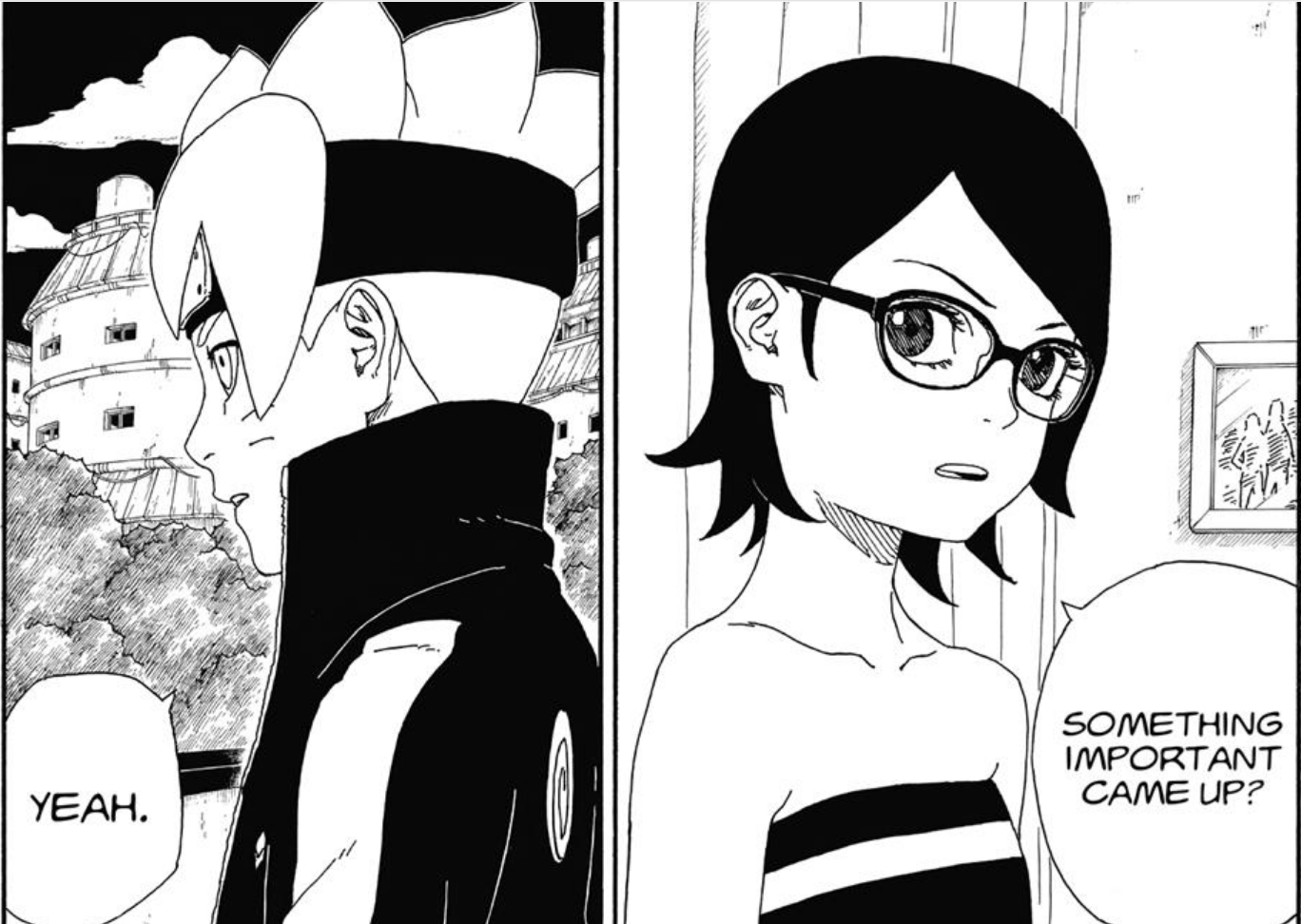
From facing each other to back-to-back.
I really like the visual contrast between these panels, each situated at the top of their respective pages. In the earlier one, we see Sarada and Boruto facing one another, each looking forward to the same future goal. Sarada holds onto her glasses, appearing to look forward at her future while Boruto also sees the opportunities ahead of them.
Their positioning remains the same in the next pair of side-by-side panels, Boruto on the outside, looking away at what he must do, Sarada on the inside, looking in his direction. Instead of having them face a united vision of what they must do, they're now back-to-back, representing the plot taking them in different directions.
Both characters show a lot of maturity in this scene. Boruto, who knows he's disappointed Sarada before by cheating, not only tarnishing his own reputation but that of his entire team, approaches Sarada to let her know he won't be able to go on their mission. In doing so, he's also trusting her not to tell anyone else about his plans.
For her part, Sarada immediately realizes the weight of what Boruto is telling her. For Boruto, who has vowed to be a shinobi like her father, to neglect an official mission means whatever he has taken on is a greater threat. Knowing all of this, Sarada tells him that she and Mitsuki will handle their B-rank mission; he should do what he must.
Meanwhile, Tento is in an industrial building, surrounded by Mujina Bandits members and his beloved butler, Yamaoka, who soon reveals himself to be none other than Shojoji, the Mujina's boss. The real Yamaoka is long dead. Like all good villains, Shojoji pauses to explain his forbidden Corpse Doppelganger jutsu to the Daimyo's son, telling him it "devours its target's form, memories, and abilities. Along with the target's life." He asks if he's appeared on any of Tento's beloved X-cards, pointing out that he's not much different from Orochimaru (another well-known fan of body-snatching).
More villain over-explanation occurs as Shojoji tells Tento of his kidnapping, the ransom, and their demands for his return before further insulting the boy, saying, "You want to become a card-worthy amazing ninja... The best you can hope for is to be a bargaining chip to se against the Daimyo." He unceremoniously drops the boy to the ground, the Lord Seventh X-card and the shuriken given to him by Boruto slipping out of his pocket.
Similar to Boruto's memory montage of Sasuke, Tento remembers Boruto speaking of his desire to one day become an amazing ninja who supports the Hokage—his father. In a move that Boruto later borrows in the fight against Isshiki, Tento snatches up the shuriken and aims it at his own throat.
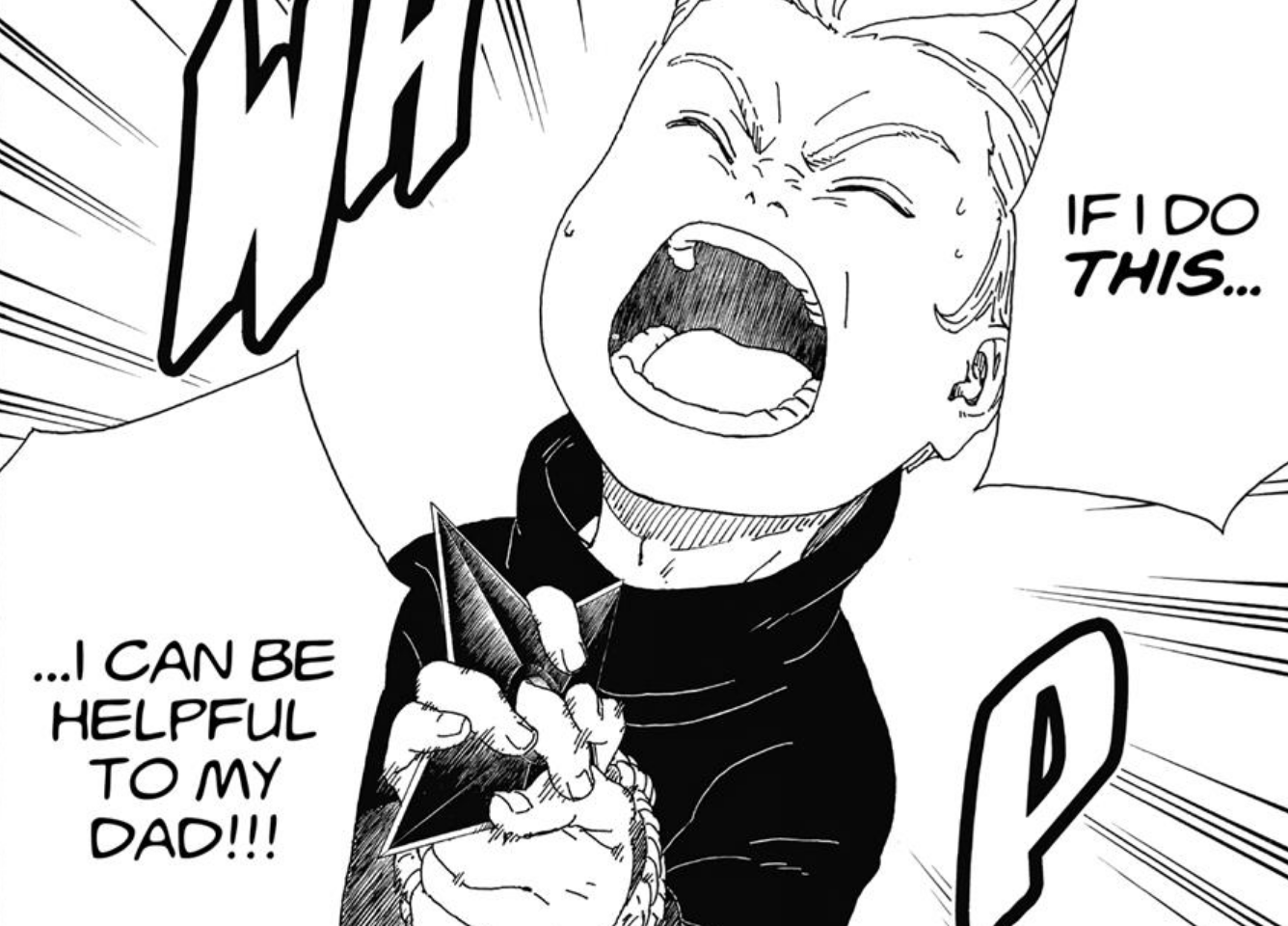
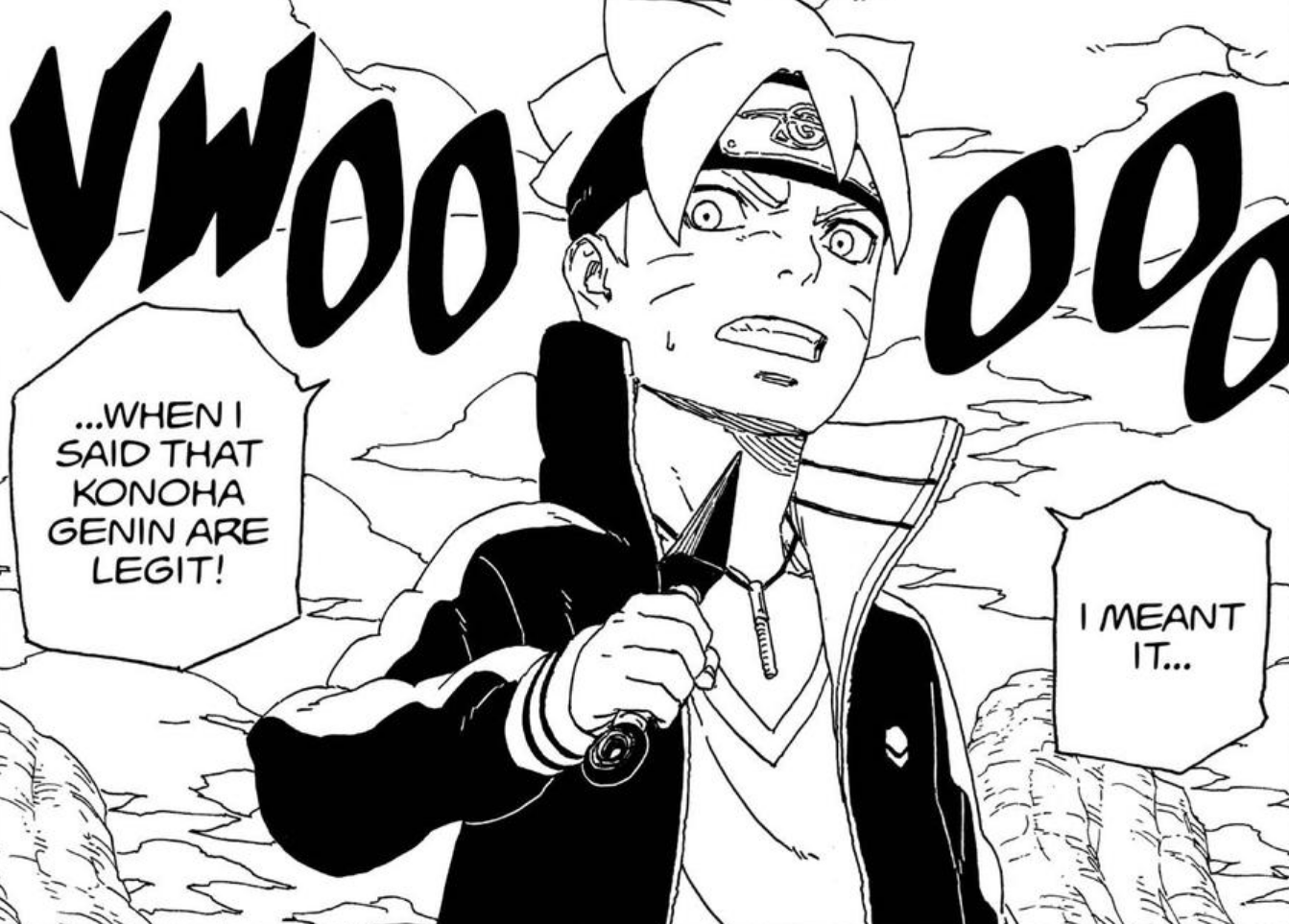
In this issue of Konoha Weekly's "Who Wore It Better" style section...
Shojoji stops Tento, revealing his true plan in the process: eat Tento's living brain while he's still living and be returned to the Daimyo in the guise of his son. In one of the more horrifying panels in the entire Boruto series, Shojoji chomps down on Tento's small head, his massive mouth engulfing a third of the boy's cranium.
Luckily for all involved, Shojoji's midnight brain snack is interrupted by a foot to the face that makes the one Boruto delivers to Code at the beginning of TBV look like a tender shoe-sole caress in comparison.
"Leave the rest to me, Tento," Boruto says, setting us up for the next chapter of Shojoji versus Boruto. "This is ninja work."
Chapter 14: Teamwork!!
Chapter 14 opens by asking the age-old question, "How many Konoha genin does it take to beat up a quartet of Mujina Bandits?
The answer: If that genin is Boruto Uzumaki, one!
On a more serious note, the beginning fight serves two functions we've discussed before. First, it sets power levels in the series, both for Boruto as well as for your average rogue-nin-turned-criminal. Second, just as we saw Naruto testing Momoshiki's power during their fight before entering Sage Mode boosted with Kurama's chakra, Shojoji is sitting back and watching his henchmen take on Boruto, noting his fighting style and technique limitations (such as only being able to create four shadow clones).
"You sure are the Hokage's son," Shojoji says after Boruto dispatches his men, licking his lips before attacking. Frequently during this fight, page turns are used to create motion and speed during combat. Below, we'll see a panel that shows Shojoji in front of Boruto, some distance away, at the end of a page, but one page turn later, he's at his side, ready to land a blow.
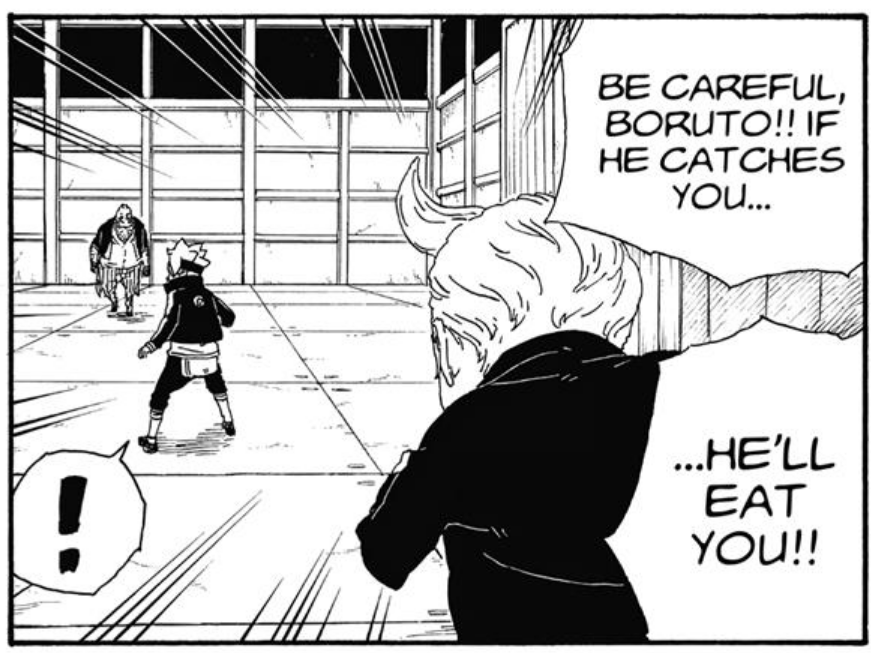
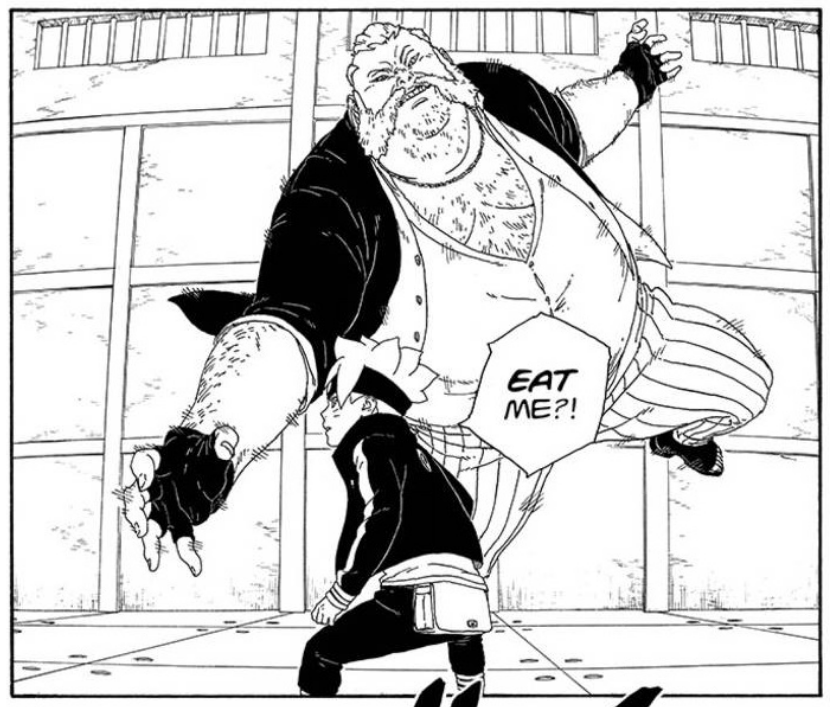
Shojoji moves from being in front of Boruto to beside him during a single page flip.
Tento's warning about the Mujina boss's cannibalistic tendencies is what saves Boruto, allowing him to escape by jumping upward, then executing a brutal headbutt to Shojoji's open mouth when he's about to get chomped on. The exchange that follows between them is one of the more interesting ones in early Boruto, especially within the context of the rest of the series.
"What the heck are you?!" Boruto asks. "Never mind if you're a ninja or not. Are you really even human?!" Shojoji's response is as follows:
"Humans are fundamentally creatures that eat anything and everything. We're just raised differently, z'all."
Now, we're going to break this statement down in a few different ways. First, this excuse of not being raised properly comes up again in chapter 28 when Kawaki tries to attack some children who ran into him, then argues with Sarada over it. In both cases, the characters are using their upbringing to justify monstrous acts, even if one is bourn out of trauma and the other out of a background that made it acceptable to "roast [Boruto] whole with some salt."
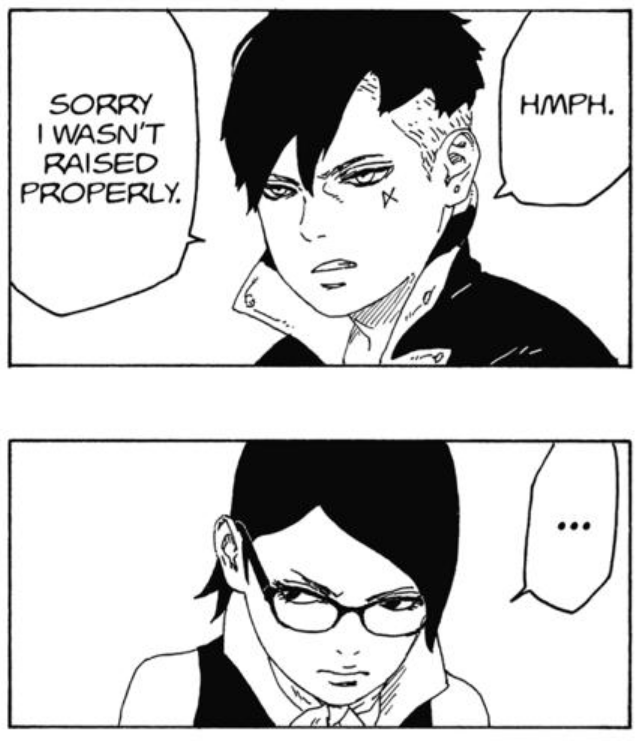
Something the Boruto manga has yet to offer us is counterfactual proof to the idea that people can defy their bad childhoods. I specify the manga as the anime frequently utilized side characters with redemption arcs, though many of them (e.g., Sumire, Ryoji, Ikada) had a loving family member or two in their background before years of maltreatment and manipulation. For the manga, this thesis statement is one that needs to be challenged unless it's foreshadowing the future.
The other interesting theme in Shojoji's statement is that surrounding the consumption of humans. The entire Boruto plot revolves around this idea—the Otsutsuki data slowly but surely consuming Boruto and Kawaki, the threat of the boys being fed to the Ten-tails, the Shinju and their targets. However, this line of thought becomes particularly interesting in the context of the Claw Grimes in TBV, as seen in the panels below.
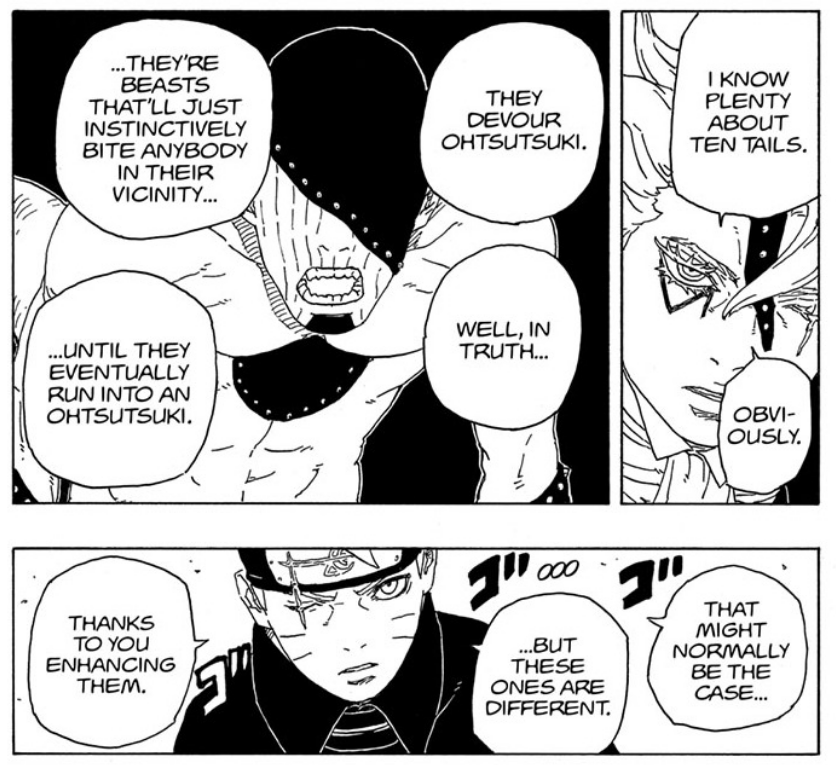
Shojoji claims that humans are beings who will eat anything, which is similar to the Claw Grimes that will "instinctively bit into anybody in their vicinity until they eventually run into an Otsutsuki." Throughout the story, we get the sense that the dark side of humanity and the nature of the Otsutsuki aren't that different; however, the Claw Grimes also provide us another example of a life form that will instinctively eat anything in a quest for power.
After that diversion, Shojoji announces his desire to consume Boruto as well, raising an interesting question: had he won, which boy would he have eaten first? He follows up by threatening to break Boruto's limbs to subdue him while also keeping him alive. Yet again, we're given another parallel to the Otsutsuki, Isshiki who broke Boruto's arm to stop him from killing himself while preserving his life for the Ten-tails and, later, Momoshiki attempting to do the exact same thing to Kawaki while inside of Boruto's body.
In the fight that follows, we see Boruto's arsenal of jutsu reflecting his father's style, now with the addition of the Uchiha shuriken jutsu enhanced with lightning. He's still heavily relying on shadow clones to create diversions and his trusty Rasengan, but he's beginning to integrate some of Sasuke's moves as well. This is another case in which the techniques Boruto is using show some passage of time between the events of the first arc, when he couldn't form a traditional Rasengan and was just starting out as Sasuke's student, and the Mujina Bandits arc.
Shojoji responds to Boruto's attacks with his own ability, the Futon Zephyr Shield, which repels not only shuriken but a Rasengan as well. I wouldn't be surprised if a data book or the expanded anime content in the future connects Konohamaru's Wind Style Rasen Barricade to Shojoji's Wind Style Zephyr Shield, the former being inspired by the latter.
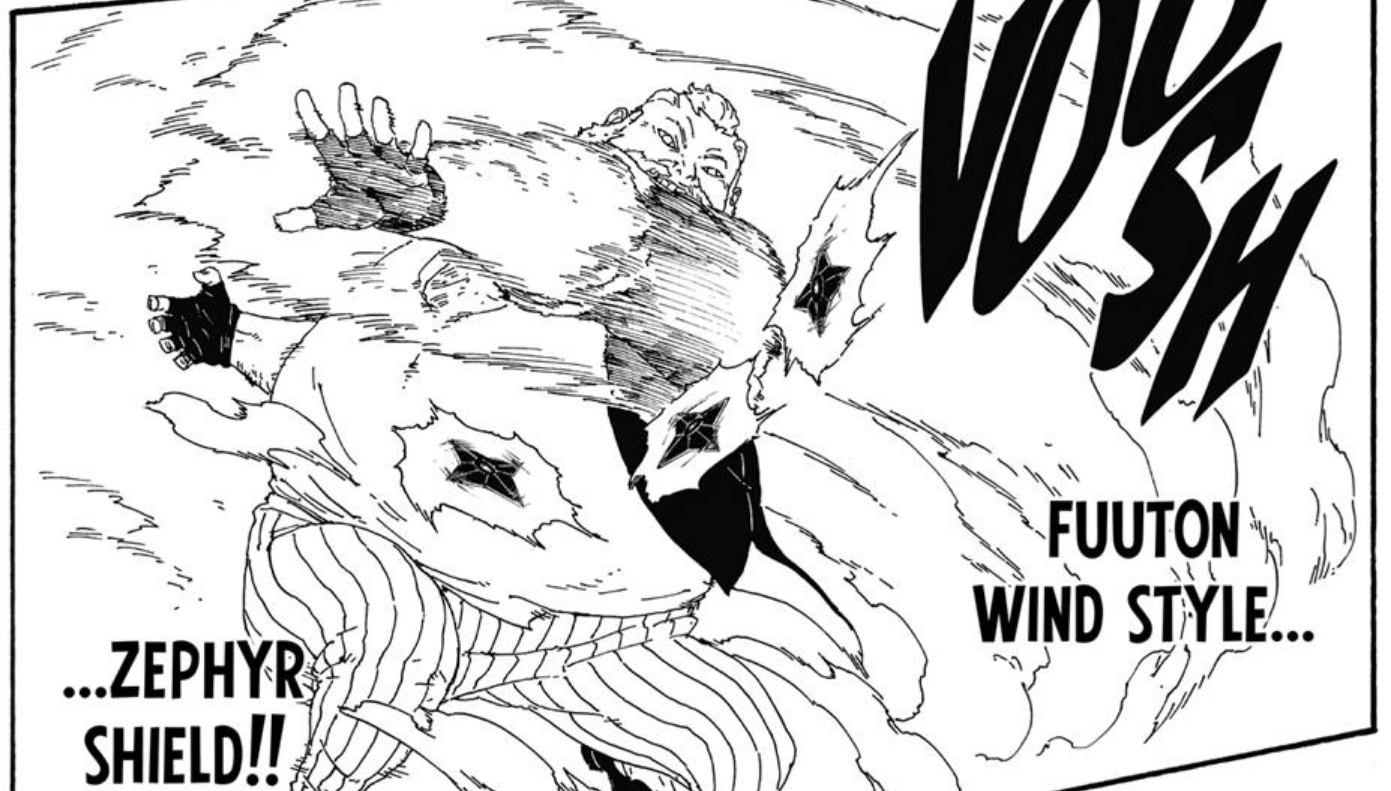
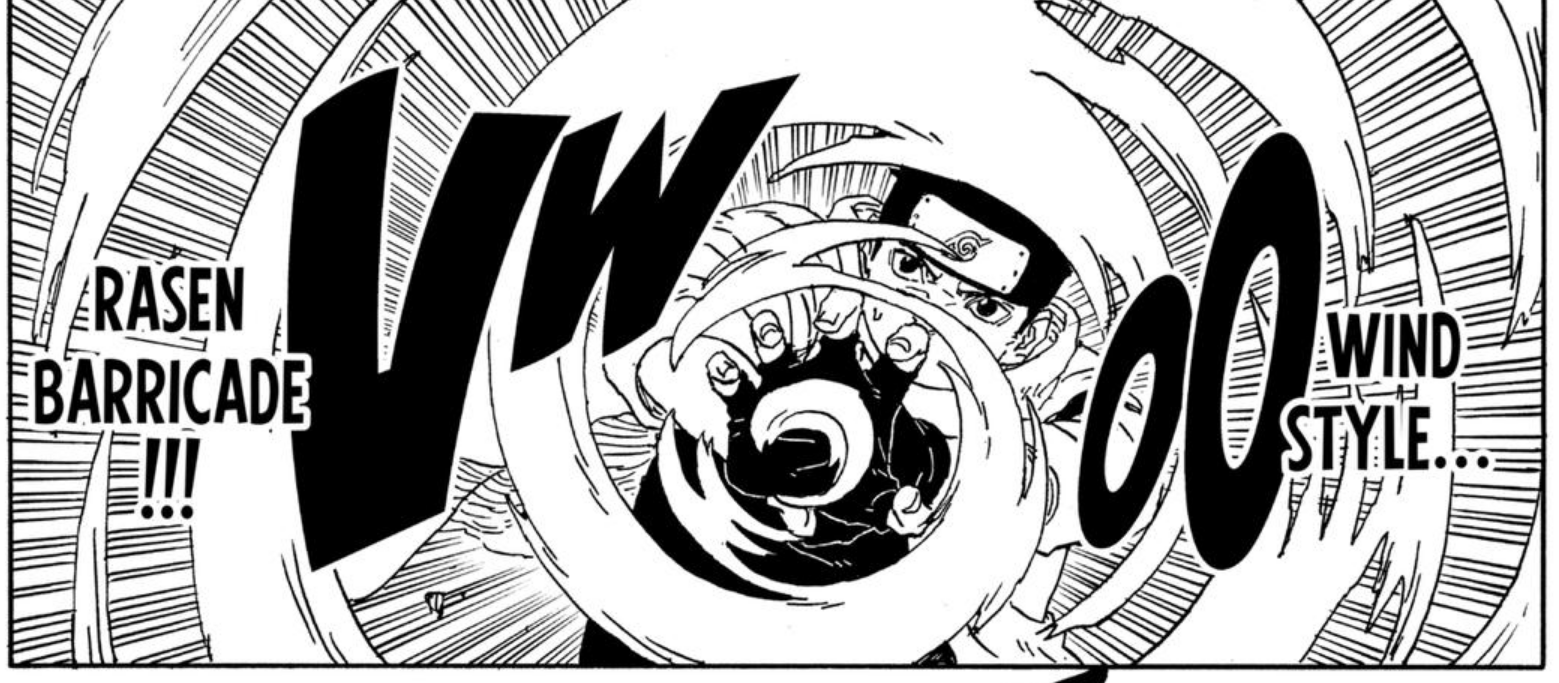
Konohamaru is lucky they don't copyright jutsu.
The theme of cheating, or being unwilling to put in the work to be a shinobi, arises again after Shojoji repels Boruto's attacks and tells him, "I don't need to learn 100 jutsu. Since my enemy'll defeat himself. And those that I like, I devour." Similar to the scientific ninja tool, the Mujina boss is able to steal the techniques (and bodies... and memories) of his victims, circumventing the arduous process of having to learn anything.
In a last-ditch effort of trickery, Boruto enacts a shadow clone attack under the cover of smoke bombs. However, as previously noted, Shojoji already knows how many clones he can make and uses that knowledge to his advantage. After dispatching three of his clones, Shojoji has the real Boruto by the neck. Our young shinobi hero tries to form a Rasengan, but it fails due to his inability to knead chakra (remember this next chapter, friends!). With his last shadow clone eliminated, Shojoji returns to the business of snapping Boruto's neck to snack on later when he's struck in the back by a shuriken.
Did he miss a shadow clone?!
No! It's Tento!
What I love about this moment is how perfectly it matches Boruto's Vanishing Rasengan scene in the Versus Momoshiki arc. Boruto has trained his own student and given him the confidence to act on his own. Even though it's a small attack, it's enough to free the more powerful shinobi and assist them in finishing the job. As he turns to lash out at Tento, Boruto delivers a very powerful Rasengan directly to Shojoji's back.
The ability Shojoji couldn't repel with his Zephyr Shield? It's the power of teamwork!
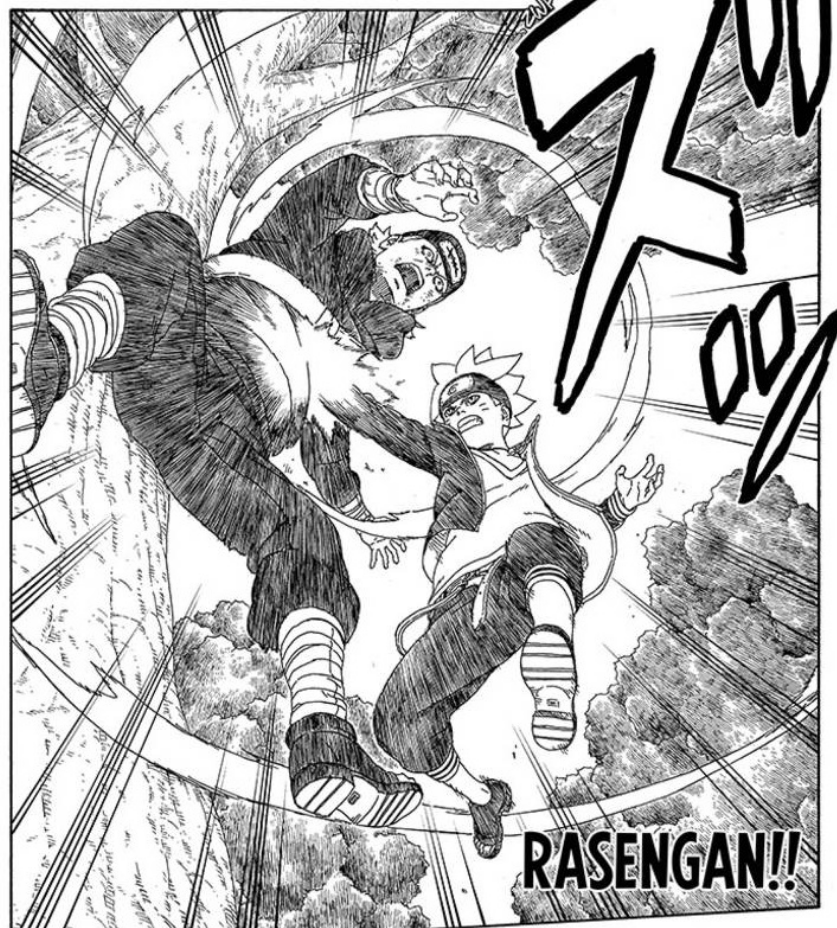
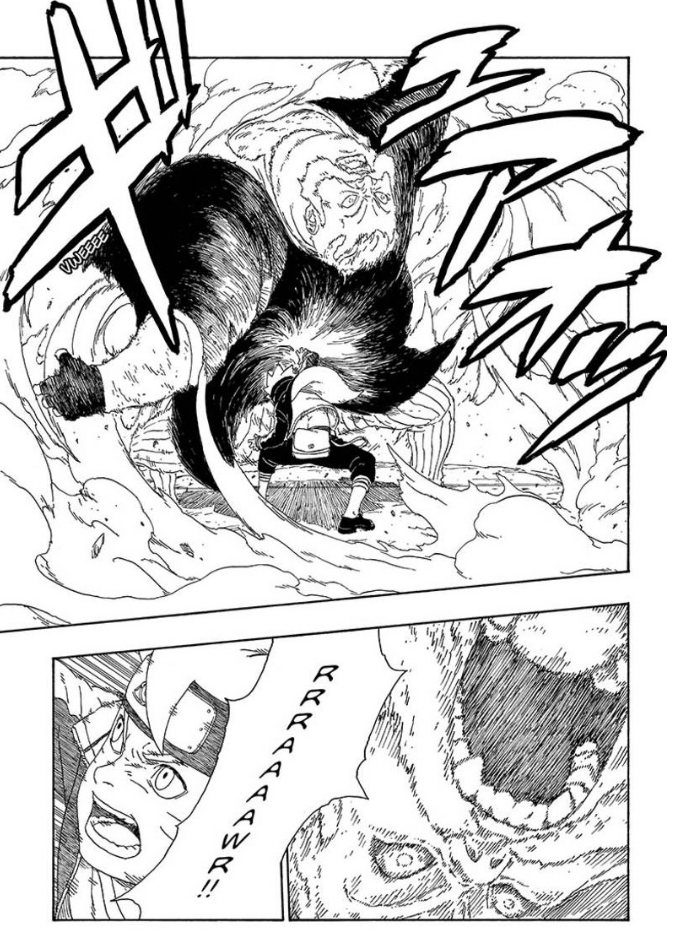
Foreshadowing via combat!
Now, lest we close on a feel-good note, I want to point out something for us to remember next chapter. Let's compare the Rasengan Boruto used against one of the fleeing Mujina Bandits at the beginning of this arc versus the one he nails Shojoji with, which is strong enough to destroy a wall while the tree behind the first robber remains intact. Once again, we see the story-telling-though-combat that appears frequently in Boruto, a detail that's easy to miss on a first readthrough or when following along with the serial release. We'll revisit this power boost during the next chapter.
Chapter 15: The Supporting Shadow!!
Chapter 15 continues to club us over the head with the parallels between Sasuke's tutelage of Boruto and Boruto's tutelage of Tento. Its title, The Supporting Shadow!!, is throwing some more brush onto that fire as well. We learn that Tento's attack was a planned distraction orchestrated during the smoke bomb offensive, similar to the way Sasuke planned for Boruto to use his Vanishing Rasengan against Momoshiki.
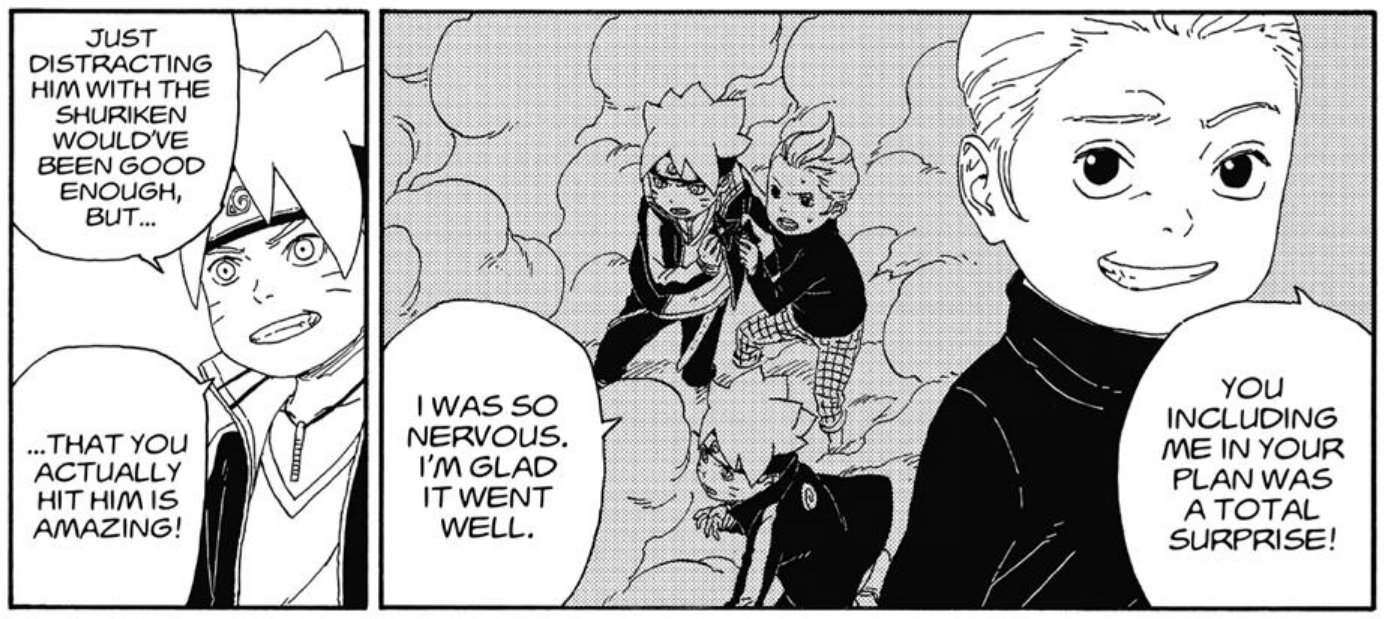
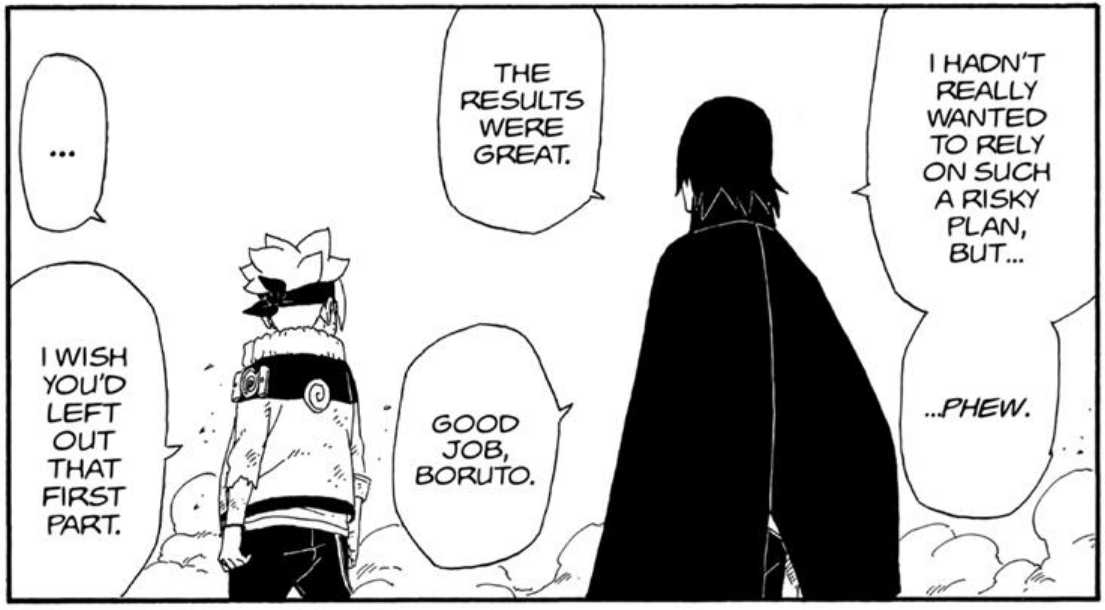
Read right to left.
Unfortunately for the boys, Boruto's super effective Rasengan wasn't effective enough to knock Shojoji out for good. The criminal shinobi gets back up, even more convinced now that he needs to eat Boruto's brain to obtain his amazing jutsu. Cockily, Boruto declares that his opponent is so injured that he probably can't use his wind-style barrier to repel attacks anymore. One more Rasengan, coming right up!
Except... that's not how it goes.
Boruto is jumping through the air, Rasengan in hand, when it poofs out of existence, just as it did in the last chapter as well when Shojoji was strangling him. Boruto collapses on the ground, grabbing his arm. A dramatic page turn reveals the black mark on his palm spreading.
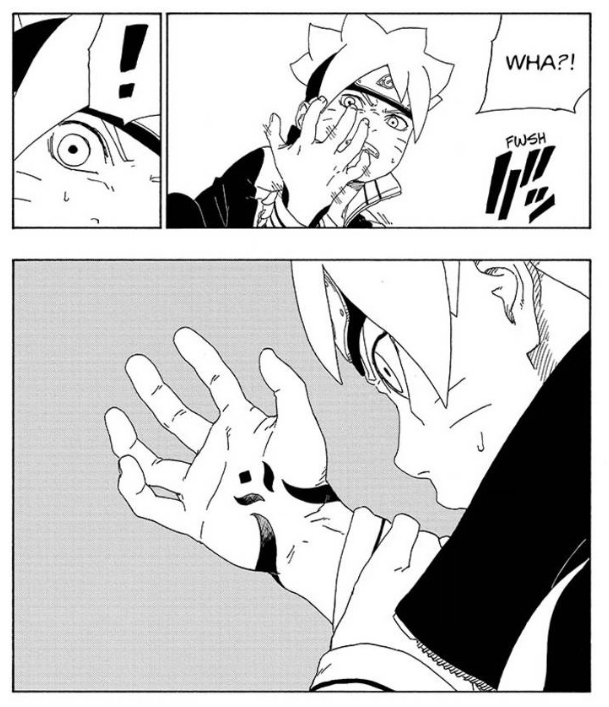
Fearsome Shojoji stops dead in his tracks when he sees the mark on Boruto's hand, immediately assuming he's part of an organization shady enough to scare a criminal who eats little boys' brains as a hobby. Instead of engaging in some much-needed ninja subterfuge and going along with it, Boruto begins questioning the Mujina boss, revealing his ignorance. Satisfied that Boruto isn't associated with the group, Shojoji winds up for another attack... only to be wrapped up by Mitsuki's snake-like arms in a very satisfying page turn. After delivering some snappy lines, Sarada ends the fight with a kick to the Mujina boss's trachea. Flabbergasted at his teammates' sudden appearance, Boruto soon learns that Sarada was so worried about him that she and Mitsuki abandoned their B-rank mission to follow him.
We soon learn that Mitsuki was able to track him down because he taught one of his snakes the scents of his friends, something that pays off over half a decade later in TBV when his now-grown snake refuses to attack Boruto despite the Omnipotence swap. Sarada is quick to brush off Boruto's gratitude, but notices something is wrong as Boruto examines his palm, realizing both the mark and its effects have returned to their normal state. Mitsuki issues his own side-eye, complete with "..." when Boruto insists that it's nothing.
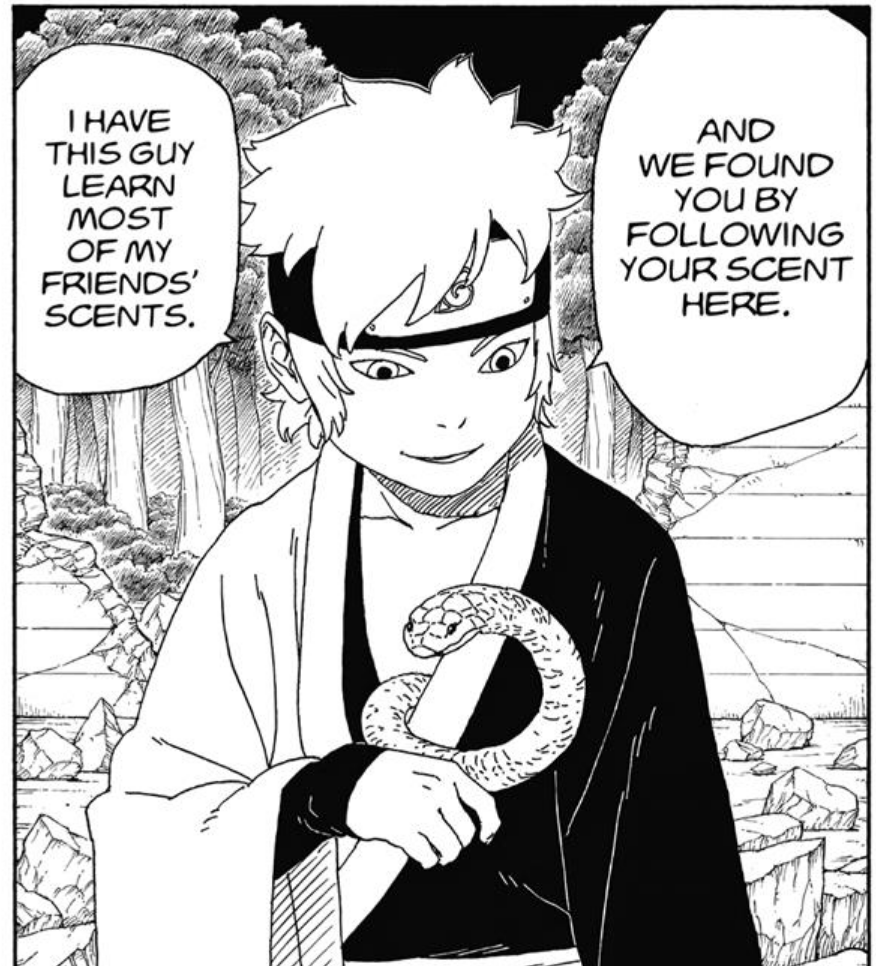
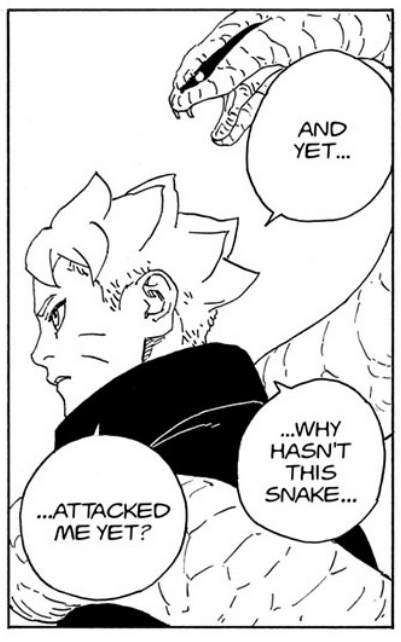
And they say rereads never pay off...
Back at Hokage Tower, Konohamaru praises them for rescuing Tento, but informs the team that there will be consequences for abandoning a high-rank mission that they all had accepted. Boruto is quick to insist that it's his fault and that the others shouldn't be punished, but Konohamaru responds, "The responsibility for a team's violation is shared jointly. So if you care about your team, don't forget that."
The threat of future punishment quickly dissipates when the Daimyo bursts into the room and embraces his son, frantically checking to make sure he's unharmed. Tento pulls a Dad-you're-embarrassing-me move before telling him that Boruto taught him to fight with a shuriken, and he's going to "keep working hard every day and become an adult worthy of supporting you." The use of the term adult sticks out to me because, despite his actions in TBV, Boruto is still technically a child, forced to take on the weight of the world because there's no one else who can do it.
We return to the themes of this arc, Boruto returning the X-card he so desperately desires, Tento echoing his vow to "...get what you want by your own strength, no matter how hard it is." After Tento departs, Boruto goes back to finding out how hard it is to get what he wants, opening a pack of cards and once again failing to find the one he's looking for. Annoyed at his stupidity, Sarada buys her own pack of cards, immediately finding the Super Super Rare card of Orochimaru, a setup for Mitsuki to divulge the identity of his parent, giving us a rare chance to see a page turn used for comedic effect.
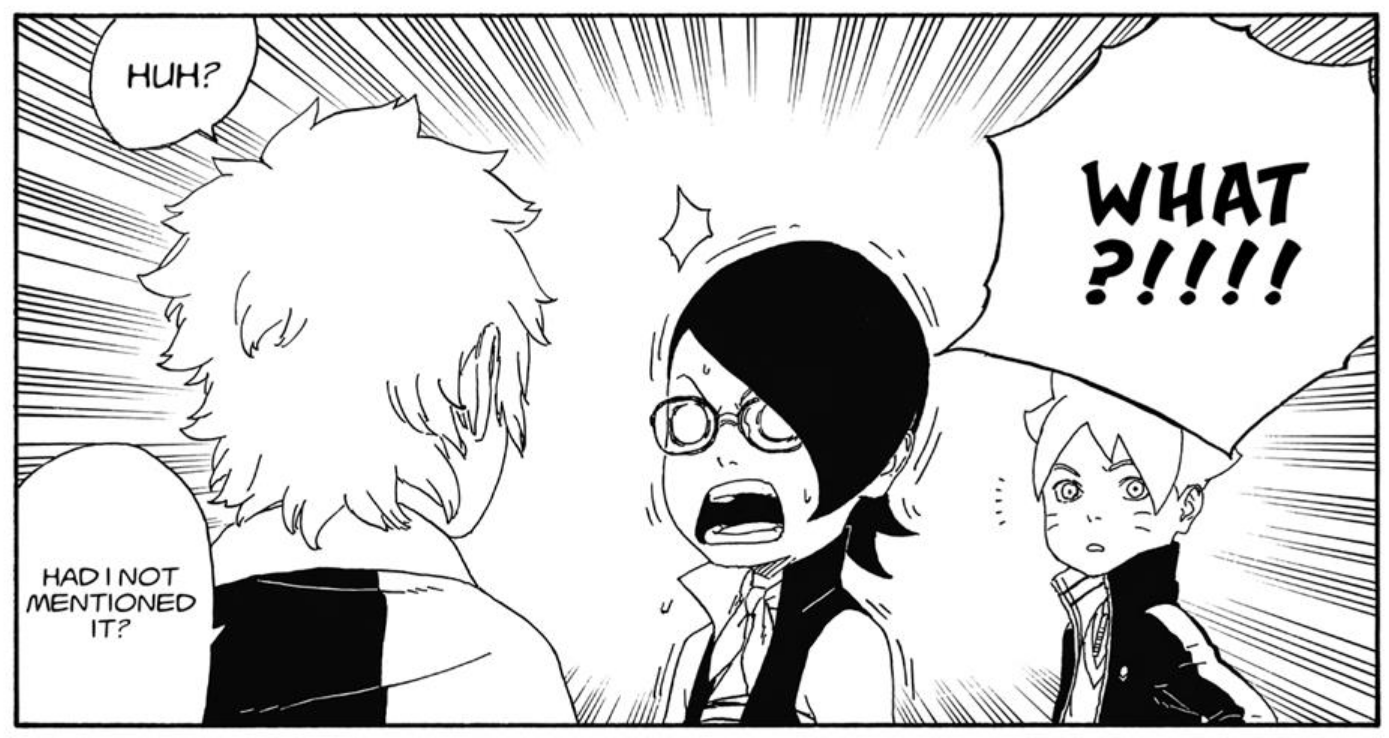
Shocked Sarada is shocked.
Whether Sarada's draw of Orochimaru's card is a prediction for the future direction of her character is yet to be seen, however his introduction into NNG allows Mitsuki to draw another connection between his parent and Shojoji, mentioning that he changes his appearance every so often (by switching bodies).
Back in his cushy mansion, Tento holds the card Boruto returned to him, thinking that his new friend truly can become "an amazing ninja who supports the Hokage" just like Sasuke Uchiha, his card titled The Supporting Shadow.
This arc began with Sasuke promising to look into the mark on Boruto's palm, so it's fitting that it ends with him appearing in the interrogation room with Sai and Ibiki, menacing the manacled Shojoji with his fearsome reputation. (I really wish Sai would have slapped the Mujina boss for that little taunt about taking his wife's last name before Sasuke's arrival.)
"You know who I am. And those of you who survived in the underside of society long enough also know how far I'll go when it comes to trash like you, hm? What do you know about that mark on Boruto's palm?" Sasuke manages to intimidate Shojoji into telling the story of the night he wandered into a basement, looking for something to steal, and crossed paths with a secretive organization of robed individuals who called themselves Kara, the Husk. For a moment, we see into the captive's memory, a series of Karma marks and a heptagram displayed on a board. Shojoji ties himself to Orochimaru one last time, telling Sasuke (the very last person in the world who would need to be told this) that Boruto's mark is unlike any of the curse marks used by Orochimaru.
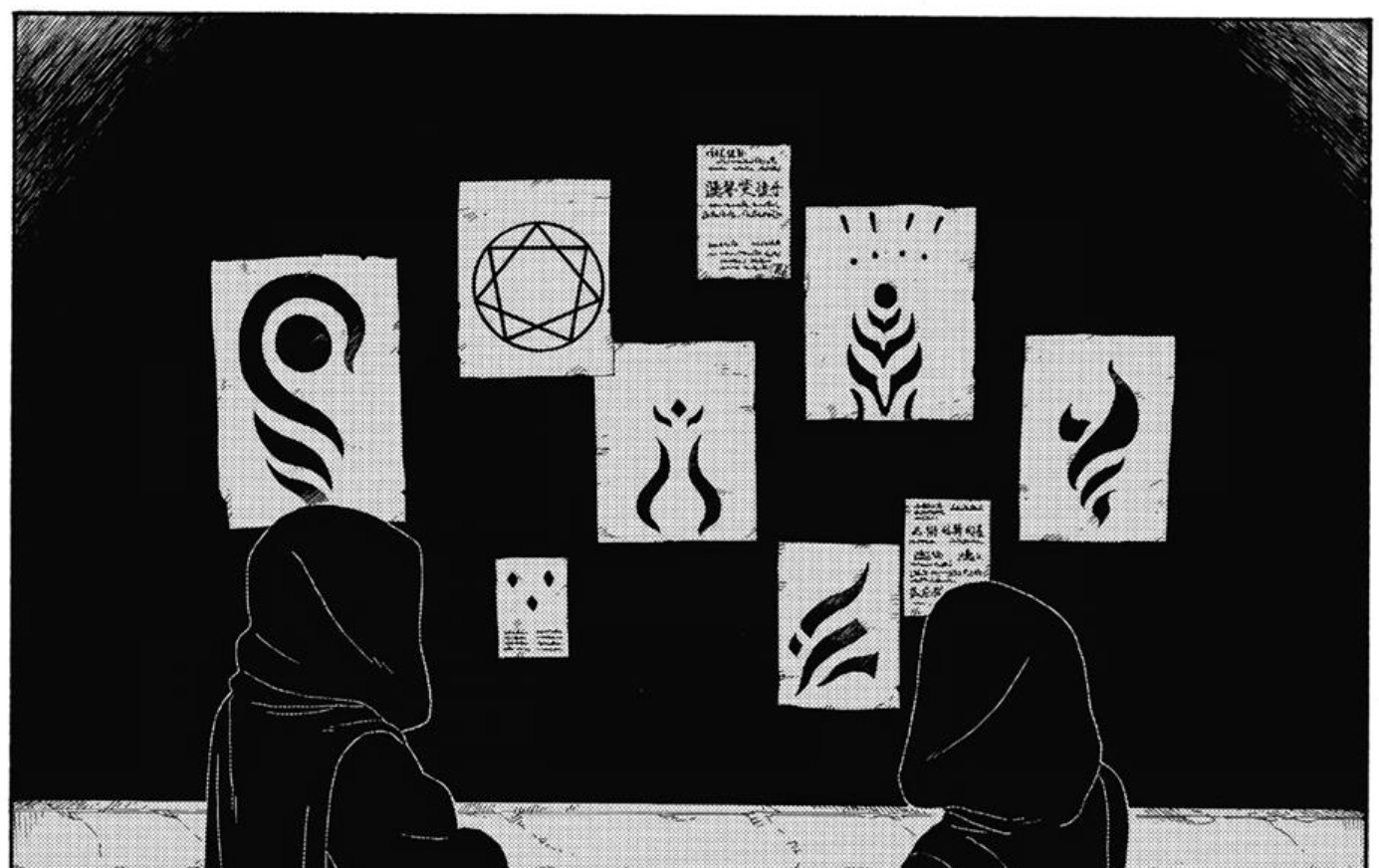
The final page flip transports us to another dimension of square-patterned cubes, the Kara Inners gathered together. Koji Kashin speaks first, addressing the only man seated among them as Lord Jigen, a black-eyed man with a diamond-shaped Karma mark on his chin.
Thus ends the Mujina Bandits arc. I've dismissed the importance of this arc in the past as a narrative transition between the first arc, which relied heavily on the Boruto movie, into the main plot of the manga. Looking back on it, though, it's surprisingly well done with Boruto stepping into the role of junior Sasuke soon after he realizes his dream to be like him. This arc also lays the foundation for future similarities between the Otsutsuki world of Shinjutsu and the shinobi use of jutsu, showing that the way humans utilize chakra is a pale imitation of the power of the gods. Not to be dismissed, Boruto's skirmish with Shojoji and his men sets a power scaling bar for the series in a fight that's human versus human before the introduction of cybernetically modified humans in the Ao arc.