Conforming to the Enemy's Methods: Koji, Boruto, and Inojin
Exactly which methods of the enemy are you guys planning to use?

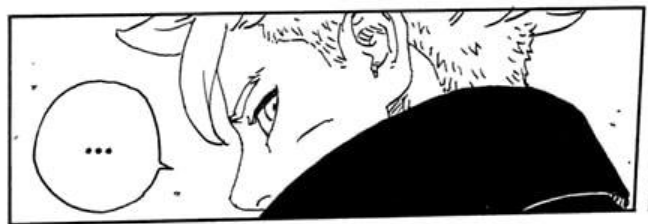
The beginning of the third arc of Boruto: Two Blue Vortex (TBV) opened with the abduction of Inojin by Koji, utilizing his romantic feelings for Himawari Uzumaki to summon the young shinobi to their lair. At their request, Inojin uses his mind transfer jutsu to connect the outlaws with Shikamaru in an off-the-records communication in the during a meeting with the village elders and the daimyo's representative.
"I don't even know how many rules you just broke now," Inojin tells them, right before Koji reminds him that he broke those very same rules as well.
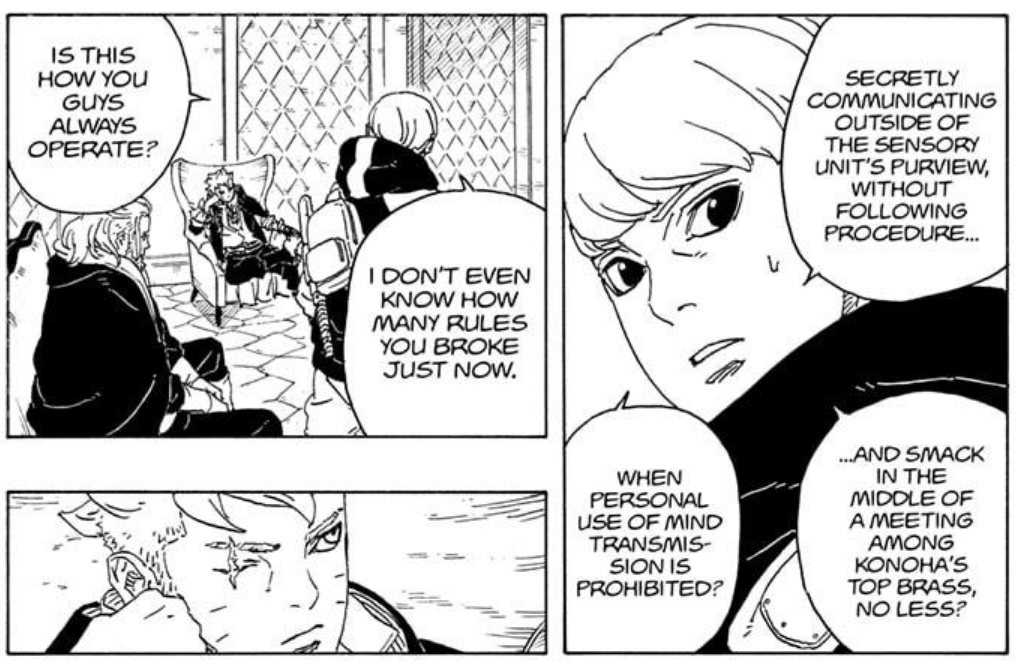
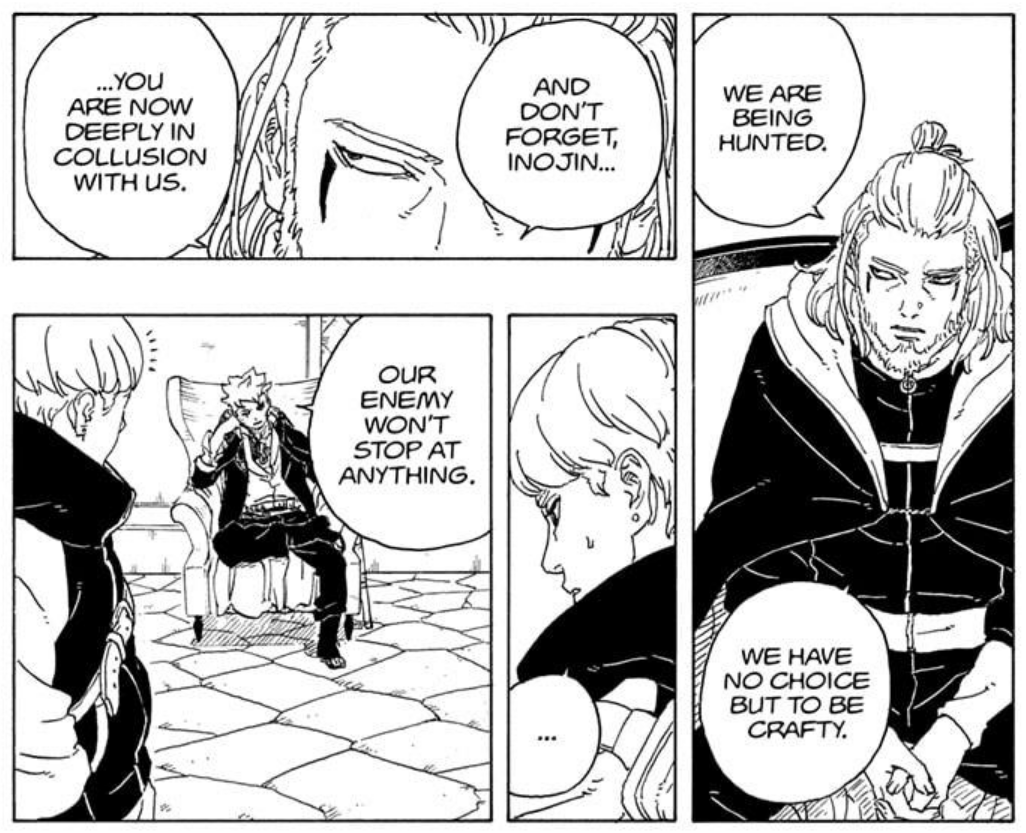
The First Rule of Outlaw Club is that the outlaws don't talk about the rules.
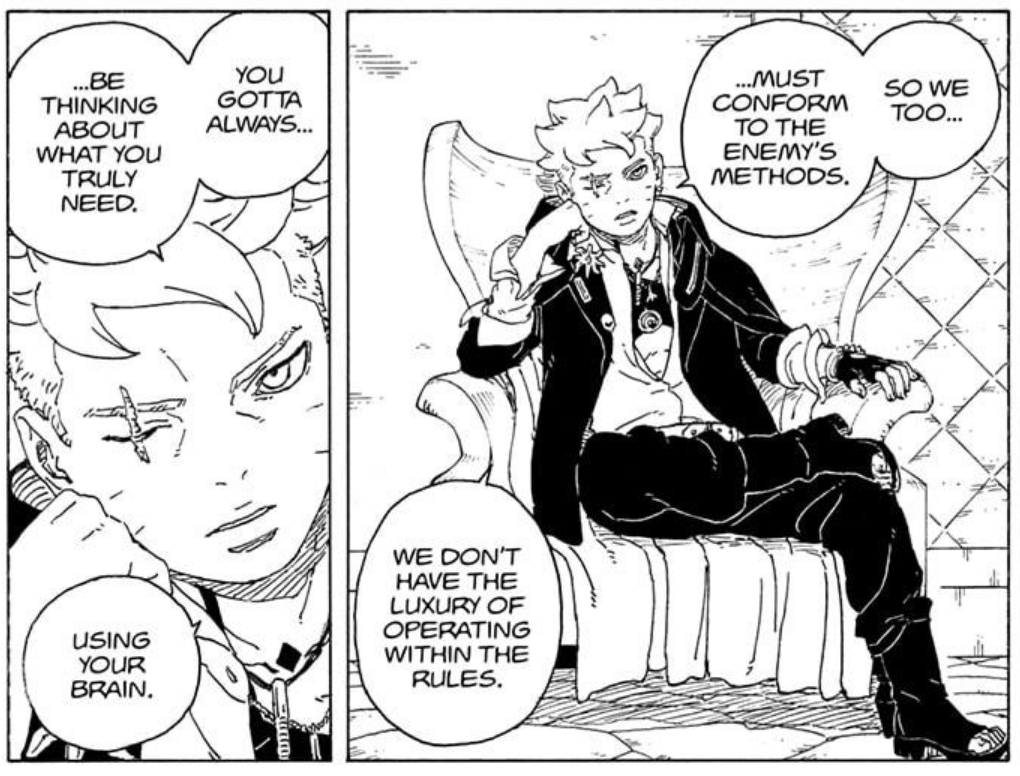
What follows is a pivotal statement by Boruto, one of the defining points of the third arc of the TBV manga:
"Our enemy won't stop at anything... so we too must conform the enemy's methods. You gotta always be thinking about what you truly need. Using your brain."
While this sounds like a statement of pure pragmatism, it's followed up by a verbal clash between Boruto and Koji, one in which Boruto stonewalls the older shinobi when he asks about his deal with Momoshiki, biting back that Koji doesn't share the most important information with him, either, such as how many people Koji was willing to let die during the mission to the Sand.
Thus, readers find themselves in a paradox with Boruto: does he truly believe that they must not stop at anything to match the will of the enemy or are there hard lines he'll refuse to cross? This question comes to a head at the end of TBV chapter 30 in which Boruto appears suspicious of the vague plan Koji mentions to Shikamaru—and rightfully so, we soon find out, as Koji manipulates Inojin into taking over Lord Kobu's body and putting him in mortal danger. In fact, the words Koji uses are eerily similar to what Boruto told Inojin in their secret hideout earlier: it's not a matter of ethics. It's matter of getting what they truly need.
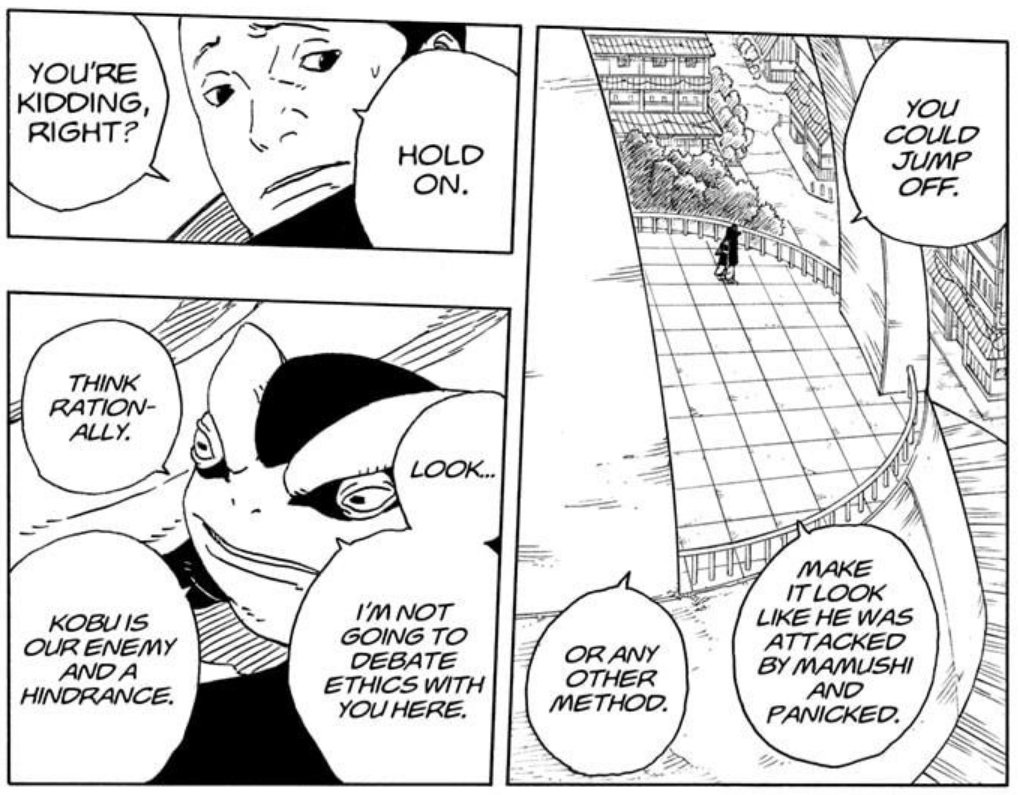
*there's no difference between these two pictures meme*
Methods of the Enemy
One of the things that is striking about Koji's plan to have Inojin take over Lord Kobu's body and kill him is that it literally mimics the method of one of their enemies revealed in this arc: Momoshiki.
From conversations between Boruto and the bored-to-death alien trapped in his mind, we learn that Momo's plan has been to get Boruto killed to put an end to his eternal purgatory living in the mind of a teenage boy (and who can blame him?). When Boruto offers him the chance to take over his body, it's a win-win situation for Momoshiki. Either he defeats Kawaki and will be free or he commits suicide-by-Kawaki and experiences a different kind of freedom.
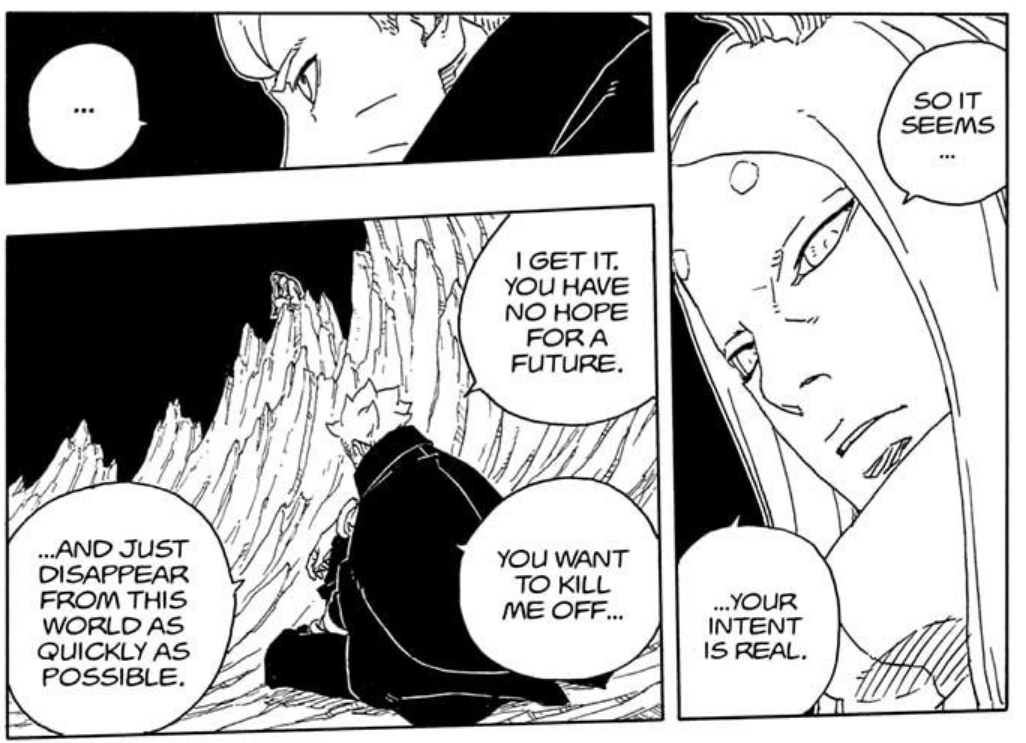
While the means are different, the ability of one individual to take over another's body and use it to achieve a desired goal is the same. As such, Koji (and Inojin, by extension) are literally utilizing the methods of one of their enemies.
Inojin in the Middle
From the very start of this arc, Koji has been manipulating Inojin into going along with every plan, dangling the possibility of Himawari's death above his head to convince him to go deeper and deeper without questioning his actions. Boruto's antagonism toward Inojin (for crushing on his little sister) allows Koji to take on the role of good cop in this good-cop/bad-cop scenario, confiding bits of the future to Inojin while constantly reminding him of what's at stake.
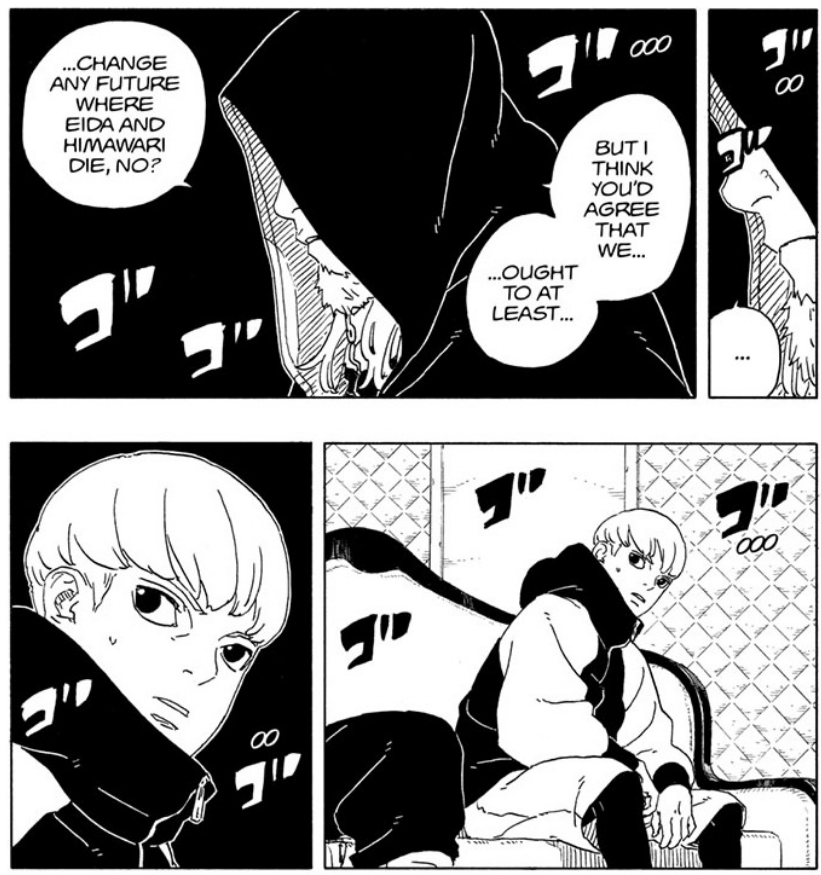
As readers, we first see the pressure he's putting on Inojin as a tool to strengthen his resolve, empowering him to master a new jutsu in a single day, a jutsu that is critical in their battle against Mamushi's invasion. But similar to the moment when Koji reveals to Inojin that he's breaking the rules as well, we learn in Chapter 30 that Koji has also been preparing the younger shinobi for the moment when he asks him to murder a high-ranking official, going so far as to antagonize Mamushi to induce an attack.
Boruto: Don't Do or Die
With his excellent use of cliffhanger endings, Ikemoto is now forcing readers to spend a month thinking about what Boruto's look in Chapter 30 truly meant. Does he truly believe that no one should die in pursuit of the best possible future, even nuisances like Lord Kobu? Or did he believe his own words to Inojin, that they must always be thinking about what they truly need and be willing to break the rules?
Or perhaps there's an additional meaning—which rules is Boruto willing to break?
During the Sand Arc, we saw Boruto break away from Koji's orders, defying his plan that was supposed to lead to a best possible future by stepping in to save Konohamaru from being consumed by Matsuri. Kawaki's arrival on the battlefield saved Boruto from getting killed by Jura, turning the tables of fate, but how many more times can Boruto veer from the path forward without endangering an optimal ending?
Koji made it clear to Shikamaru that one of the ways to ensure they are moving toward a best possible future is to keep him in the position of Hokage. The plan for Lord Kobu's untimely demise is just a means to achieving that end, keeping Shikamaru in place while proving to the Daimyo how important the shinobi village is in the Shinju-infested world. While saving Lord Kobu might change his mind about Boruto, it could also have the opposite effect, letting him live while proving there'd been a conspiracy to murder him and that there are individuals in the village assisting the traitor. His skepticism might be enough for him to decide that his rescue was little more than a staged event to get his sympathies, resulting in Shikamaru's removal.
At the end of Chapter 30 of TBV, we're left wondering if Boruto was simply referring to his own bargain for Momoshiki's powers when he spoke of using the methods of their enemies, or if we're going to see our main character sinking to similar depths to ensure the survival of the world he's promised to protect.