Power Creep as Plot: The Anime Arms Race and Boruto

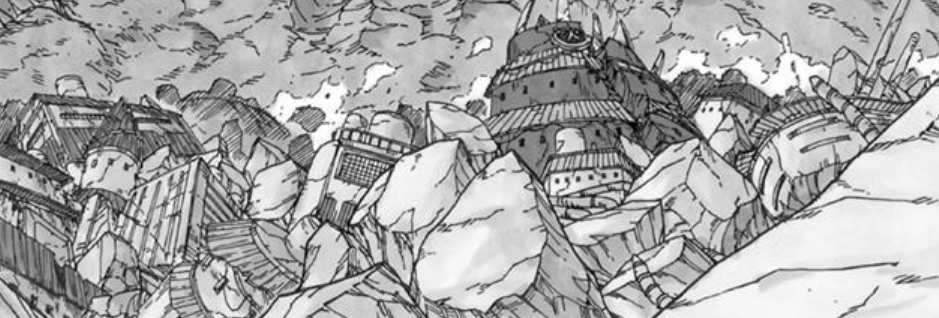
The term power creep was first coined to explain a phenomenon in game design when expansions added to a game's original structure make its earlier content obsolete. It was later co-opted by battle anime fandoms to describe how characters in long-running series encounter increasingly more powerful foes, necessitating the heroes themselves to gain more powers and more abilities. Power creep is often used derisively when fans feel as though a series has lost its early charm and appeal as the story moves beyond what was perceived as its premise, city-level threats becoming country-level, then world-level, then galactic-level—to borrow an idiom from American television history, they feel as though the series has "jumped the shark."
I contend that this criticism is a misunderstanding of the historical context underpinning modern manga and anime—and failing to recognize its importance means that audiences are also misunderstanding warnings issued by contemporary series.
Focusing in on Context
Modern battle anime originated in the 1970s and 1980s with early mecha series and dystopian science fiction, which were set on a collision course with the rise of super hero-like protagonists in the 1980s and beyond to create what we know today as the battle anime genre. The central question dividing the early genre from later shonen is "Can we be saved?" versus "Who can save us?"
These mangaka whose series would later be adapted into anime were children during the years immediately following World War II and the atomic bombings of two Japanese cities. Close to 250,000 civilians were killed in an instant, the survivors' wracked by the aftereffects of radiation. We see the mark left by mass national trauma on anime: bright white explosions bursting outward during battles, the littered rubble of destroyed cities, grotesque body horror of expanding growths and melting flesh.
The influence of the post-war era doesn't end there, however, the impact of Japan's disarmament appears as well with sci-fi settings of a remilitarized world or characters who become weapons themselves, governments and civilians relying on the power of a specific individual rather than a formalized military structure. Throughout the mid-to-late 20th century, the politics surrounding the treaties that led to disarmament were a polarizing topic, both Japan's lack of its own military and its alliance with the United States, turning their country into a base of operations for a foreign government. Protests and demonstrations were a feature of this era, also appearing in many manga of the time.
To view power creep as little more than a result of a bloated plot that doesn't know when to quit fails to recognize that Japanese history is very well aware of the consequences of real-world power creep—the technological arms races that took human war from canons and horses in the 19th century to atomic destruction only 100 years later. Through this lens, power creep isn't creep so much as it is a factor of conflict in which your enemies become stronger, therefore you must become stronger as well.
Many series grapple with the cost of necessary strength, the pain it inflicts on its users—both physical and emotional, the destructive force restrained only by morals, the collateral damage stemming from such power. What makes Boruto a uniquely interesting series to examine the meaning of power creep is that from the opening pages of the manga, we know where the story is going—the complete and utter destruction of a modern and prosperous village displayed as the backdrop to a conflict between Boruto and Kawaki.
The Theme of Power Creep in Boruto
Boruto's story is told in retrospect through the title character's voice as the clash between Boruto and his adopted brother Kawaki begins after they discuss the inevitability of their fight. But when the narrative begins to recount past events, we're introduced to a village on the precipice of change. Cultural and technological advancement has accelerated in the post-war era, a time of peace and economic growth depicted in the modernization of the setting—burger joints and collectable card games replacing ramen stands and swings.
The first arc of the story initially poses the question of whether scientific ninja tools—the availability of ninjutsu abilities without ninjutsu training—pose an existential threat to the way of shinobi, concluding that "even if times change, the soul of a shinobi remains the same." But as the narrative progresses, we learn that technology in the hands of shinobi is not the story's crisis point. Instead, we are introduced to an organization full of super-powered cyborgs enhanced through scientific ninja technology, some of which was stolen from Konoha in an act of espionage.
These technologically-enhanced humans become antagonists—and in the case of Kawaki, deuteragonist—for most of NNG. As in real life, their creation is necessitated by external forces changing the world—in the case of Boruto, the appearance of genocidal god-aliens from outer space, a sociopathic species dedicated to consuming the lifeforce of planets they encounter to attain transcendence. As the threats to Konoha (and, frankly, the entire world) grow, the power level of the characters increases as well, culminating in the left panel below.
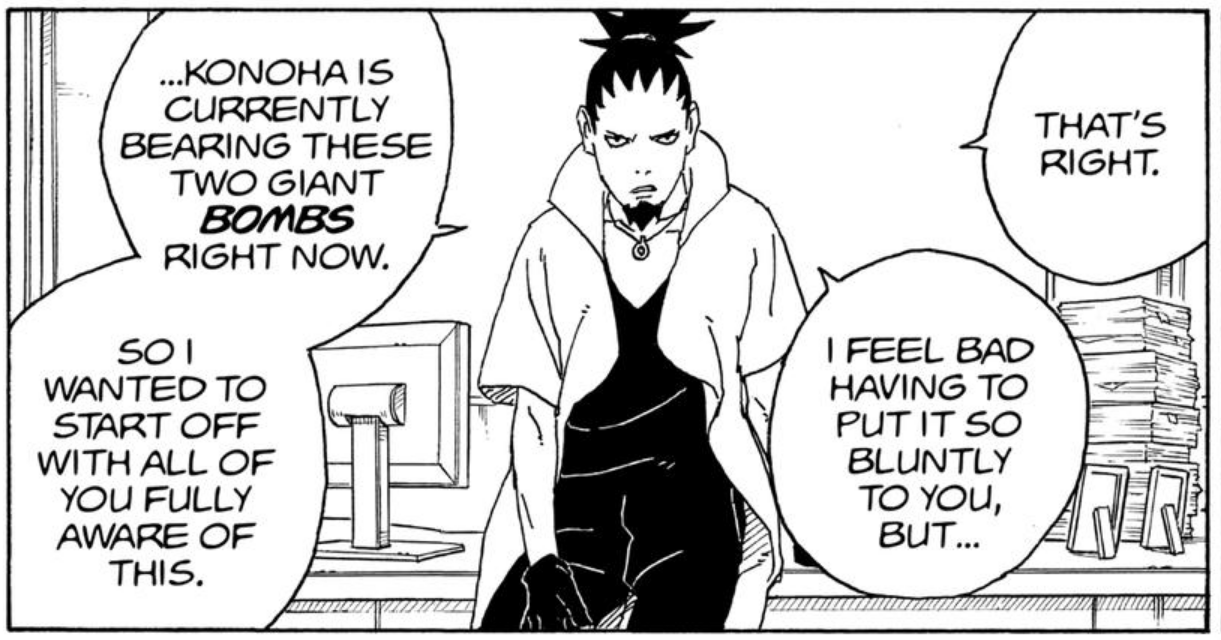
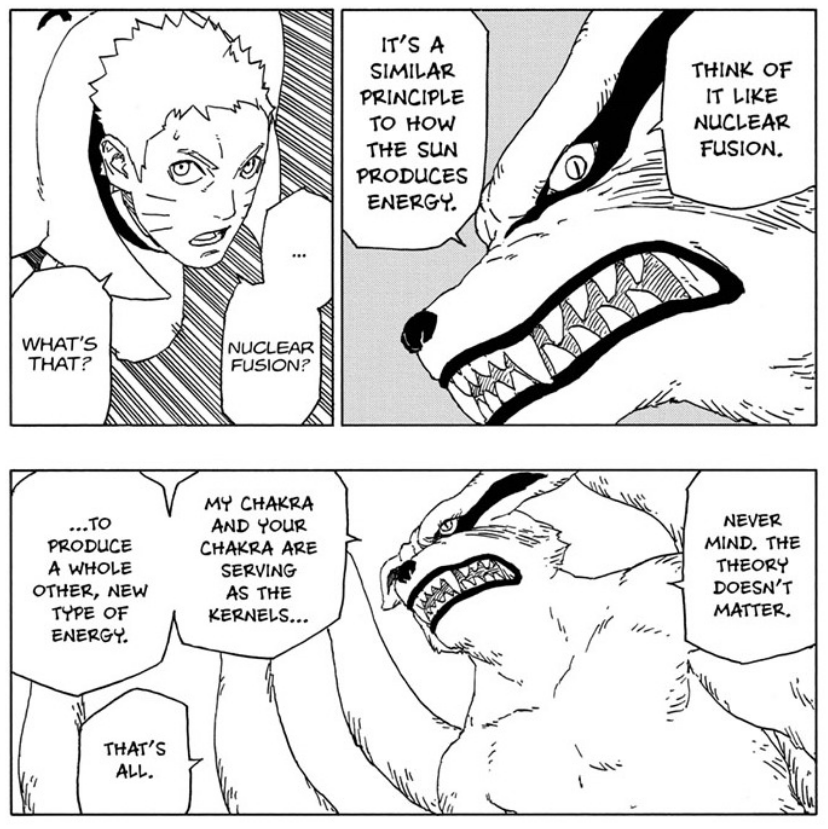
In chapter 73 of Boruto: Naruto Next Generations (NNG), Shikamaru, the Hokage's genius advisor, specifically calls out Kawaki and Boruto for being two giant bombs in the village that have yet to explode. The choice of words here is important, calling both the boys bombs and stating that there are two of them, reminiscent of the pair of bombs that were dropped on Japan during World War II. And lest we think that nuclear technology is far from the minds of the writers, let's remember Kurama's nuclear fusion explainer in NNG chapter 52, shown above.
Through Shikamaru, the story is reminding us that not only are Boruto and Kawaki threats to the world that can't be restrained by the village, they also contain a massive amount of destructive potential, teased by the opening scene of the manga. Unlike other series in which we're following the growth of characters towards eventual victory, the Boruto series has already shown us that their conflict leads to ruin.
As the story transitions from the shonen era to the senin era in Boruto: Two Blue Vortex (TBV), an additional cast of overpowered characters are introduced in the form of the Shinju—sentient God Trees created when the cyborg Code's god-like powers shrunk a juvenile ten-tails down to human size pieces to use them as weapons in his conflict against Boruto and Konoha.
The introduction of the Shinju set off a new metaphorical arms race between Boruto and Kawaki outside of their ongoing fraternal feud. Both of them specifically seek out power to combat the new enemies before they target the people they love and destroy the planet. Boruto, with premonitions from the cyborg-clone Koji Kashin, begins to accelerate his training beyond what he'd need to simply defeat Kawaki. As he proves during their first clash in TBV, Boruto is well beyond Kawaki level when he returns to Konoha. Unfortunately, his goal to clobber his brother hard enough to keep them from killing each other has been pushed to the wayside in face of the Shinju threat. Thus, Boruto is the one who prompts Kawaki to get stronger, telling him that even though it's not ideal, he's going to have to rely on his scientific ninja tool enhancements to take on the Shinju threat.
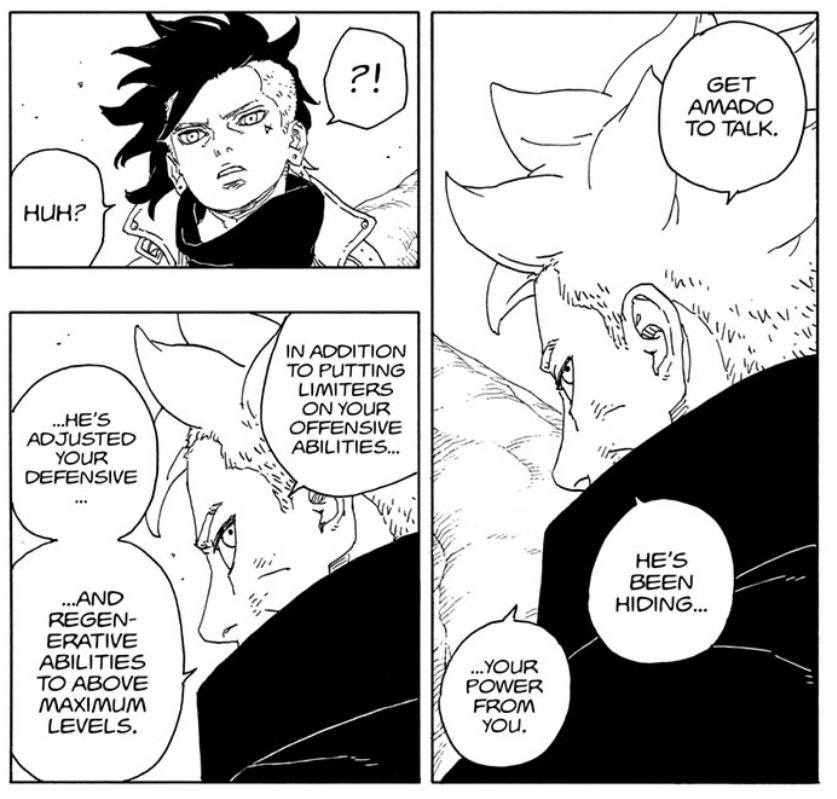
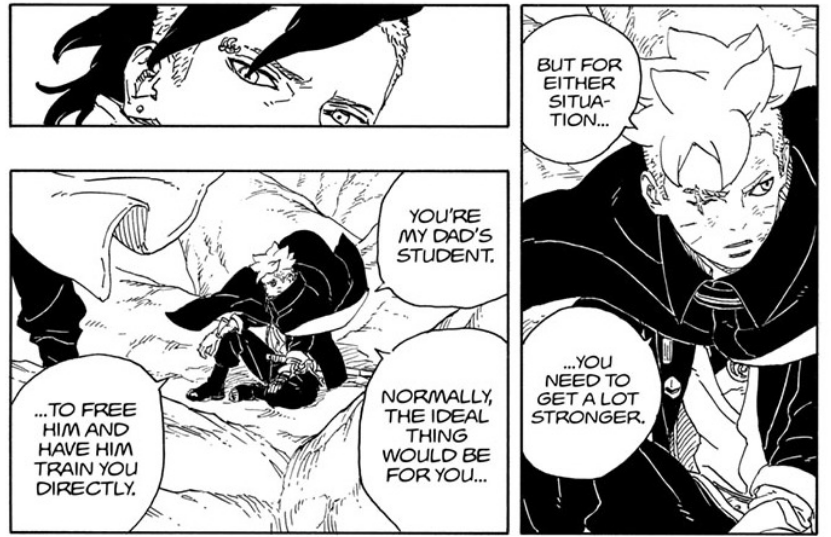
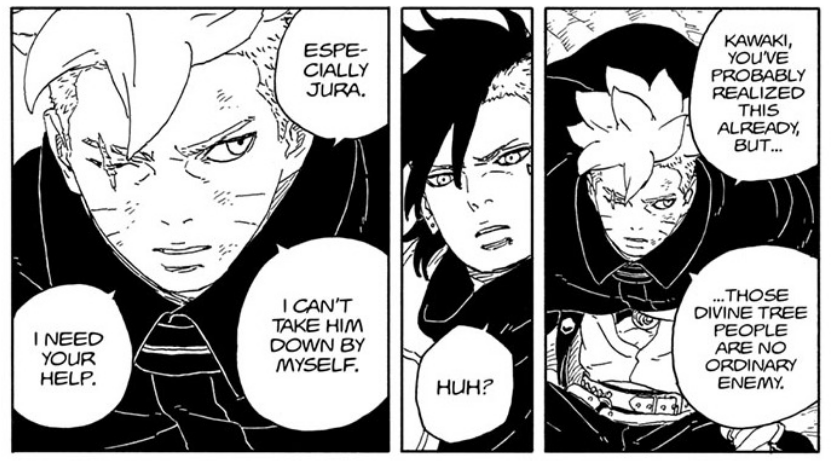
Read right to left.
The emergence of the Shinju sets in motion fast-paced power creep as both boys try to gain the power they need to defeat their new enemies—power they're destined to unleash against one another in the future.
One of the masterful features of Boruto is that once this "arms race" begins, traditional methods of training are eschewed for riskier bets, putting their own lives and the lives of the people around them at risk. When Kawaki demands that Amado, the scientist who originally modified his body, remove his limiters, Amado informs him that it's more likely he's going to die. And later, when Kawaki returns to him for power again after seeing Jura in action, Amado warns him that alterations to his body might be fatal.
While Kawaki is bargaining with Amado for power and risking his life for strength, Boruto is making a bargain of his own, approaching Momoshiki, the Otsutsuki alien who had been trying to take over his body and has spent the past three years moping over his failure to do so. In exchange to access Momoshiki's abilities, Boruto makes a deal that after they kill the Shinju, he'll turn his body over to the alien. While we believe that Boruto is playing some 4D chess with Momo, either having a loophole to get out of their deal or foresight that Kawaki will be powerful enough to kill him and avoid planetary demise, his approach to becoming more powerful is not dissimilar to Kawaki's. Instead of earnest training arcs and natural growth, both boys are engaging in less-than-ethical behavior to attain the power they need in the face of more powerful threats.
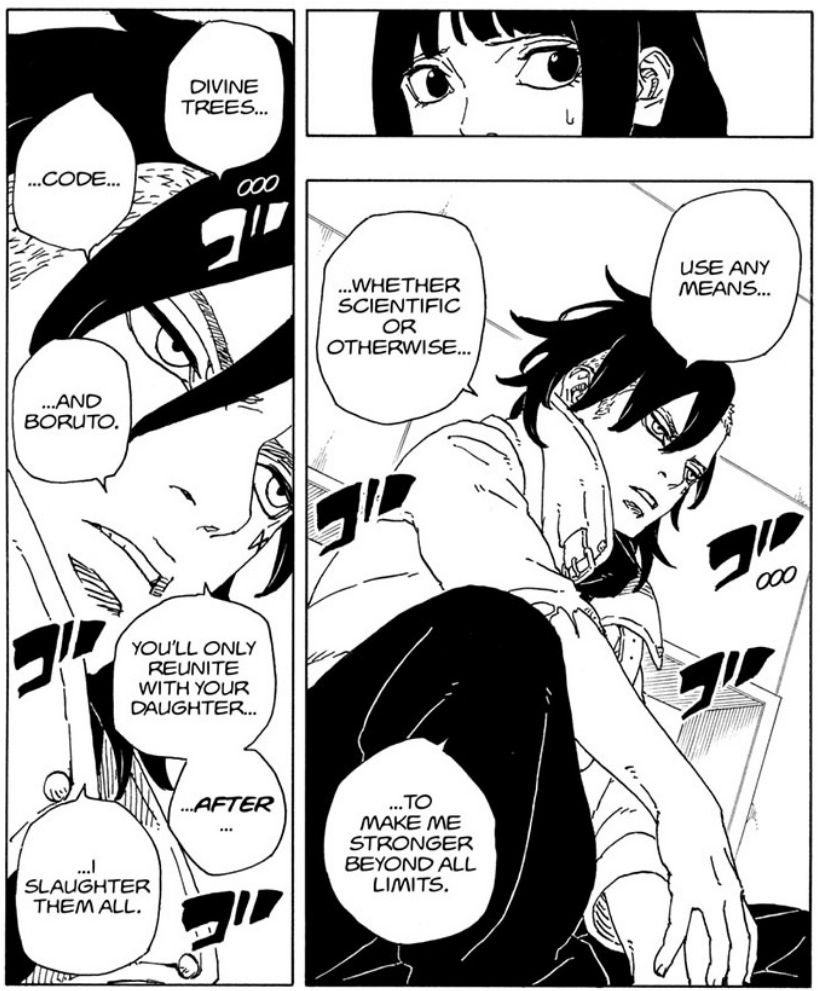
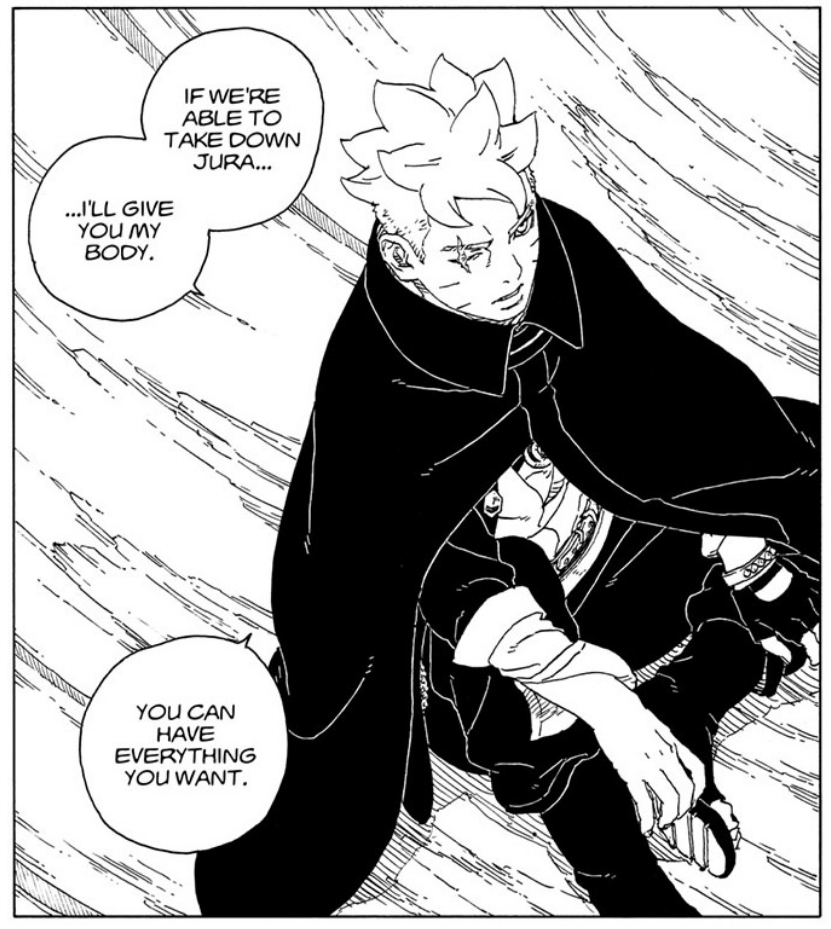
Deals with the Devil
What We're Missing
While the theme of power creep leading to planetary destruction isn't specific to Boruto, we need to look at the series in the context of other themes it's exploring to get the full picture of the way in which the story is both commenting on the past and warning us about our future.
Since Ikemoto took over writing duties with Kishimoto's approval, the story has taken a turn toward social commentary instead of relying on the theme of modernity versus tradition that filled the early chapters. The love-inducing cyborg Eida works as a stand-in for social media influencers and her all-seeing Senrigan akin to the forever-scrolling digital age. Code is coded (hehe) as an incel. Both of them, as well as Daemon and Bug, are named after features of computer programming, pulling the story out of a fictional realm and into our real world. This commentary continues with the introduction of the Shinju, newborn beings with a thirst for knowledge and identity who can only gain it through the metaphorical consumption of books and the literal consumption of people. Jura, their leader, can be read as the most explicit stand-in for AI, killing the young artist in the series, then asking "is this aesthetics?" as Inojin dies in front of him.
Once we acknowledge the ways in which story elements are functioning as contemporary metaphors, we also have to grapple with the meaning of Kawaki and Boruto's power creep in the story. Just as war went hand-in-hand with technological acceleration during World War II, we're at another inflection point in military development as ongoing conflicts are turning to technological and AI-driven solutions. The amorality of the tech industry and unpredictability of AI can be read as a kind of modern deal with the devil in a quest for strength and global dominance, one that could end in planetary destruction of not kept in check by ethical human judgment. In the same way that manga stories have undergone power creep, battles being specific to countries and locals before going global, so, too, has our own world. In an era undergoing a kind of power creep of our own, the story of Boruto and Kawaki serves to remind us that when opposing sides compete to gain power as quickly as possible, in the end, it's our own humanity and survival that's at stake.