Boruto: Two Blue Vortex Chapter 35 Review

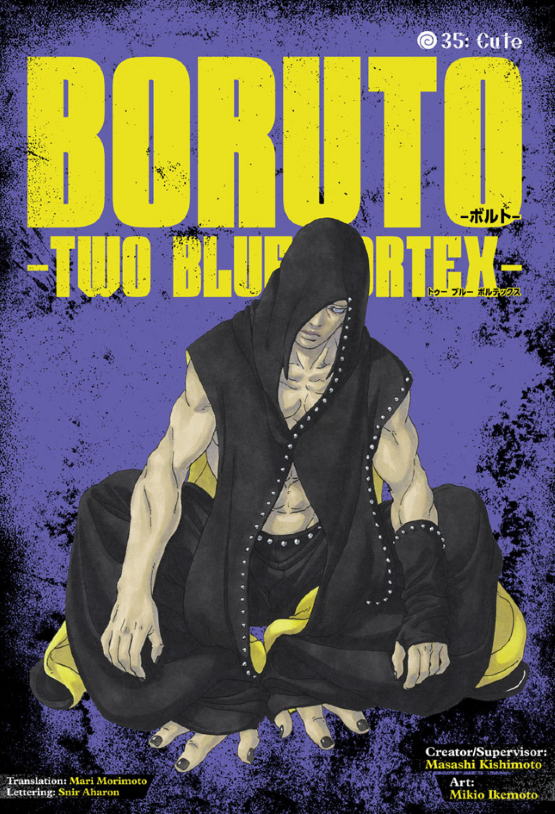
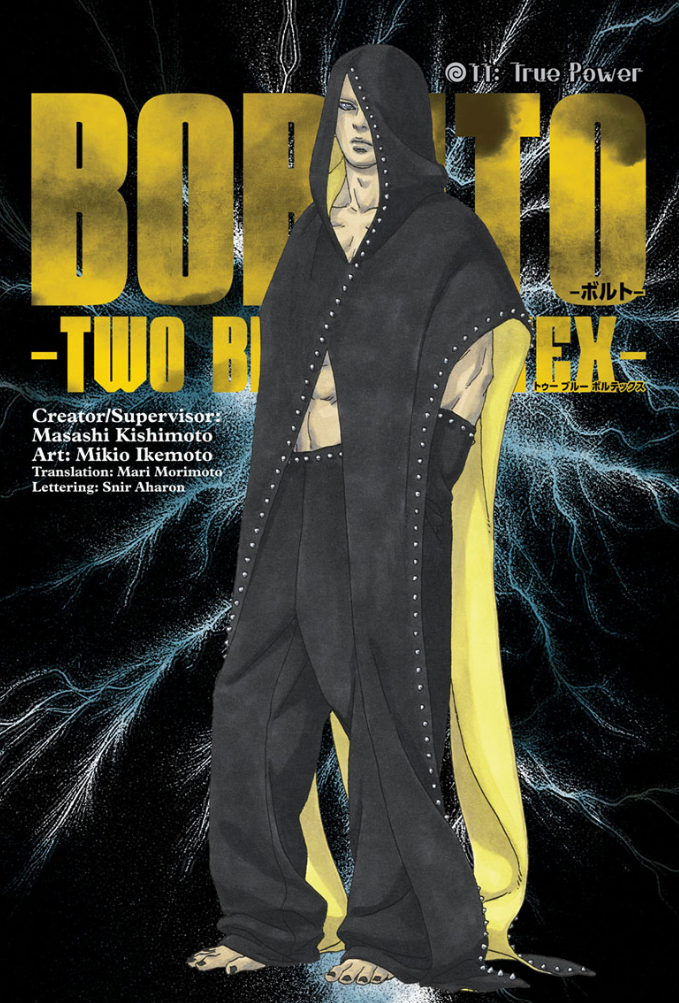
Boruto: Two Blue Vortex (TBV) opens with an amazing cover featuring the Shinju, Hidari, his monstrous appearance seemingly at odds with its title—Cute. I want to dive right into discussing this cover because there is so much there. Let's begin with a comparison between this depiction of Hidari and the one that was featured the cover for chapter 11, True Power.
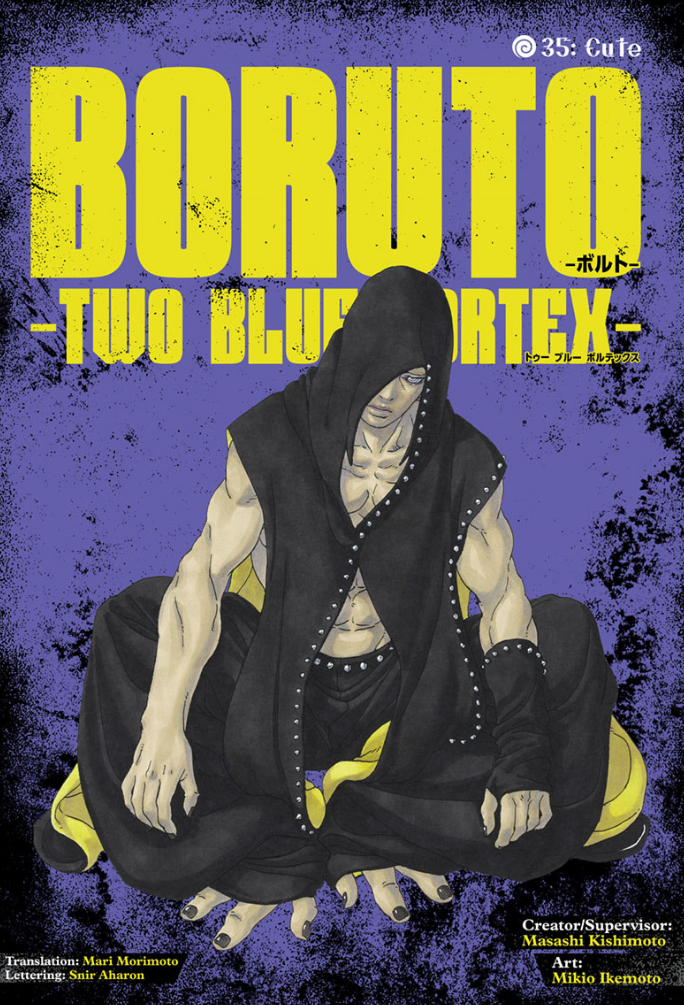
Hidari cover boys.
Hidari first appeared on the cover of TBV when he confronted Sarada in Konoha and attempted to consume her to learn more about his identity. Featured behind him on the chapter 11 cover are lightning bolts, referencing the chidori that he instinctively used, not understanding the jutsu's connection as one that was created by his sensei and passed down from Sasuke to his daughter. Instead of focusing on bonds shared by chidori's users, Hidari coveted the object that would allow him to perfect it—Sarada's eyes—assuming that mastery would lead to knowledge of self.
A different Hidari appears on the cover of chapter 35. He retains the yellow accent color of his Shinju design and its meaning: yellow is opposite on the color wheel from purple, the shade of Sasuke's chakra. However, we see that same purple begin to permeate the background, the blackness around him fading to be filled with Sasuke's aura.
The other notable difference between the two covers is his stance. Thus far, the chapter covers have largely featured characters standing (a difference from the volume covers that often feature them sitting or kneeling). Other than Himawari's first cover with Kurama and the multi-layered Mamushi cover, this is the first one we've seen in which the featured character is depicted in a more passive stance. As opposed to the first cover in which Hidari is staring directly at the viewer, on this cover, he's looking upwards. Hands out of his pockets suggests a body language that is more open, less guarded, while revealing a different eye than the last time depicts a change in perspective.
The title Cute was so unexpected, yet it embodies so much of this chapter. We'll get into it more in-depth later, but it references the acknowledgement of attachment between Hidari and Jura, Amado's perspective of his tiny toad army, the long-awaited meeting between Sarada and Boruto, and Hidari's cat fixation. If we want to reach a little further, we also have Kawaki's weaponization of his diminutive size when shrunken to accost Koji and the innocence of both characters in the face of Amado's scheming.
Desires
The chapter opens with a conversation between Jura and Hidari in the Shinju's hideout. In light of my previous interpretation that Mamushi was supposed to represent a type of base physical desire that links attraction to possession for the sake of status and generational genetic improvement, I want to take a moment to examine Jura's perspective on his character and his character's demise.
We begin with the statement "...[Mamushi] gave into his desires, and ended up burning out," a cautionary tale of the mindless pursuit of lust leading to a character's fall. However, Jura follows this up with additional commentary, reckoning with the idea that sexual desire is indeed a form of love—but "base" and "animalistic," and that love designed only to improve your genetic potential is a sign of imperfection.
After this exchange, Hidari points out that Jura didn't have the opportunity to retrieve Mamushi's Thorn Soul Bulb, but he actively chose not to do so when Ryu and Matsuri were destroyed, letting their human selves be revived instead. His question is not why he let their other comrades fall, but why he chose to rescue Hidari's own bulb from Boruto rather than letting go of him as well. Jura responds that he never considered his actions before, but reflecting now makes him realize he'd be sad if Hidari was gone. He picks up on Hidari's discomfort upon hearing this, asking for confirmation that his friend finds his attachment gross. Hidari admits that it makes him feel uncomfortable, but he's also "okay with it." Though comedic, this is a complex exchange that I want to discuss through a few different lenses.
Yaoi
At least in the English translation, there are strong flirty vibes throughout this scene, hitting conventional romantic beats. We have a confession from Jura: Hidari's absence would make him sad, admitting that he has an emotional attachment to his fellow Shinju. Hidari's glare and his feelings of discomfort occurring simultaneously with his acceptance of attachment are giving big tsundere energy, while Jura's phrasing of "Don't disappear on me, you hear?" seems like it could have been ripped straight out of a romance novel. With Hidari's admission that he doesn't mind Jura liking him, we have a panel in which the oft-used descriptor "his eyes softened" is depicted, Jura responding with an intrigued "Really?"
On the next page, we find out that Eida has been watching this exchange and we, as readers, have been viewing what she has been viewing with her Senrigan. Her response is "What the? Are they seriously..." Without outright saying it, she's inferring that they're possibly flirting.
I want to throw a secondary reading of this scene out there that parallels a pure romantic read of this scene. If we take Shikamaru's words as truth, the Shinju came into this world as children, as innocents, and began learning about the world around them. Jura has done so through books, those books leading to his discovery of emotions (later we'll find out that he finds books without words pointless). It could be less that Jura is developing his own emotions and more that he's parroting the emotions he's read about in books (please reference here the studies that being a reader gives you greater emotional empathy). I think what lends credence to this theory is the conversational pattern both characters fall into, especially that "Don't disappear on me, you hear?" line. That doesn't feel like a genuine expression coming from Jura, but a sentiment inserted from an outside source, a trope suddenly emerging into their lived reality.
Romantically, we can view this exchange two different ways: either Ikemoto is playing with romantic trope dynamics, intending for readers to be familiar enough to pick up on them or his characters are falling into romantic trope dynamics because they are familiar with it and have no other means of expressing their burgeoning emotions than through the literature they've consumed.
Brotherhood
If we take into account the idea that Hidari is gradually becoming more like Sasuke, his Shinju nature giving way to Sasuke's humanity the longer he exists, a secondary read that focuses on his responses rather than Jura's could be that Hidari is manifesting the attachment to a brother-like character that Sasuke felt and desires but was unable to fully manifest due to his past trauma. As Ikemoto said, the Shinju represent the interiority of their human counterparts, the things they feel inside before they develop a face to show to others. Free of Sasuke's traumatic burden and societal expectations of masculine behavior, Hidari is able to accept Jura's attachment the moment he expresses it. He retains a personality that experiences discomfort (ick) at emotional moments, but that discomfort doesn't lead him to reject Jura or his own feelings.
In this framing, the exchange isn't romantic but explores the interiority of Sasuke, his true desire for brotherhood manifesting in his Shinju's acceptance of Jura's attachment. This reframes the "Don't disappear on me, you hear?" line as referencing the way in which Sasuke ran from his friends to seek power rather than staying with them. Free from Sasuke's past, Hidari is able to freely accept his friend's attachment—though potential conflict may arise between them later if he sacrifices himself for Sarada or chooses her over Jura.
One of the fun aspects of this read still is the romantic undertones of the conversation, a metaphorical elbow-to-the-ribs to remind us of the way in which deep friendship sometimes felt akin to romantic attraction in Naruto, especially if we're supposed to read Eida's reaction as interpreting their exchange in that same light. She becomes the "reader" inferring romance onto a platonic dynamic.
It's Getting Creepy
The last potential reading I want to raise for this exchange references a previous dynamic we've seen in the series, going back to Boruto: Naruto Next Generations (NNG), that of Kawaki and Naruto. Going back to Kawaki and Jura's exchange in the Sand, we recognize them both as characters who are drawn to Naruto, Kawaki to protect him, Jura to devour him. Yet Kawaki respects the Shinju's instinct to target Lord Seventh as an individual who embodies love. Being that Jura is the Shinju version of the juvenile Ten-tails, his past and Kawaki's are not dissimilar. They are both sentient beings who were taken by Jigen as children, imprisoned, and exploited. Kawaki found love in Naruto as someone who accepted him despite his past. As a tailed beast, Jura is aware that Naruto also accepted all of the other tailed beasts inhabiting the planet as individuals rather than monsters. For both characters, Naruto is someone valued for his radical acceptance and empathy, though one has removed him from this world for his own safety while the other desires to remove him permanently by devouring him.
The interesting similarity here is the discomfort Hidari expresses with Jura's attachment paralleling when Naruto told Kawaki that his attachment was "creepy," a moment echoed later when Kawaki tells Mitsuki to "quit following me around like some sick perv." These are the two other prominent times in the series when we've seen characters express disgust at attachment (Mamushi and Eida aside). In both these cases, Kawaki and Mitsuki were ready to use lethal physical force to protect the person they're attached to, Kawaki wanting to kill Boruto and Mitsuki wanting to kill Boruto as well due to the effects of Omnipotence. What this is possibly setting up us that Jura may react very poorly when the object of his attachment is threatened, similar to Kawaki sealing away Naruto or Mitsuki incapacitating Kawaki. If Sarada and Boruto succeed in killing Hidari but not Jura, consequences could follow once he feels the pain of lost love.
Incognito Mode
Sarada emerges from an optician's office after getting her lenses adjusted. The effectiveness of her glasses is proven a moment later when a kunai lands in front of her, marked with an Uzumaki symbol, which she immediately identifies. She then looks up at a small speck in the sky, seeing Boruto far away, jerking his thumb to show she should follow him. He flies away, Sarada running after him.
The scene transitions to another street in Konoha, Inojin walking while one of Kashin Koji's scientific ninja toads hides in his collar. An ongoing theme throughout Boruto has been the balance between privacy and safety, the abilities of the watcher and the rights of the watched. Starting back in chapter 61 of NNG, Inojin talked about violations of privacy when discussing the sensory net with Kawaki.
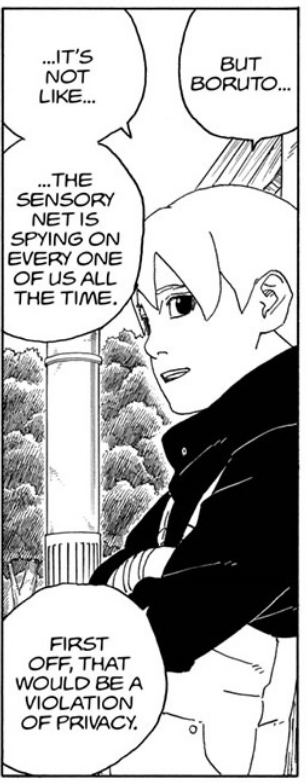
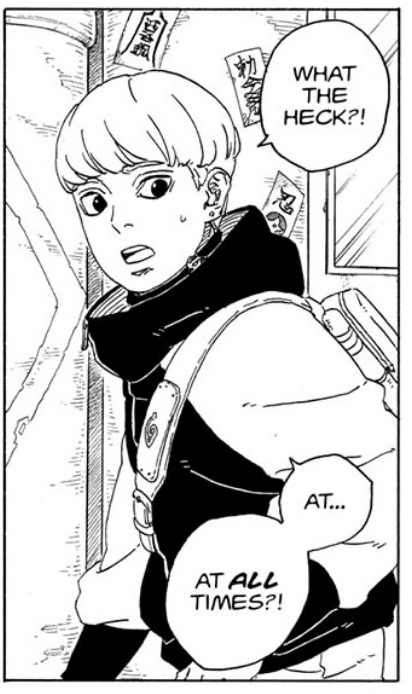
Inojin Yamanaka, privacy rights advocate
At this point, we have so many observers throughout the story: Eida watching everyone, Koji monitoring the future, Amado using Kawaki and Delta's eyes as cameras, the Hokage's office spying on Amado's lab. In this chapter, Inojin joins the ranks of the watched when Koji informs him that due to his new value to the save-the-world mission, he'll need to keep a toad on him at all times so Koji can contact him to activate the Mind Transmission or Mind Transmission Formation jutsu. Unlike Kawaki, we see Inojin grappling with this violation of privacy, naming all the intimate moments when Koji's toad will now be watching him.
Complete Control
Kawaki walks into Amado's lab to discover that it's been beset with a plague of toads. I have to admit that I had a bit of a moment when I thought about the Ten Plagues of Egypt, some of which have come to pass in TBV: water to blood with Sarada's tears, a swarm of gnats/flies/locusts in the form of Mamushi, and now the excess scientific ninja tool frogs coming from both Amado and Koji.
Amado reveals that the pale toads on every surface are essentially identical to the ones that Koji uses, but they've been modified for Amado's use, speaking with his voice, able to be shrunken by Kawaki's Sukunahikona. After this explanation, he shows Kawaki a computer display that monitors the functionality of his cyborg body, his attack (or offensive) capabilities represented with an A, his defense capabilities represented with a D. When Kawaki sees that Amado has only ramped his offensive abilities up to 85%, reserving 15% for defense, he snaps at the scientist, but Amado informs him that if he had cranked his attack rating up to 100 when he overheated, he would have died.
This exchange marks the first of two of the clearest expressions of emotion that we've seen from Kawaki since the beginning of TBV. Called out for his uselessness during the Mamushi battle, Kawaki is depicted with his eyes looking down as if guilty, no response to Amado's taunt. Amado continues with a proposal for Kawaki: he's modified the toads to remotely adjust Kawaki's attack and defense levels by thought alone. If Kawaki agrees to it, his body's functionality will be adjusted to suit the situation with Amado in control of how his power is distributed as long as he's willing to keep a toad on him at all times.
This exchange leads to the second moment of true emotion we see from Kawaki. After Amado states that that his control of the toads mimics the way a ninja can control their chakra, something that Kawaki has avoided learning by not training, we see a moment of pause and reflective sadness before Kawaki agrees with the lukewarm phrase "It's not a bad deal," after which he thanks Amado for further tinkering with his physical agency. There's just one caveat: Amado wants a favor from him before enacting their new plan.
I have so, so, so much to say about this scene and exchange.
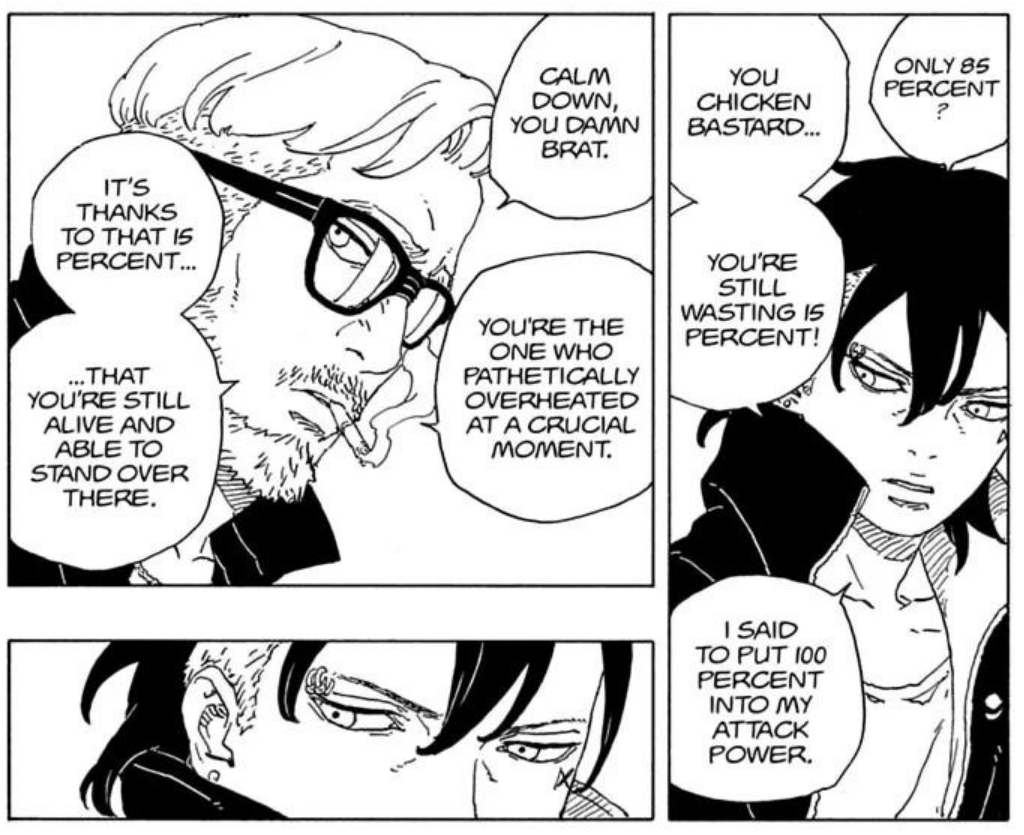
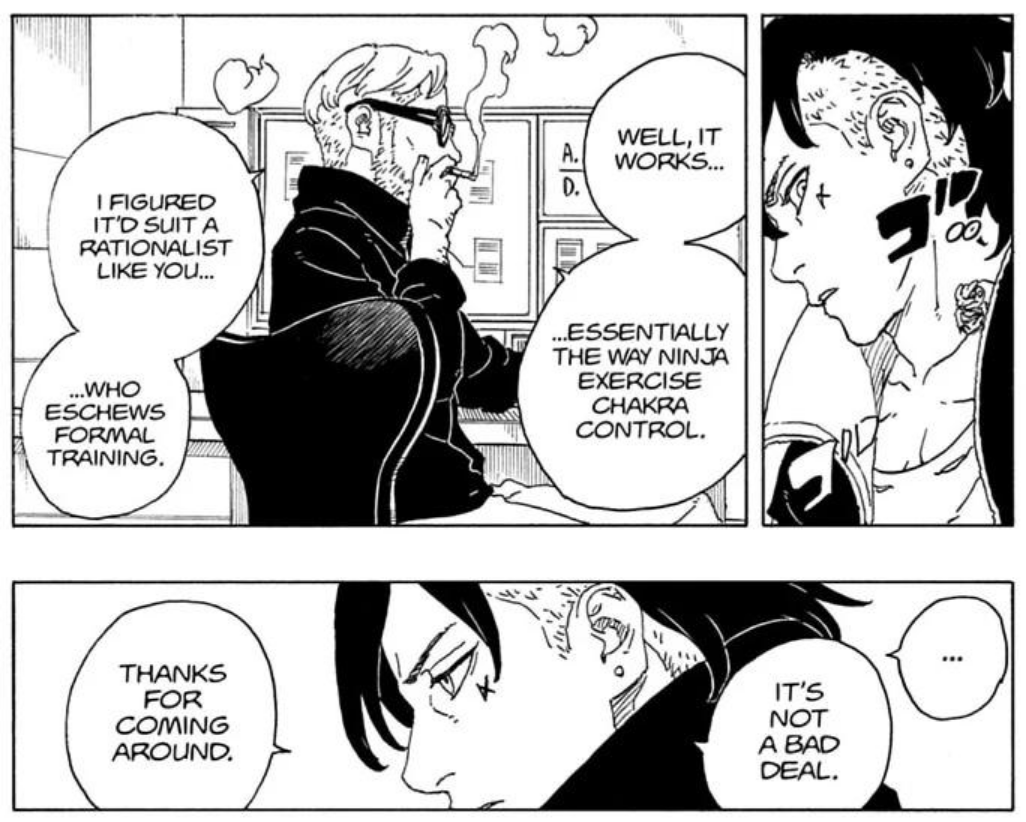
Kawaki has feelings???
Kawaki and Training
I think that it's important for us to take a holistic view of Kawaki's past with shinobi training to understand where he is at this point in the story. His first combat experiences weren't as a shinobi, but at the hands of Jigen who abused him, a brutal methodology that was also incredibly effective in terms of skilled outcomes.
When he arrives in the Uzumaki household, Naruto doesn't ask Kawaki to train initially, but he invites him to witness the father-son sparring session after which Kawaki remarks that Naruto doesn't abuse Boruto to get results. After witnessing the Delta fight and being given Naruto's prosthetic arm, which remains active due to the Hokage sharing chakra with him, Kawaki asks to be trained as a shinobi. Naruto responds by taking him on as his student. Over the course of two chapters, we watch Kawaki rebuild the shattered vase that represents himself amid a montage of training.
The first thing that disrupts his faith in the shinobi way is when Jigen arrives in the Uzumaki household, a place where Kawaki was promised safety, and abducts Lord Seventh right in front of his eyes. Though he can't do anything in the moment, Kawaki and the rest of new Team 7 manage to rescue Naruto from Boro using a combination of shinobi techniques and karma-enhanced abilities. However, even more powerful dangers to Lord Seventh and the village still remain in the world.
The next event that leads him to questioning shinobi practices is when he loses his karma as everything is about to go wrong. While he's passed out, Sasuke, Naruto, and Boruto battle Isshiki in another dimension. Still, when Kawaki is teleported to the battle ground, discovering Boruto brutalized, Naruto near-death, and Sasuke in pretty bad shape, he still can rely on the ninjutsu techniques Naruto taught him to delay Isshiki long enough that his lifespan runs out. Even when Momoshiki takes control of Boruto and destroys Sasuke's Rinnegan, it's ninjutsu that Kawaki turns to, lighting himself on fire and forcing Momoshiki to absorb the flames, awakening Boruto rather than lose his sacrifice to the Ten-tails.
The true turning point comes when Code and Momoshiki are the only two enemies that remain, both Naruto and Sasuke having lost some degree of power and no other shinobi prepared to step into the vacuum left by the death of Kurama and the destruction of the Rinnegan. The promise of teamwork failed twice over, once to protect Lord Seventh and again to stop Momoshiki from emerging. In the face of a threat more significant than Jigen, Kawaki lashes out at his new teammates when Sarada suggests they begin their training with a basic chakra control drill, wanting to jump straight into physical combat instead.
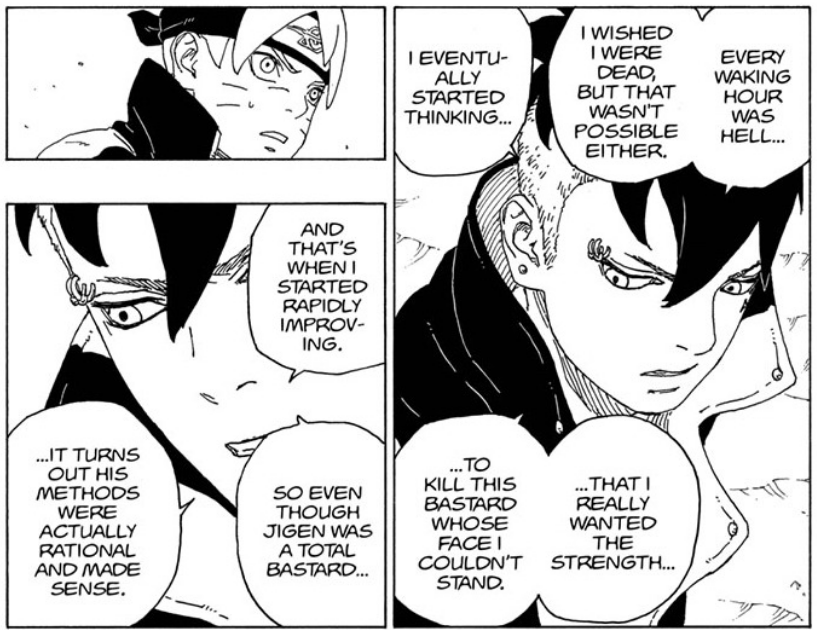
In the passage above, we see that his opposition isn't to training but to stillness, a drive to improve rapidly fueled by urgency rather than a slower, longer process. This is what leads to the clash between Kawaki and Sarada, where Boruto steps in to champion shinobi ideals. However, during their match, Boruto uses his Karma to absorb Kawaki's scientific ninja tool blast. Kawaki attempts to do likewise against Boruto's lightning style, forgetting that he no longer has the mark he hated, and is defeated.
Even in the face of this, Kawaki agrees to try their shinobi methods a little while longer, despite Amado's taunts about desiring his karma's return, which leads to Boruto giving him his original headband. Late at night, Kawaki clutches it and decides to sacrifice himself to Code for the sake of Lord Seventh and the village, an offer that Code ultimately rejects due to his alliance with Eida. Only when his brother once again gets taken over by Momoshiki, turning a super massive Rasengan against his own father, does Kawaki fully embrace karma as a means of power, rejecting both the shinobi training he requested and the bonds he made through it.
Through this journey, we see that shinobi training was truly valuable to Kawaki. Much the same way Boruto and Sarada seem to reminisce about their lives right before Omnipotence changed everything, Kawaki finds himself reflecting on the path to becoming the kind of person that Amado describes as "a rationalist who eschews formal training." That's not who he always was, and a part of him wishes this isn't the person that he ended up becoming.
The Heritage of Toads
We also have to pause here to discuss the legacy of toads in the Naruto universe. Jiraiya, the Toad Sage, was Naruto's master who passed down his summoning techniques to two of his students, both Naruto and Naruto's father before him, Minato. In this way, toads are both a pedagogical legacy and a familial legacy for Naruto.
In the Boruto manga (not so in the Boruto anime), we see animal summoning not in its original form, but as a scientific ninja replication of ninjutsu techniques through the character of Kashin Koji, a modified clone of Jiraiya. Masters don't have the opportunity to pass summoning contracts down to their students (or it's something that has yet to be revealed). Mitsuki's affinity for snakes also seems to be an extension of his genetic relation to Orochimaru rather than something he worked in tandem with a teacher to learn.
What's significant about Kawaki receiving a toad in this way and for this purpose is that it's a hollow mirror of Naruto's training arc after Jiraiya's death when he needed more power to take on Pain, the man who killed his Master. Traveling to Mount Myōboku with the same wise toad who taught Jiraiya, Naruto went through a complete training arc to gain mastery of his power, controlling his energy as opposed to Kawaki, who is abdicating control of his body to Amado.
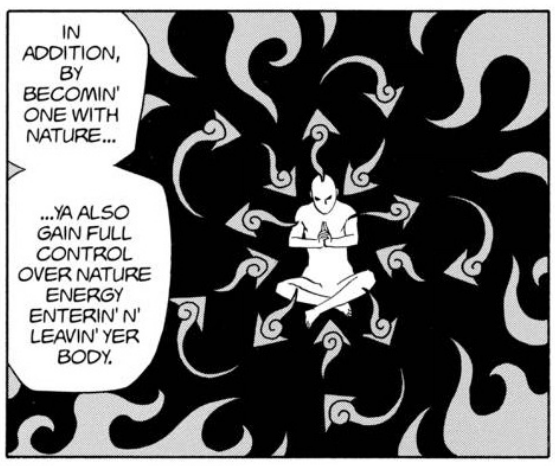
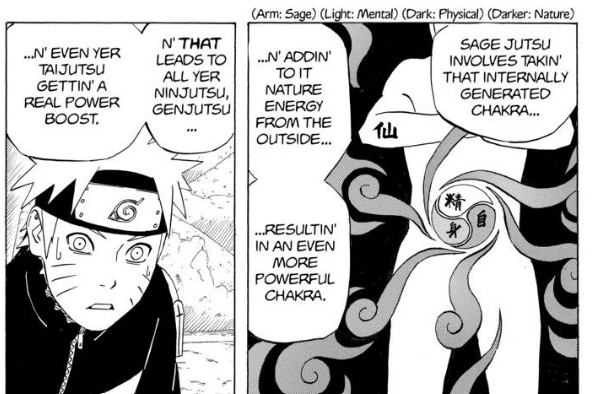
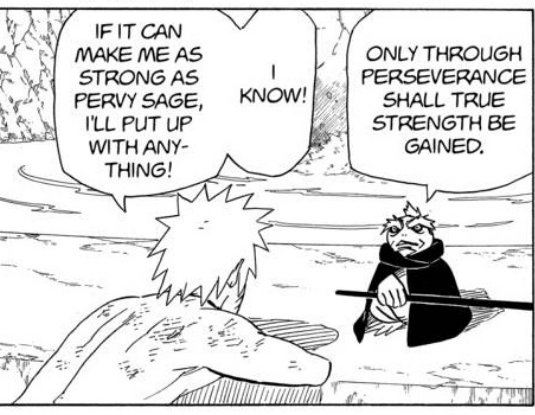
The key to mastering Sage Technique was stillness, the exact thing that Kawaki has been unable to stand since chapter 58 of NNG. However, what we learn when we review Naruto's training arc is that conventional techniques didn't work for him, either. But with the background of all his previous training leading up to that point, he was able to devise another means of building up nature energy while in combat that didn't involve having a toad attached to his shoulder at all times.
I think it's also important to note that while Naruto was training at Mount Myōboku, he frequently expressed frustration with the training process and asked for shortcuts and hacks to speed it up. At times, these pathways were provided to him (such as the oil that allows him to sense the nature energy around him), though all shortcuts come at a cost. Though Naruto's solution to utilize shadow clones to gain nature energy came about because of his previous experience when training, that's a technique only available to him with his extreme chakra reserves, which are still significant even after Kurama's loss as he's able to keep two clones back in Konoha to gather nature energy when he goes to retrieve Kawaki during the Code arc.
The training arc in Naruto and this chapter in Boruto parallel one another in other ways as well. It's directly after Sasuke awakens his Mangekyo Sharingan, then learns of its cost in battle against Killer B, that Naruto masters Sage Technique. It's also in the absence of his Master that Naruto needs to find out how to gain more power on his own, however he can rely on Jiraiya's bonds with the toads to support him. Alone and without Naruto, Kawaki is subject to manipulation by Amado to achieve the same ends.
Amado Continues to be Suss
Herein, we reach a point where I'm going to engage in some speculation, and you're coming along for the ride.
During their conversation in this chapter, Amado reveals that he can remotely control scientific ninja tools with his mind and speak through them using his voice. So, it's time for us to take a trip down memory lane, back into the chapters of NNG, and explore an old theory that's gaining new relevance.
Back in NNG, there were multiple panels in which it appeared as though Amado was talking to himself or seeing things that only he could see. With recent revelations, I think it might have been reasonable to assume that Amado could always see through Kawaki's modified eyes and was witnessing events as they occurred, but this chapter has validated another possibility.
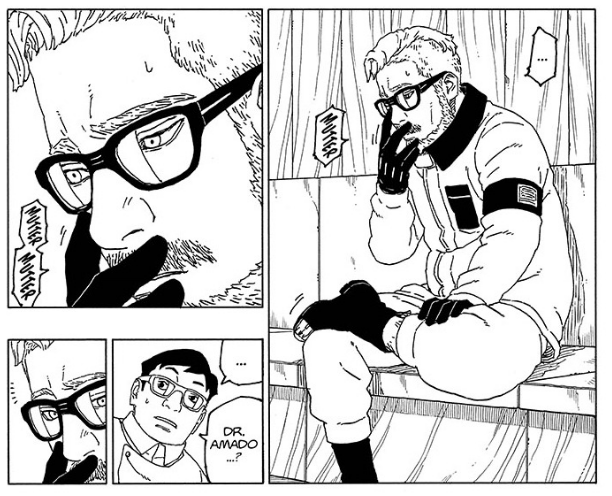
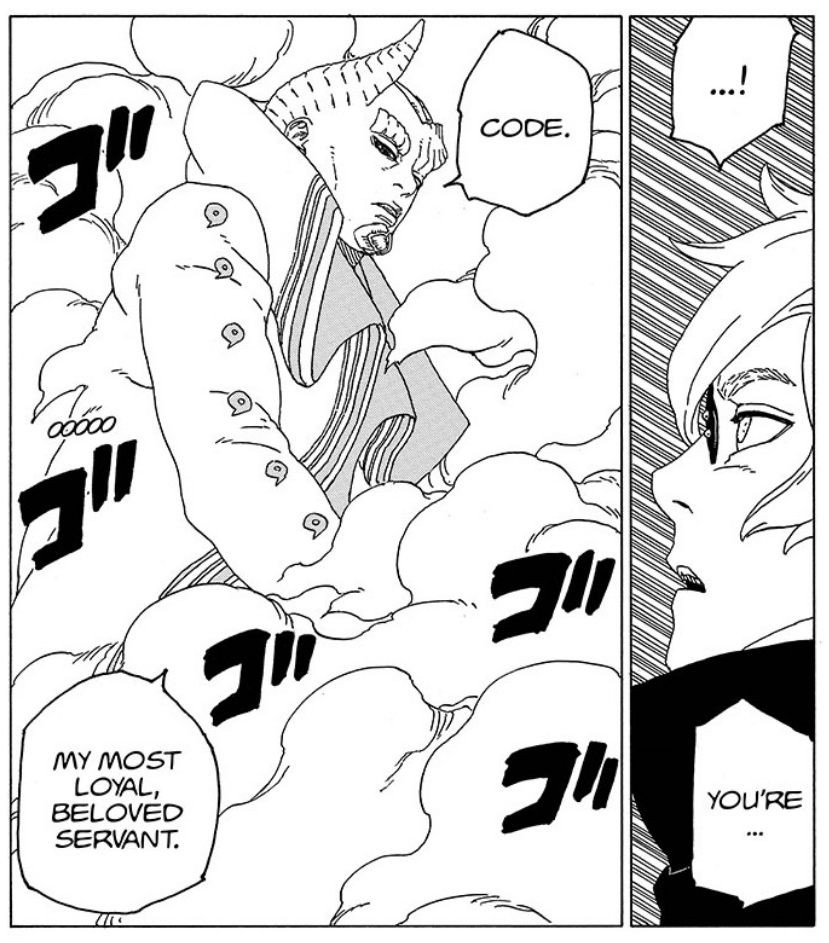
In the underground bunker, Amado was talking into his glove after Isshiki's death, right before it was revealed that everyone returned home from the battle alive. There wasn't much for him to be seeing during this lull between the resolution of Momoshiki's emergence and Naruto, Sasuke, Boruto, and Kawaki appearing on the roof of Hokage Tower. The only other significant thing that occurred simultaneously was the appearance of Isshiki's spirit to Code.
Now that we have confirmation that Amado can remotely trigger scientific ninja tools with his mind and can speak through them as well, it's very possible that Isshiki's manifestation in front of Code was engineered by Amado, a projection he inserted into the white Karma. The "god" speaking to his most loyal servant from beyond the grave could really be Amado, giving Code his marching orders to grow the ten-tails and consume the resulting fruit, knowing that knowledge of Isshiki's death would also drive him to target those who killed him, setting off the chain of events that led to Kawaki reclaiming his Karma—which was needed for his daughter's revival.
Are we cooking with gas here?
Long-awaited Conversations
Sarada catches up with Boruto in what we're to assume is Senju Park, where he's waiting for her arrival on the roots of a massive tree. The visualization here is stark: inside his head, Momoshiki waits to take over his body on the stump of the destroyed God Tree, a desolate landscape of destruction and hopeless. In Konoha, the real world, he and Sarada meet one another at the base of a massive tree with a place in the village's history. It's leaves are alive and thriving unlike the tree that contains Sasuke or the stump where Momoshiki waits. This meeting with Sarada is a moment of hope grounded in the tangible world, thriving and growing despite the horrors around them. It stands as a testament to time, a representation of the endurance of Konoha's residents no matter what conflicts the world has thrown at them, the hope to keep going on and growing no matter what happens—a fitting setting for this conversation.
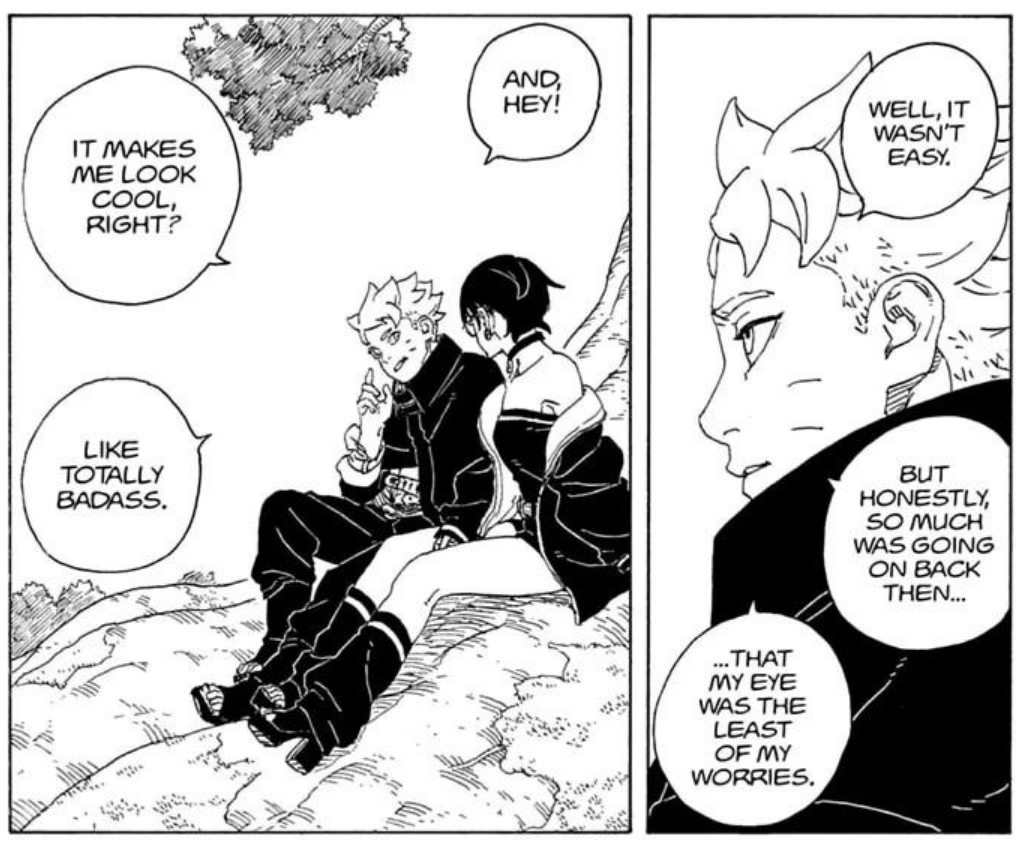
Boruto begins by stating that he was afraid their conversation would get interrupted if he tried to talk to her in the village, then follows up by expressing relief that her eyesight appears okay at the moment. Sarada responds that the Mangekyo-induced damage she sustained during the Mamushi fight is nothing compared to the eye he lost when he protected her from Kawaki three years prior. Boruto dismisses her concern, noting that everything else that was going on was a bit more pressing than a lost eye (Omnipotence, fleeing the village, everyone trying to kill him, Momoshiki).
From this interaction, we get our first peek at the Boruto of old, only seen in TBV in his flashback with Sasuke. He smiles! He jokes! But, unlike Sasuke, Sarada actually thinks he's funny. He's still more subdued than his twelve-year-old self, but it's clear he wants to put others at ease with his humor while also using it to ask hard questions—how is my training going? Do you still like me with only one eye? It's touching to see this side of him still exists and that there is someone in the world with whom he feels comfortable being genuine.
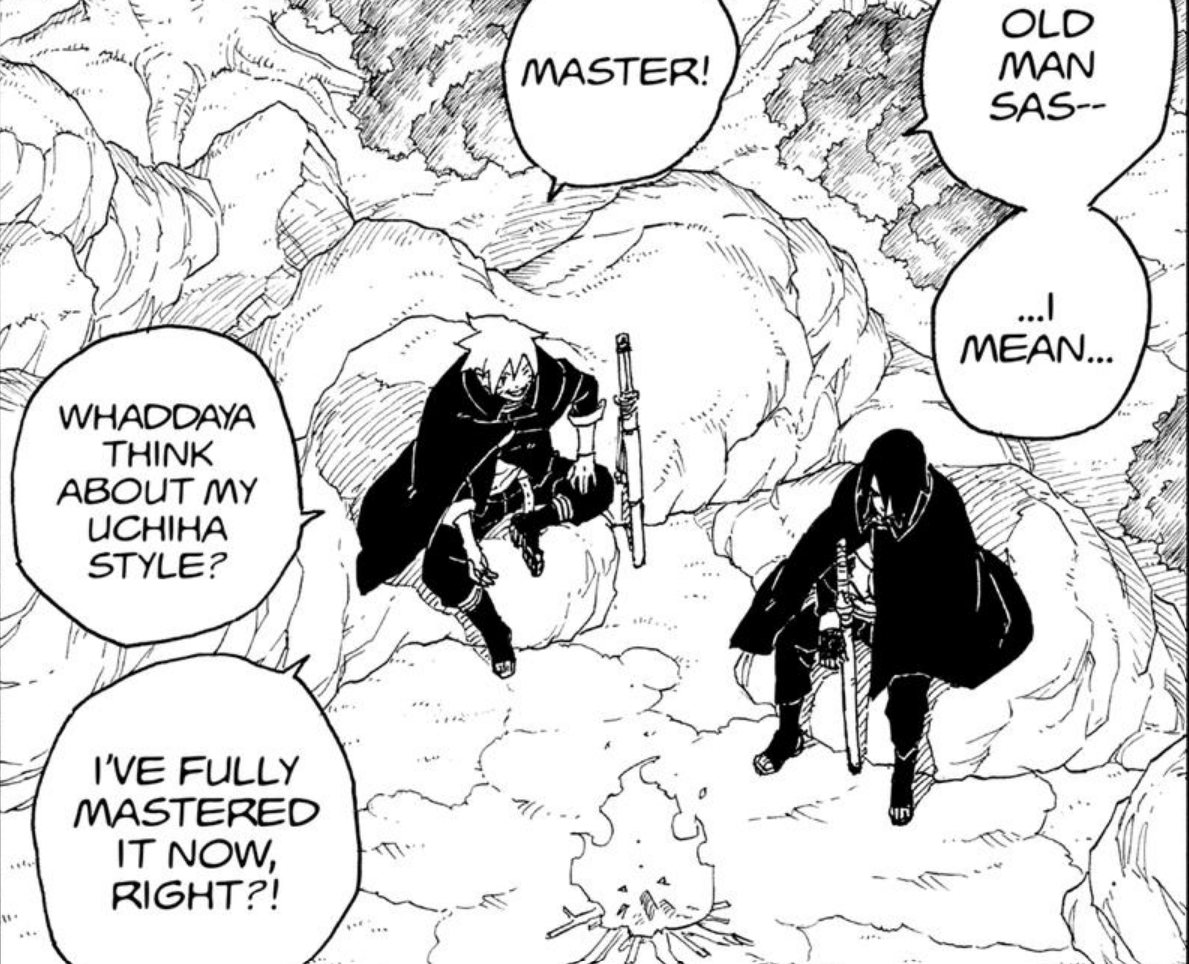
The boy is joking, and my heart is in pieces!!!!
The above panel on the far right is worth examining. With where Sarada is seated beside him, we're seeing him from her perspective, the missing eye not in view, the damage of the past three years out of sight. She's seeing the Boruto she knew before everything happened, his sincere face, soft profile. If I can reach a bit, I think that panel is representative of how she sees him, someone who is still who he has always been, not grappling with the weight of who he is in the present. It's simultaneously heart-warming and harrowing.
The Code Plan
We learn that during the Mamushi invasion, while Eida was unable to use her Senrigan, Code took the opportunity to use the swarm's widespread presence in the village to riddle Konoha with claw marks once more as part of his plan to kidnap Sarada. Boruto notes that Kawaki does have the ability to shrink them, but it'd take him and the entire police force to even begin to find them all. This is also the reason why he chose a remote location for their meeting rather than somewhere in the village. After giving her two of his pins, Boruto reveals that he has a plan—to let Code capture Sarada, take her to the Shinju's hideout, and then for Boruto to teleport to her location via the pins.
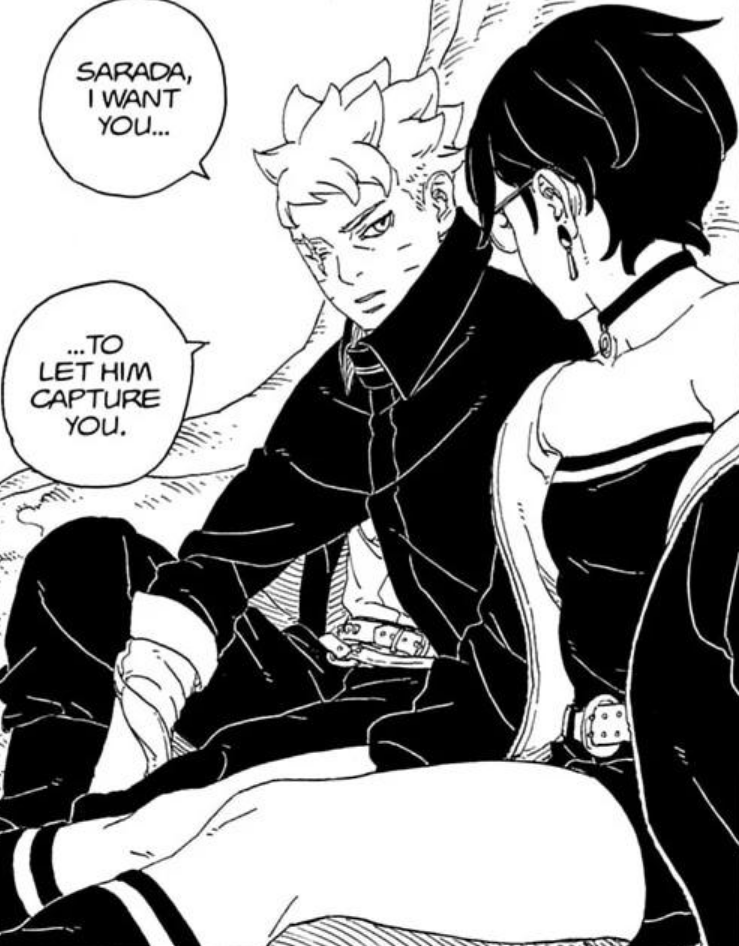
I want to take a moment to reflect on the panel above, the emotional whiplash of seeing Boruto going from his smiley old self to an expression closer to the one he wore when Inojin was in Koji's hideout. Yes, this is a serious moment and a serious topic, underlined by what he tells her next, but the emotional transition he undergoes is almost the exact opposite of Kawaki's. When being called out for being a rationalist, Kawaki's stone-faced demeanor fades, however when offering a rational plan that could end in disaster, that same stone-face appears on Boruto.
I want to talk about the specifics of this plan for a moment. On Bluesky, I joked that Boruto was using the same plan as Shikamaru did with Eida, tempting the enemy with their goal. Upon further reflection, I've realized that this is the strategy they've used with every Shinju. Konohamaru was supposed to use Matsuri's crush on him to separate her from Ryu, allowing both of them to be killed. With Mamushi, Shikamaru used a honeypot scheme to lure his swarm to her location. Now, Boruto is using Code's plan to abduct Sarada against him, allowing Boruto to target the Shinju's hideout directly.
One thing I'm curious about is why he gives her two pins rather than one. A speculative part of me wonders if it's just more precise for her to have two for him to lock on to, a stronger chakra signal for him to latch on to. But even if that is the case, I wonder about the potential for problems this might cause. He's betting on Code taking Sarada directly to the Shinju, but what if he doesn't and this leads to her dropping pins in two separate locations?
The other factor I want to address is how he's going to know when Sarada has been kidnapped (especially with Koji indisposed later in this chapter). Koji was in direct communication with Eida through the use of scientific ninja toads, but in his absence, Boruto might have to go to her directly (or ask Inojin to be a connection between the two of them). This brings up the possibility of that other long-awaited conversation between the two of them.
Never Give Up Hope
I've noted before that there are no purely peaceful moments for Boruto and Sarada in TBV. As has happened so many times before, this scene ends on a sad note. Sarada notices a pensive look on his face when he doesn't answer a question she'd asked. He finally responds with, "I'm hoping we're successful, of course. But it's a risky plan. Unforeseen circumstances are possible. Just, Sarada, never, ever give up hope. No matter what happens."
We'll explore what Boruto may be thinking about in a moment, but the framing of this statement automatically assumes that Sarada will be the one to survive. He's not suggesting she's in mortal peril and should prepare accordingly. Rather, he's setting her up for something terrible to occur in front of her. So, what's that terrible thing?
When it comes to this plan, extreme success can be as devastating as extreme failure. Extreme failure would mean Sasuke's death, obtaining his Thorn Soul Bulb but being unable to revive him. However, extreme success would mean eliminating both Jura and Hidari, which would result in Momoshiki taking over Boruto's body as the parameters of their agreement have been met. That would likely trigger a showdown between Borushiki and Kawaki, brother killing brother yet again.
I also think there's a middle ground for something terrible to seem to happen. We now know Boruto has access to all Momoshiki's powers. In order to defeat the Shinju, he's going to need to tap into every ability he can access, which might make it appear that Momoshiki has taken over. While he doesn't want to explicitly state what a last resort might look like, he's preparing her for what could happen. It's also possible that Momoshiki could take over for a short period of time until Boruto wrestles control back from him.
It's also likely that Boruto has some other contingency plan to handle Momoshiki if his body is taken over, some life-ending measure to prevent something so evil from returning to the world. And again, in the event of his death, he's asking Sarada not to give up hope for the future.
Cute
We return to the Shinju hideout, that dastardly place of wrongness and evil that Boruto is planning to infiltrate, to discover Hidari looking at a book of nothing but cat pictures. When Jura looks at the book, he says there's nothing to think about as it has no text, just cat pictures, to which Hidari responds, "Don't you find them... cute?" which Jura appears unable to understand.
To discern the meaning of this exchange, we have to understand the psychology behind our response to cuteness. Humans are hardwired to have a positive emotional response to things with cute features—large heads, big eyes, smaller bodies. We release dopamine in response to cute stimuli, and in our brains, our prefrontal cortex (the decision making part) is what responds to cute signals.
Why?
It's an evolutionary adaptation to make sure we care for our young, their appearances bonding us to them, flooding our bodies with feel-good hormones. It ensures we'll want to take care of them, feed them, cuddle them, and protect them. The fact that Hidari is experiencing this connection to cuteness through images of cats means that he's manifesting a human instinct related to the care of children, which ties into Sarada being his target. Jura, who only relates to the world through the consumption of knowledge, is unable to feel anything when faced with a picture, meaning that the experience of recognizing cuteness is unique to the other Shinju. This very likely could be setting the stage for Hidari to be unable to devour Sarada, his instinct to protect overwhelming his instinct to consume.
Mad Scientist
Inojin is minding his own business in Konoha when Amado accosts him on the street, an unusual occurrence for a man who rarely leaves his lab. He gives a flash drive scroll (welcome back for the first time since the Ao arc!) to Inojin that supposedly contains the data from Mamushi's fight, insisting it be handed off directly to Koji.
Both Inojin and Koji are dubious, especially because none of Koji's visions have foreseen this turn of events. To be on the safe side, he accepts the flash drive scroll but says he won't open it until he has another glimpse of the future. As soon as he summons the toad Inojin had and the scroll drive to his location, Koji knows something is wrong because the tassel attached to it sways despite the lack of wind. Koji drops it, prepared to defend himself, only to find Kawaki behind him, hand extended with one of Amado's toads prepared with a shutdown code—cul de sac, a turn for a turnaround at the end of a road, which literally means "the bottom of the bag."
After Koji passes out, we find out that Kawaki didn't know Amado's full plan, saying in surprise, "Yeesh. You put a command code in him, too?" From this, we can infer that the favor Amado asked of him was to take the toad to Koji without revealing the reason why. Amado replies with instructions to summon Kawaki and Koji's body back to the lab.
Conclusions and Questions
I feel as though I posed a bunch of questions and possibilities throughout this review, but here are some additional thoughts.
- This chapter spiked the ball like it was nobody's business. Flipping fantastic. No notes. Praise Ikemoto for the food to keep us going until next month.
- Obviously, Koji going offline just as Sarada is being targeted by Code is an awful thing even if it (temporarily?) resolves him treating the other characters as his own personal chess pieces.
- What is Amado going to do with Koji? It is a similar situation to Kawaki in which he subdued him with his shut off code to have a conversation or does he want Koji's powers for his own machinations?
- Soooo... is Shikamaru still Hokage after the Kobu kerfuffle?
- What's the status of Mitsuki and Sumire?
- Who is going to control Kawaki's levels when Amado is sleeping? My son asked if there is coffee in the lab, but this seems like a short-term solution.
- How is Inojin going to react when his spy toad doesn't return?
- We know Koji is aware of Amado's shutdown codes. Did he plan for this possibility? What will happen?
- Is Delta ever going to get some character development?
- Is it possible for Boruto and Sarada to take out Code, Hidari, and Jura together? Just one Shinju seems like a stretch for the two of them. Will Code peace out again while Jura is out getting his bff a cat?
- Could Hidari's draw to cuteness manifest in a desire for a child of his own outside of Sarada?
- Who pays the electric bills in Koji's hideout? And where is the computer???
- Now that we're finally getting some emotion from Kawaki, what direction will his character go in? Is he going to just regret the path he's taken or change something?
- Is it me, or does it seem like a really bad idea to bring Koji to Konoha when the entire place is riddled with Code's marks and wants him dead?
- Why do we have to wait until July 20th for the next chapter????