Boruto: Naruto Next Generations Volume 5 Reread


Chapter 16 begins the Ao arc (also referred to as the Vessel arc in some sources), which spans volumes 5 and 6. Throughout Boruto: Naruto Next Generations (NNG), each arc marks personal growth for our titular character, taking him from his bratty persona at the beginning of the series to the mature shinobi that debuts in Boruto: Two Blue Vortex (TBV). At the same time, each arc marks a further progression of his Karma, from the point at which he receives it to finally being able to beat back Momoshiki's attempts to take over his psyche. Both these factors are heavily at play in the Ao arc, the last chapters before Kawaki's introduction as the story's deuteragonist.
Chapter 16: The Vessel
Chapter 16 opens with our first introduction to the Kara inners, all members present save Amado. Giving off some strong Akatsuki vibes with their matching cloaks and hidden faces communicating via genjutsu transmission (which is perhaps scientific ninja tech in this era), the Kara members have gathered to discover the loss of their vessel.
From the very start, we can see the way in which all members of the organization have dehumanized Kawaki, referring to him as it, a pronoun usually reserved for an inanimate object or an abstraction. The vessel, as they call him, is a means to an end, not a human being, despite having been brought into Kara as a small child. In some sense, he is not a person but a piece of a greater project, one larger than its constituent parts and larger than his own humanity.
Coming off the Mujina Bandits arc with its theme of excess, we soon learn that the Kara organization is also another resource-bloated entity whose excesses exceed even that of the Daimyo when Delta mentions that they spent enough money to buy a nation in pursuit of their end goals. As we can contrast the modest lifestyle of the Uzumaki family to Tento's lavish life with his father, so, too, can we contrast the immense financial enterprise that is Kara with Kawaki's early origins in a tiny village so untouched by technological developments that he can earn booze money for his father by selling firewood to their neighbors. The theme of inequity in technologically advancing society is a frequent theme in the Boruto anime, but it manifests more subtly in the manga, contrasting destitute Kawaki's childhood with the unfathomable expense to turn him into an object for the ultimate goal of global destruction.
In addition to retrieving the vessel, the conversation also addresses who should bear responsibility for its loss—a conversation largely driven by Kashin Koji. The hidden meanings within hidden meanings, a theme that's going to pop up later in this chapter, is at play here as Victor tries to deflect blame onto Amado while dodging Koji's accusations. As we know from what happens in later chapters, Koji and Amado are in league with one another to betray Jigen and the Kara organization. In this scene, Koji is manipulating events not only to eliminate Victor, but to put himself in a position of power and oversight to manipulate events surrounding Kawaki's escape and his defection to Konoha.
Despite the fact that he's actively double-crossing Kara, Koji's thought process in this scene is quite similar to his demeanor in TBV, chastising Victor for naive thinking and seeking efficient ends through violent means. It is also during this conversation that we learn that Kara was behind the use of the scientific ninja tool during the Chunin Exam, Dr. Katasuke's genjutsu-influenced behavior being a method for gaining additional combat data on it.
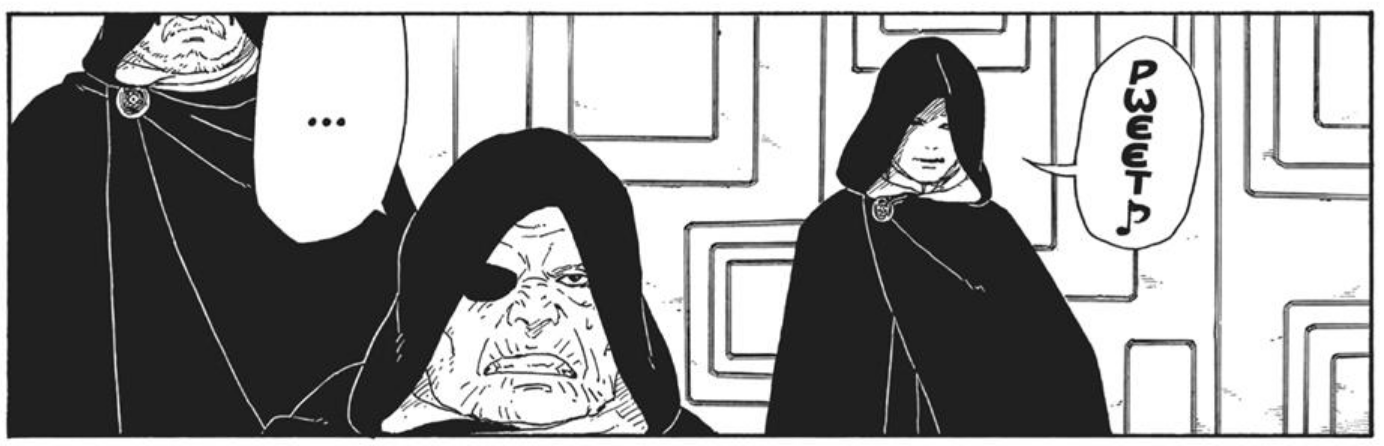
The assembled members resolve that Koji should be the one to handle the vessel's disappearance by enlisting assistance from a Kara Outer instead of Victor's involvement, leaving the old man disgruntled by the lack of respect he receives. The transmission ends. Seemingly alone in his home, Victor flops down on his futon, cursing Koji—an inopportune choice as Koji, a self-proclaimed "assassin who's not even hiding his bloodlust," stands behind him (one of those fun page-flip moments).
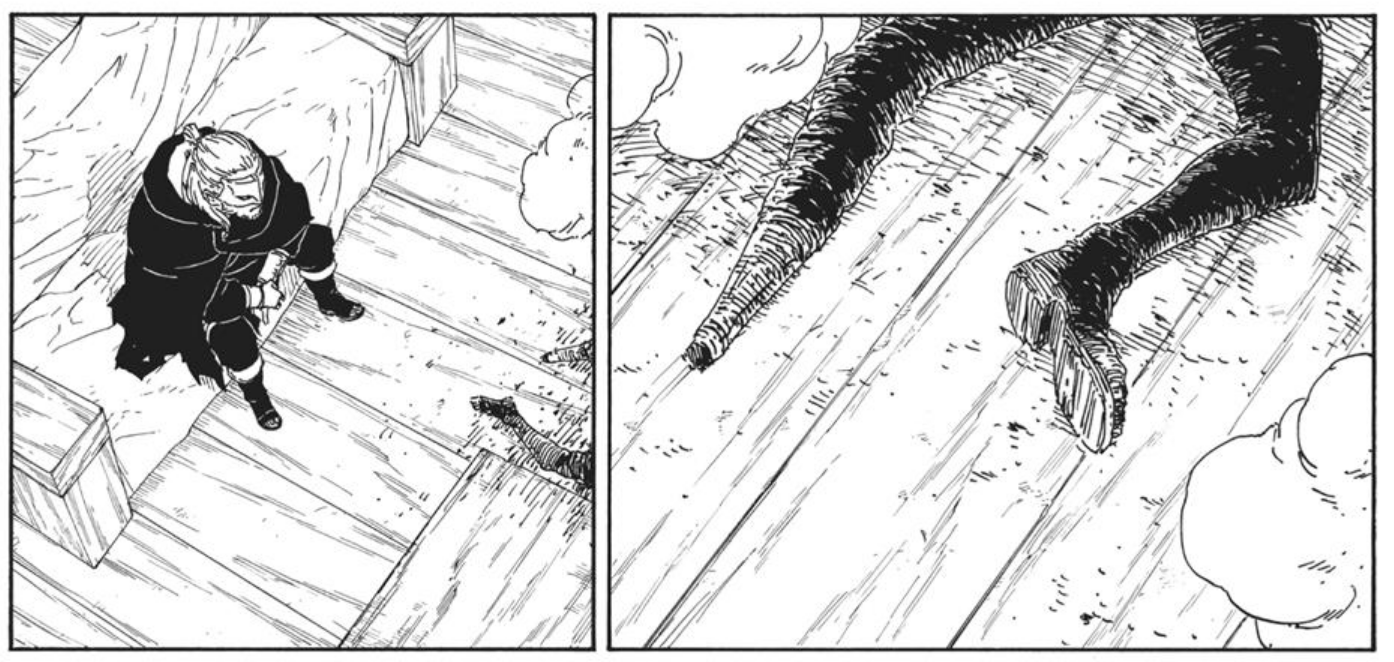
Even in the great organization of Kara, we quickly see Koji's shinobi techniques winning against Victor's scientific ninja tools, Koji's kunai moving faster than Victor is able to respond. After the first strike, Victor then reaches out to utilize a traditional jutsu (something we should remember later in this arc), but it's too late as Koji has already deployed the Trance of True Flames jutsu, burning Victor so efficiently that his regenerative abilities have no hope of saving him. After Victor's death, Koji sits down on his futon and contemplates that he seems to be linked to Konoha by fate. This early mention of the concept of fate by a character who later becomes an arbiter of the future is interesting in the context of Prescience, his later Shinjutsu ability to view branching possibilities and influence them with his actions.
The scene transitions to the ninja academy where Naruto and Boruto are about to engage in a public demonstration of sparring before his classmates and officials from Hokage Tower (including Sasuke). We're meant to contrast this sparring session with Boruto's performance in the Chunin Exam and see Naruto's growth as a father as well. To that point, we see Boruto deploying a very similar arsenal of jutsu to the ones he relied on his scientific ninja tool to produce during the first arc. This serves once again to undergird the point that Boruto was talented enough to perform well in the Chunin Exam, but his previous lack of training combined with his personal insecurity surrounding both his abilities and his father led him to cheat.
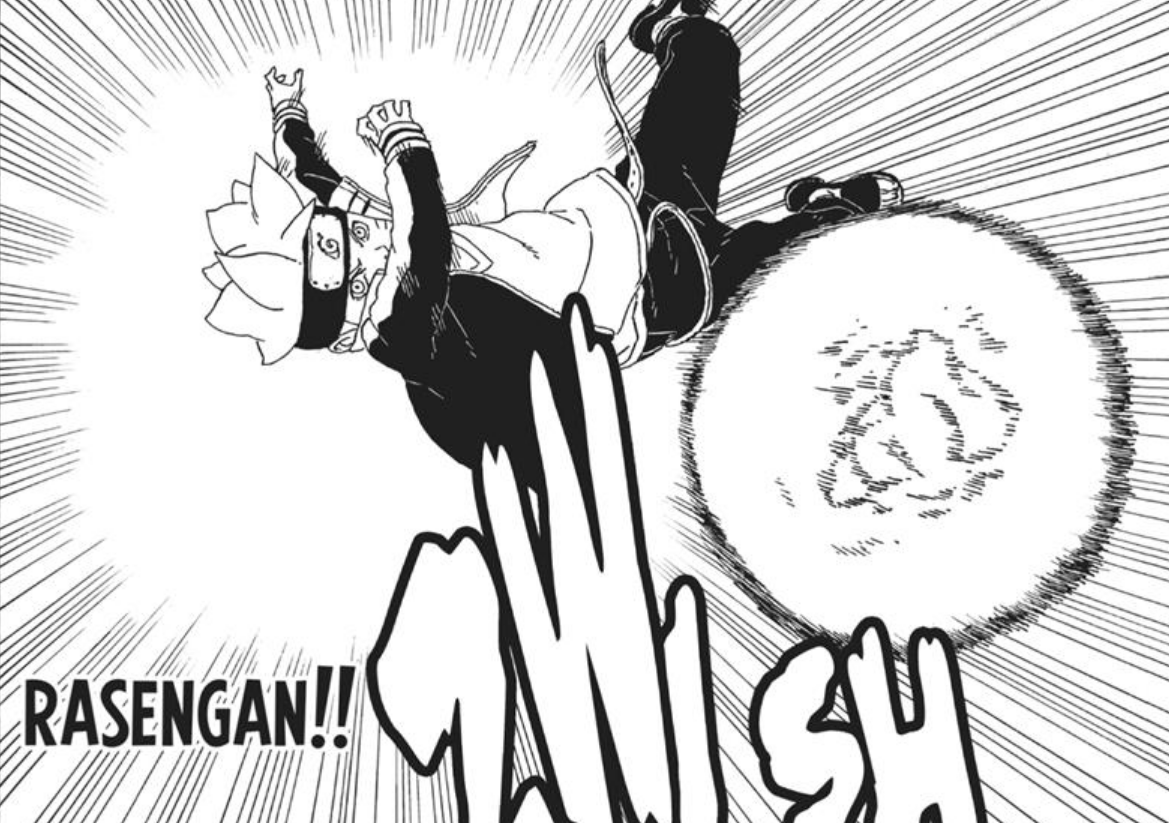
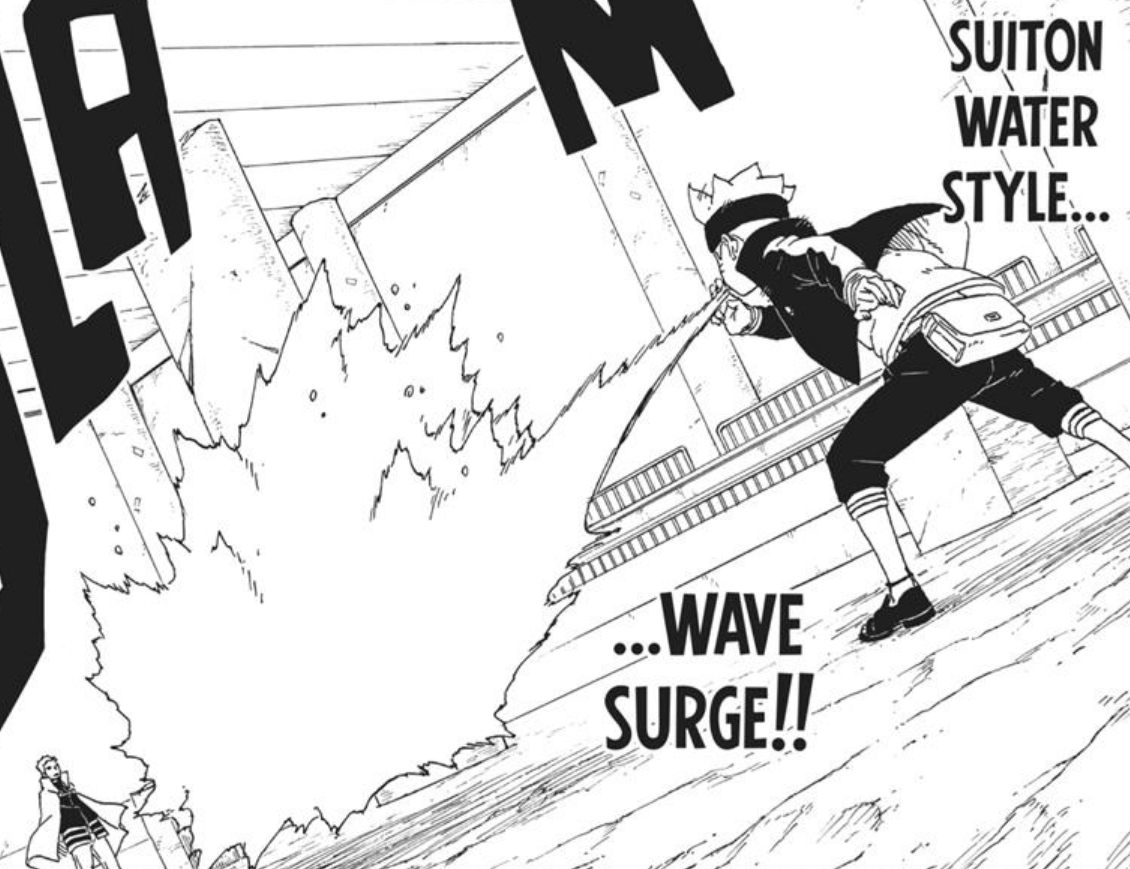
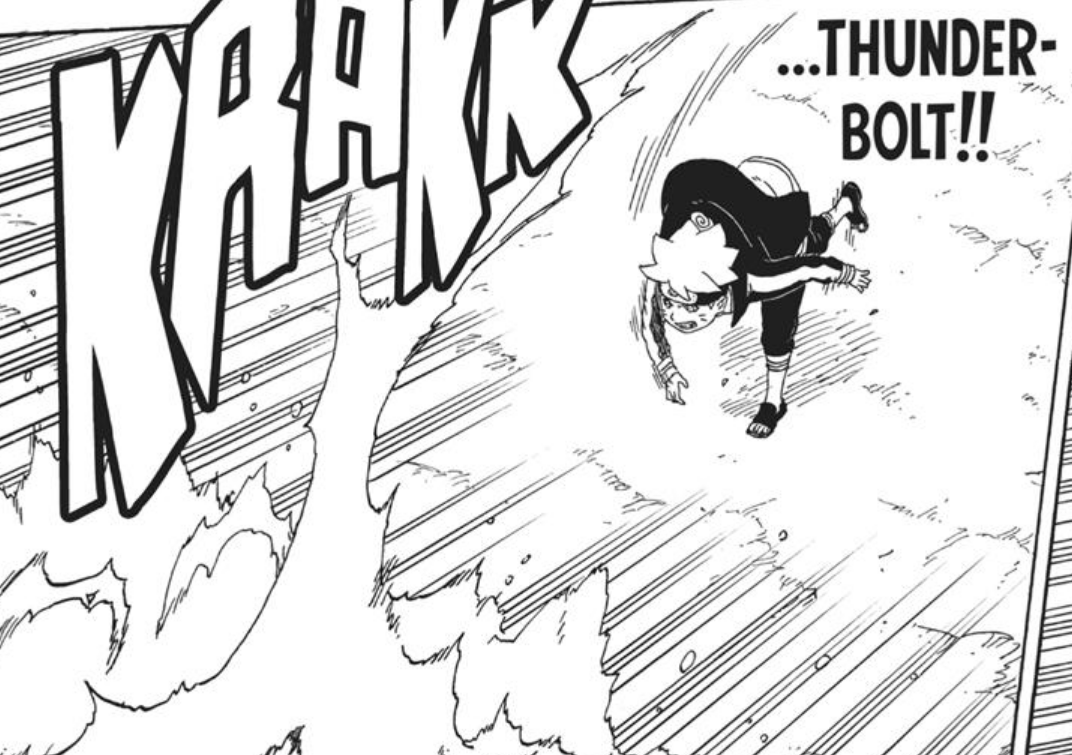
All we're missing is a curving shuriken and a few dozen shadow clones.
For Naruto's part, we finally see him acknowledging his son during their battle, not only publicly sparring with him, but also providing him with affirmations that prove he's truly paying attention: "Quite the nice Rasengan you got there," "Looks like you've been putting in the training," "A combination jutsu, eh? Nice!" "You've gotten strong, Boruto." It's a credit to the writing craft in the series that both Boruto and Naruto begin the series with flaws that they steadily overcome through subsequent arcs (also a demerit to the larger fandom that who they are at the start of the series becomes the center of so many conversations about the entirety of the series). However, this chapter in particular also shows that overcoming one's flaws takes time, that a single realization and a promise to do better does not result in immediate and complete change.
To block the onslaught of Boruto's electrified water from his combination jutsu, Naruto erects a mud wall through which he punches a hole with his prosthetic hand, absorbing his son's attack for the second time. While Boruto stares at the unmoving hand, trying to decide what his father is doing, Naruto comes up behind him, delivering the line "Ninja must read the hidden meanings within hidden meanings" before also delivering a brutal kick to his son, ending the match.
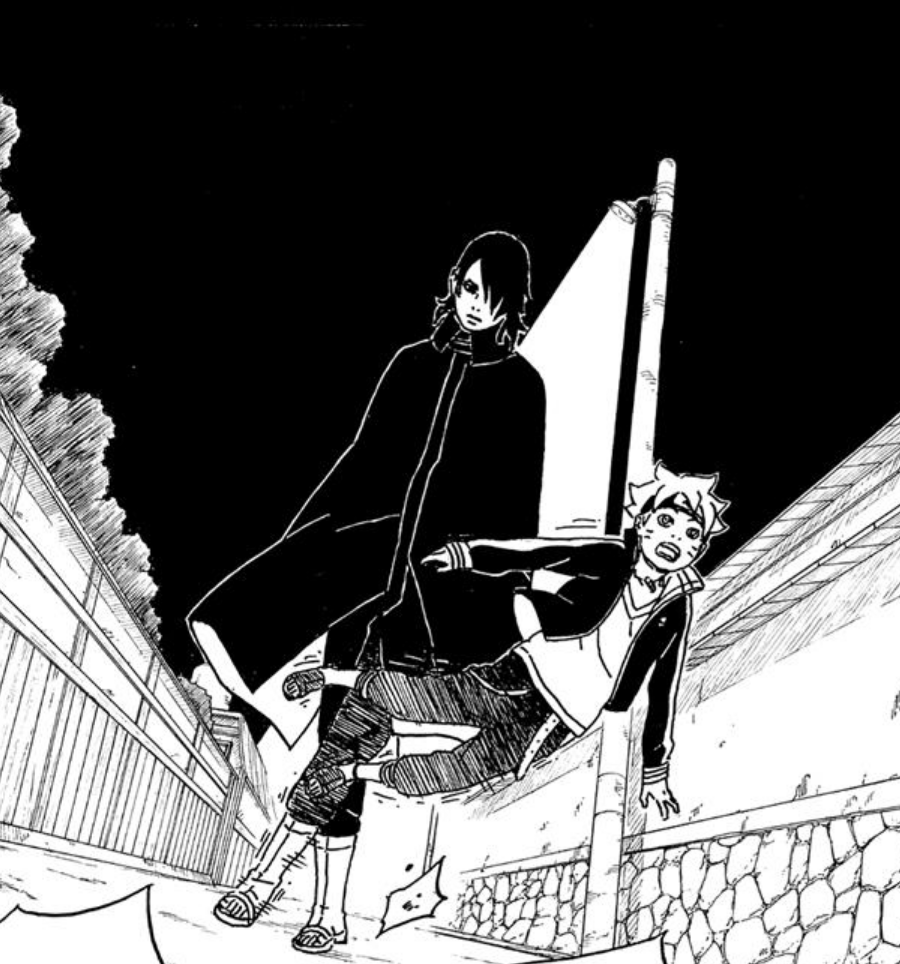
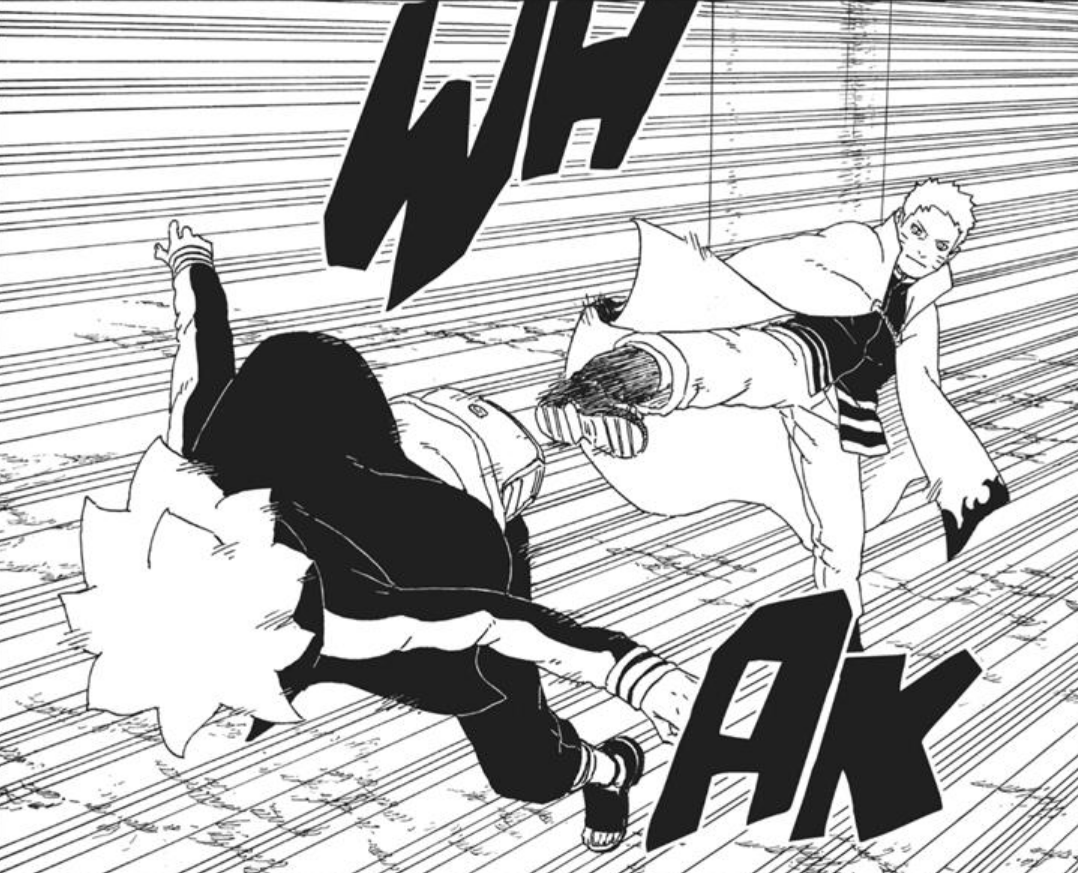
tfw you and your bestie both love playing Kick the Kid.
The goodwill from his father's acknowledgement only lasts until Team 7 is in the Hokage's Office, and Naruto reveals that he'd been using a scientific ninja tool prosthetic during their fight that is capable of absorbing jutsu. Given that his father publicly shamed him for using a scientific ninja tool in front of the entire village and foreign dignitaries, Boruto rightfully feels duped when his own father used one to defeat him in front of his peers. From the perspective of the adults in the room, the fight between father and son was supposed to allow them to test out the functionality of a scientific ninja tool prototype Dr. Katasuke modeled after Momoshiki's abilities; from Boruto's perspective, his father just used the very technology that disqualified his son from being a ninja to defeat that same son in front of all his friends.
Sasuke shows up to chastise Boruto, saying, "I thought you'd matured a bit, but the key is in how one uses it. Nobody said that the tool itself was wrong." He goes on to explain that the battle with the Otsutsuki has shown them that the era of peace they've been experiencing is merely an illusion with new threats bubbling beneath the surface.
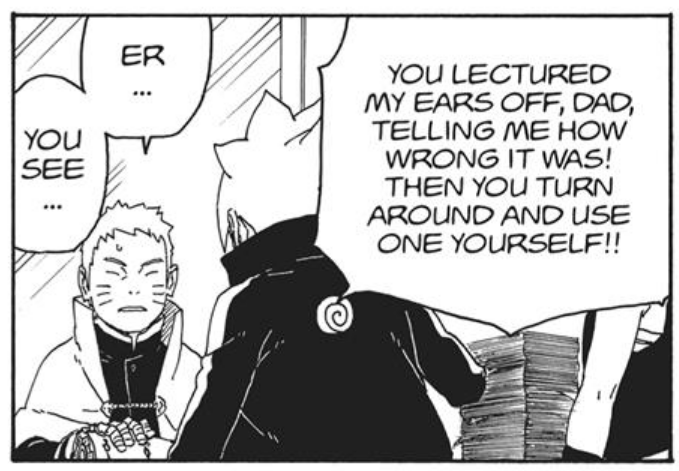
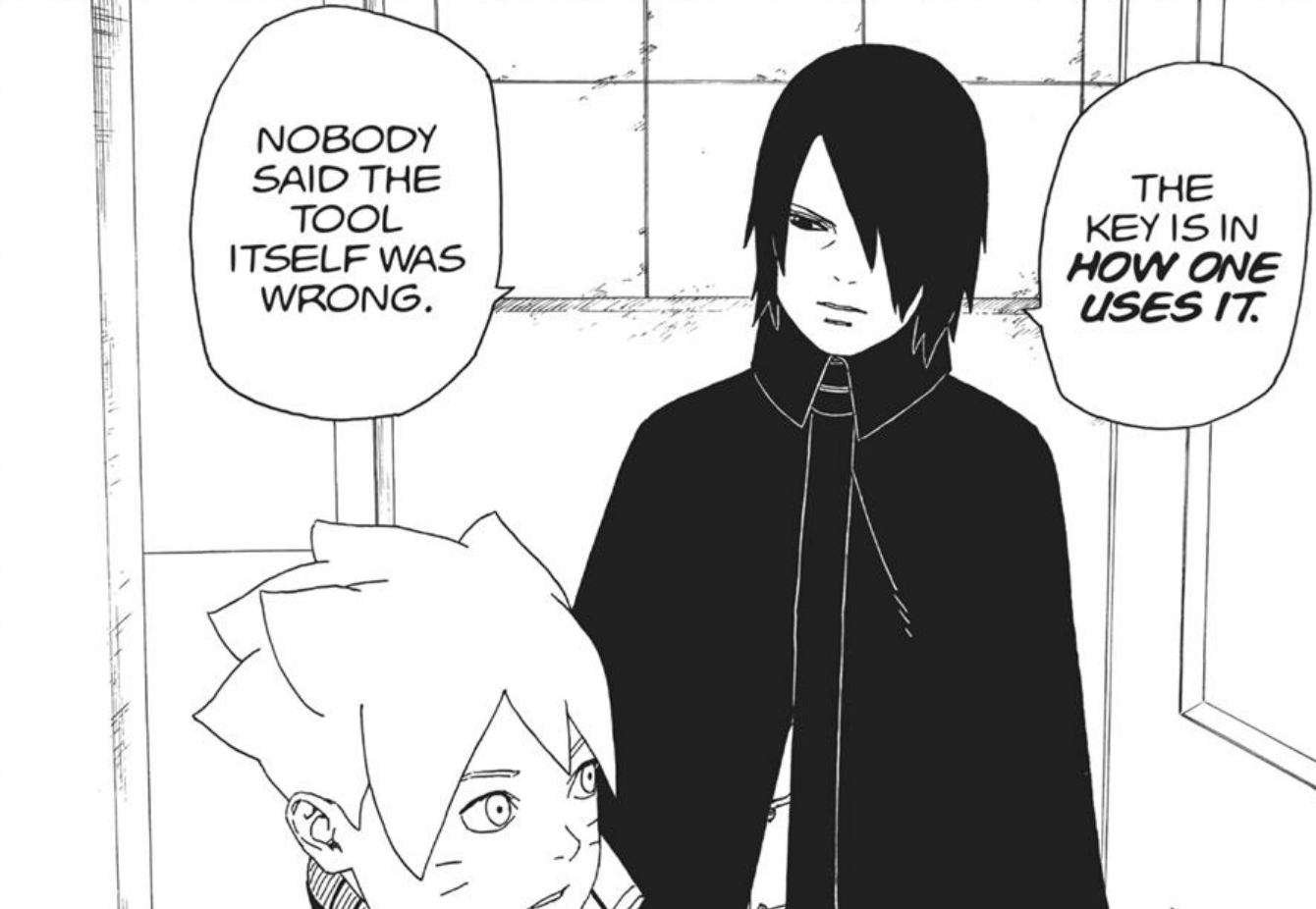
tfw you need other dad to come in and back you up.
As Sasuke's ominous words hang in the air, the scene changes to that of a crash site with a smoking airship. Konohamaru and a shinobi companion approach, their communication lines with Konoha cut off by the distance. As they enter the ship to investigate, Konohamaru discovers an empty coffin-like container inside. While they debate their next move, a menacing foot approaches their location.
Chapter 17: Ao
The beginning of chapter 17 continues at the crash site, Konohamaru investigating inside the airship while Mugino (RIP you handsome bastard in the anime) guards the door. Within the context of the greater Boruto story, I think Konohamaru is supposed to function as the quintessential jounin, attempting to function in an era of growing threats that surpass the abilities of traditional shinobi. Frequently, we see him investigating and asking questions, but despite his promises to protect his students, it's often them who protect him. (as we'll see later in this arc).
All this is to say that this scene starts out with Konohamaru exploring the airship and attempting to gather intel via a scroll-like thumb drive before Mugino is attacked while on watch. Who attacked him is a mystery to be answered in a different chapter.
We return to the Hokage's Office, Boruto's conversation about scientific ninja tools and threats to the world still in progress. Boruto dismisses the potential dangers they face, thinking Sasuke is speaking of Shojoji and other gang activity. He's promptly corrected when his master informs him that the threats in question are on the same level as the Otsutsuki, revealing what has been learned about Kara thus far.
With hindsight, one of the fascinating things about this conversation is that while Sasuke and Naruto are discussing the Otsutsuki with Kara in mind, one of the biggest future threats is standing in the same room—Momoshiki lying in wait within Boruto. Without the context of his son's body, Naruto is easily able to declare the Otsutsuki a threat, framing them in a similar light to the way in Kawaki later views them: "You saw them destroy the arena that day, didn't you? [The Otsutsuki] think absolutely nothing of injuring humans. We need power to protect everyone from those like them." In a few simple sentences, Naruto is able to other the alien threat ("those like them") and specifically say that they're a threat to humans. The indecisiveness over the danger they pose only comes later when his son is turning into one of them, Momoshiki lurking in the back of Boruto's mind, biding his time until the opportunity presents itself to take over his body.
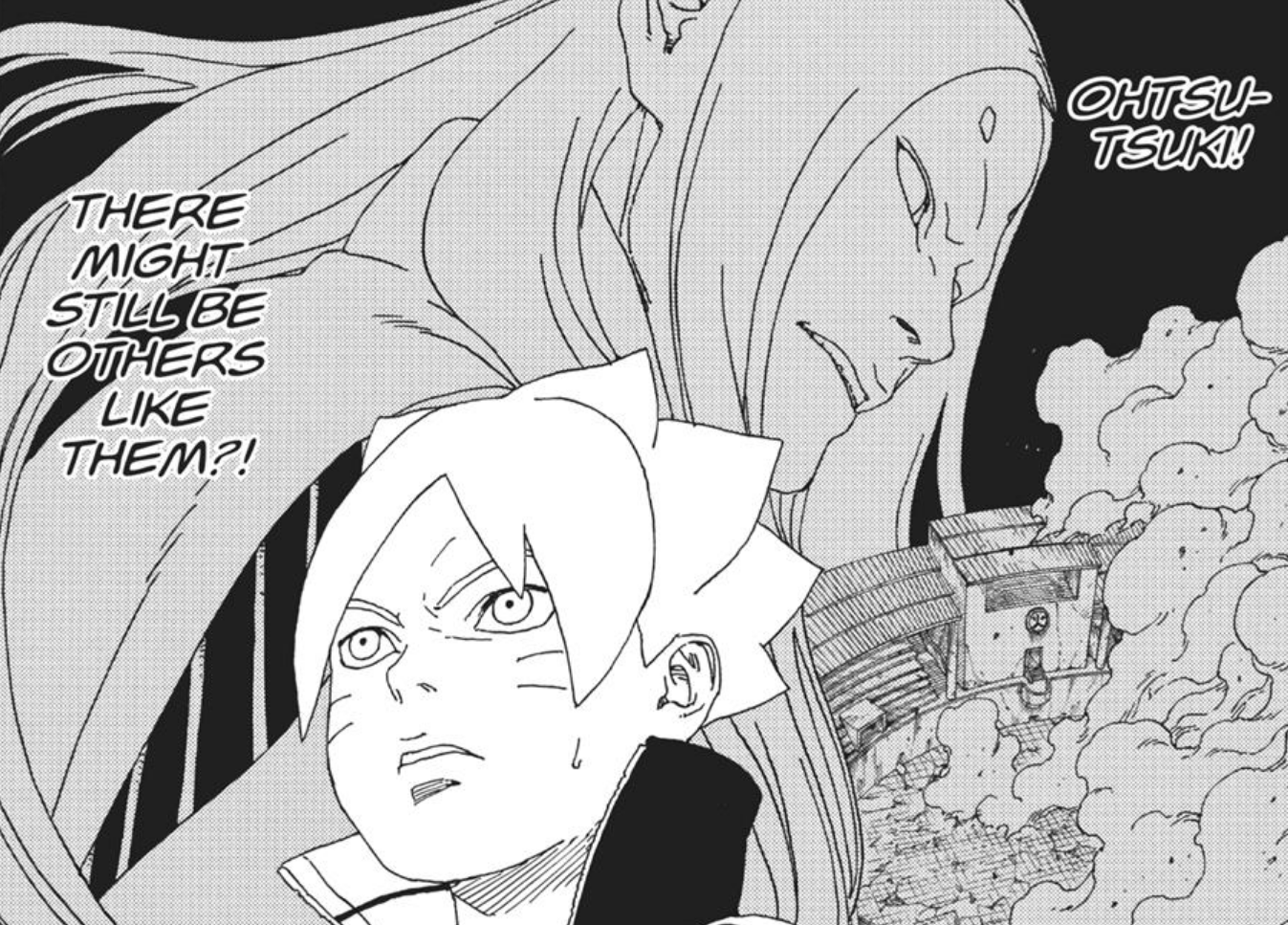
A factor we'll return to throughout this reread is the fact that Sarada is often distanced from the Otsutsuki threat inside Boruto despite her overwhelming concern for him. This pattern begins in this chapter as Mitsuki is the one who raises the issue of the mysterious mark on Boruto's palm and asks if that's what's been affecting Boruto's unusual behavior.
As Naruto and Boruto's argument over scientific ninja tools continues, we see father and son flipping roles from the first arc, Boruto arguing that it is ninjutsu, not scientific ninja tools, that will defeat upcoming threats, repeating Naruto's own words that what shinobi need are "hard work and guts." Naruto tries to explain to his son the difference between the circumstances surrounding the Chunin Exam and now when they might be necessary to defend the village from a clear and present danger.
The situation doesn't improve when Dr. Katasuke who, if we recall, is the one who manipulated Boruto into cheating, shows up and tries to explain the importance of the scientific ninja tool Naruto had been testing. When Boruto chastises him, Naruto explains that the scientist's technological acumen supports the Hokage, much in the way that Sasuke does. Being on the cutting edge of technological advancement in Konoha is a way of protecting the village, planning for a future in which threats exceed the abilities of Sasuke and Naruto... or allowing the village to take on threats if both their strongest shinobi are gone.
As I mentioned earlier, characters don't immediately shed their flaws in Boruto. Our titular character continues to lash out in bratty ways while Naruto doesn't seem to have considered his son's perspective, both when he chose him as a sparring partner to test the scientific ninja tool and when he assigns him a mission to escort said tool and Dr. Katasuki back to Ryutan City.
Boruto refuses the mission immediately, storming out of the room before his father has finished. After he leaves, Naruto tells Sarada and Mitsuki that in addition to the mission they're on, both of them are responsible for keeping an eye on Boruto's Karma mark as well. When Sarada questions whether Boruto will even go on the mission, it's Sasuke who assures them he'll do it.
Sarada and Mitsuki find Boruto pouting in Thunder Burger with a soda afterwards, reminding her of when they had to convince him to apply for the Chunin Exam (once again, replaying the events of the past arc). We see Boruto's development in action when he says that he understands his father's perspective, but his dislike of scientific ninja tools is holding him back. We also see Sarada beginning to shift, admitting she sees Boruto's side of things, but prioritizing following orders given by Lord Seventh to "live up to his expectations."
When she leaves Boruto and Mitsuki alone, Boruto sulkily tells Mitsuki to leave, too. In a masterful trap of manipulation, Mitsuki first tells Boruto that he'll only go if he does (his general policy towards everything) before pointing out that this would leave Sarada all alone on the mission. He then reminds Boruto of his promise to be Sarada's right-hand man (perhaps the last time this comes up in the manga?), asking if he truly would allow her to go on a mission alone. His final nail in the coffin of Boruto's resistance comes when he reminds Boruto that what he'd be protecting is not just a scientific ninja tool, but his father's hand (later to be Kawaki's hand), responsible for not only defending the village, but Boruto's mother and sister as well.
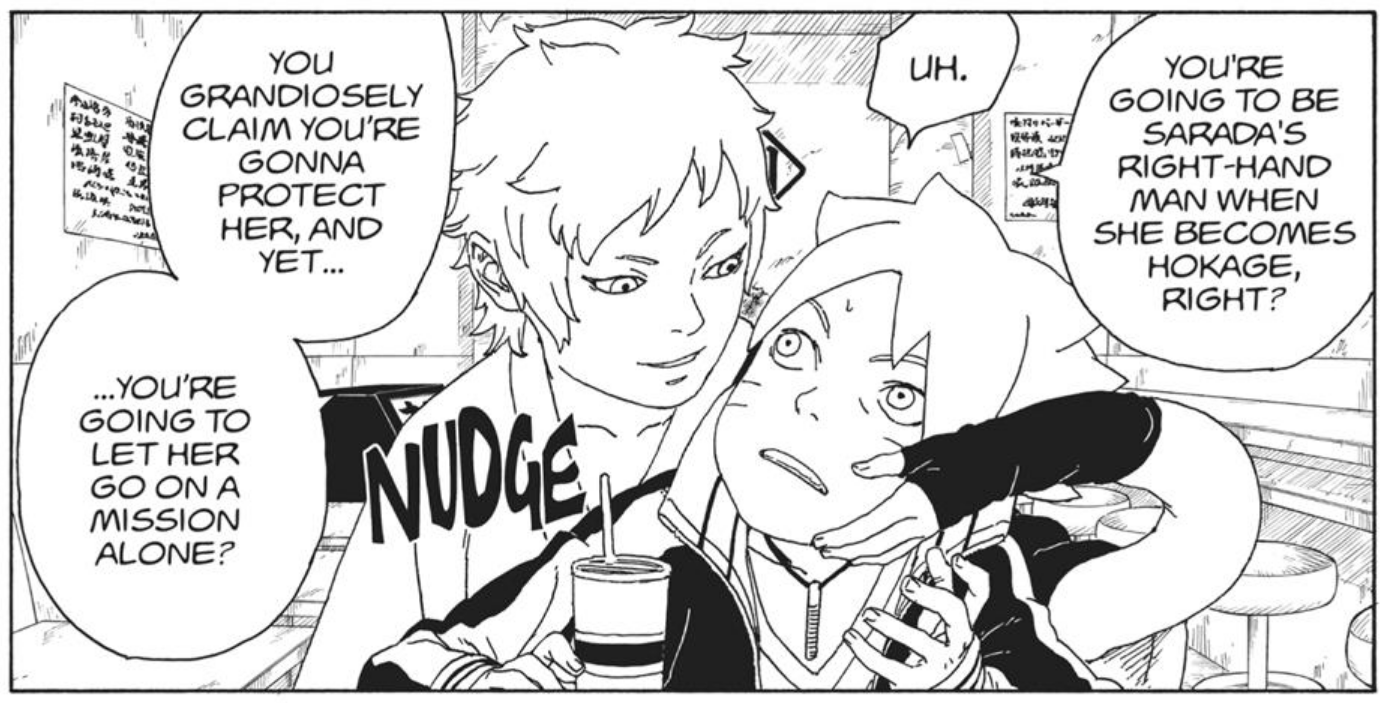
Boruto grumpily agrees to go on the mission, saying "I do have some self-awareness of being a shinobi, okay? I ain't gonna whine and just reject a mission. That's a loser move." Mitsuki informs him that Sasuke told them all he'd end up joining them.
Despite acquiescing to the mission, Boruto makes his displeasure known as they get on the train, giving Dr. Katasuke a shoulder cold enough to turn water to ice. One of the joyful parts of this chapter the banter between Sarada and Boruto, further establishing their early bickering dynamic before events soon change everything. When they eventually find empty seats on the train, new Team 7 meets Ao, an acquaintance of Dr. Katasuke.
In meeting Ao, a veteran and victim of the Fourth Great Ninja War, new Team 7 is forced to face the cost paid by the previous generation for peace. Unlike other adults in the story, Ao talks about an earlier era in the shinobi world, one in which he was already on the battlefield by the time he was their age, growing up as a child in Kirigakure back when it was known as the Blood Mist Village. Boruto is eager to interrogate him, his own (and relatively new) enthusiasm for the world of shinobi pushing both his sour mood and social niceties aside.
While Dr. Katasuke is giving Ao's prosthetic arm a tune-up, the former shinobi notices Boruto's skepticism about scientific ninja tools. Without warning, Ao grabs the screwdriver from Katasuke and aims it at Boruto's jugular vein, stopping before he impales him. "You'd be dead if you'd been my enemy," he tells Boruto, echoing sentiments similar to Sasuke and his father. "This isn't inherently good or evil. It all depends on how you use it." Perhaps Boruto should have been more alarmed by a mock attempt to murder him, but opts instead for staring down considerately at the case containing his father's prosthetic hand.
After Boruto and his team depart, a page flip reveals that Kashin Koji has been sitting in the seat behind them the entire time. Through his conversation with Ao, we learn that the former shinobi is a Kara Outer and was responsible for casting the genjutsu on Dr. Katasuke. As one of the few Outers he considers trustworthy, Koji assigns Ao the mission of retrieving the lost vessel, gifting him a crate of intel and weapons to use.
In the final panel, we see Boruto fondly remembering his conversation with Ao while the former shinobi contemplates his first combat mission in sixteen years.
Chapter 18: The Hand
New Team 7 escorts Dr. Katasuke to the Advanced Technology Laboratory. The moment they walk through the doors, it's clear the level of respect that's commanded by the scientist Boruto recently referred to as a quack. Among the staff members they encounter is Sumire. Her introduction into the manga occurs through an informational text box only used in this chapter for both Sumire and Inuzuka Akita.
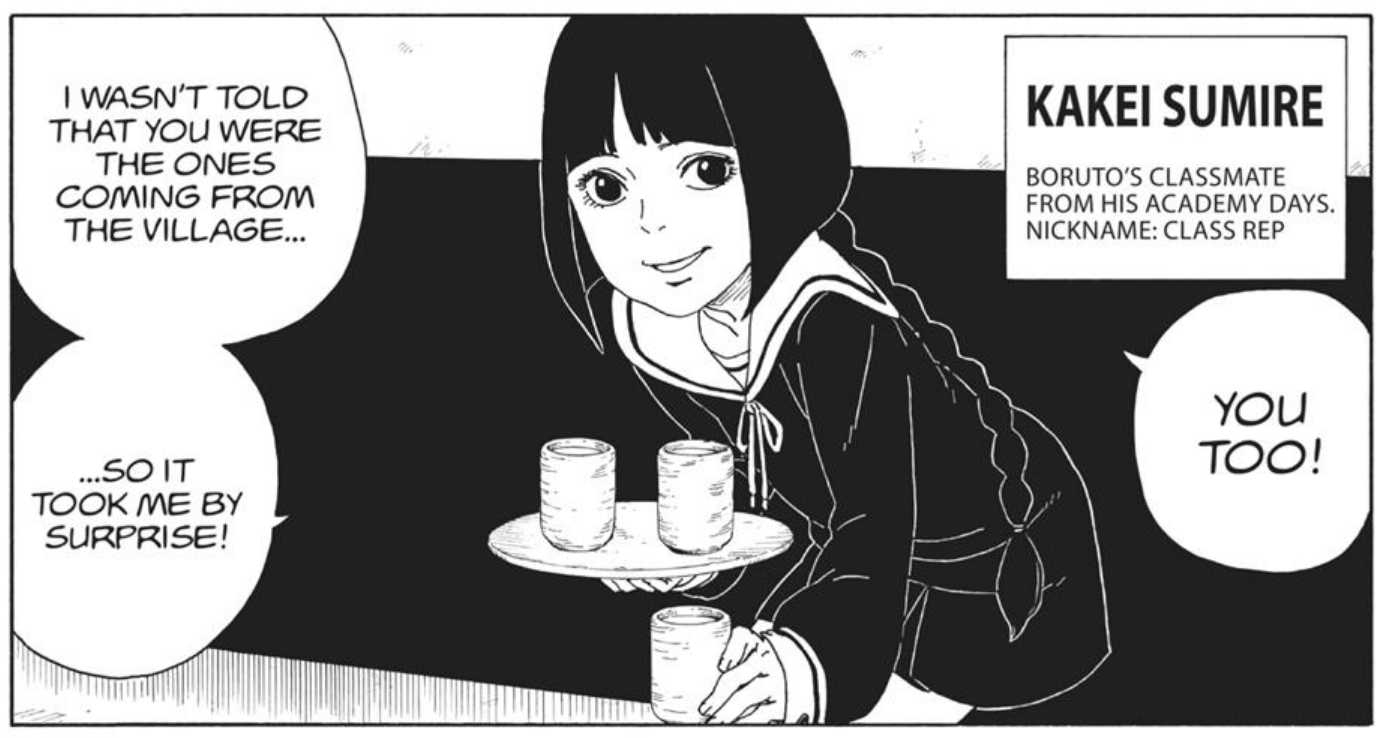
From a writing perspective, we see how Sumire's relation to Team 7 is immediately framed around Boruto. Her first utterance is his name, but the text box is also there to describe her as Boruto's classmate (rather than Team 7's classmate), supplying the nickname "Class Rep" to be used without any additional context beyond her being a shinobi who applied to work at the Advanced Technology Laboratory instead of taking the Chunin Exam. The anime does a much better job of integrating her with the rest of her peers, but the manga drags its feet on building a larger dynamic between Sumire and Sarada until they're forced together by Eida's arrival in the village.
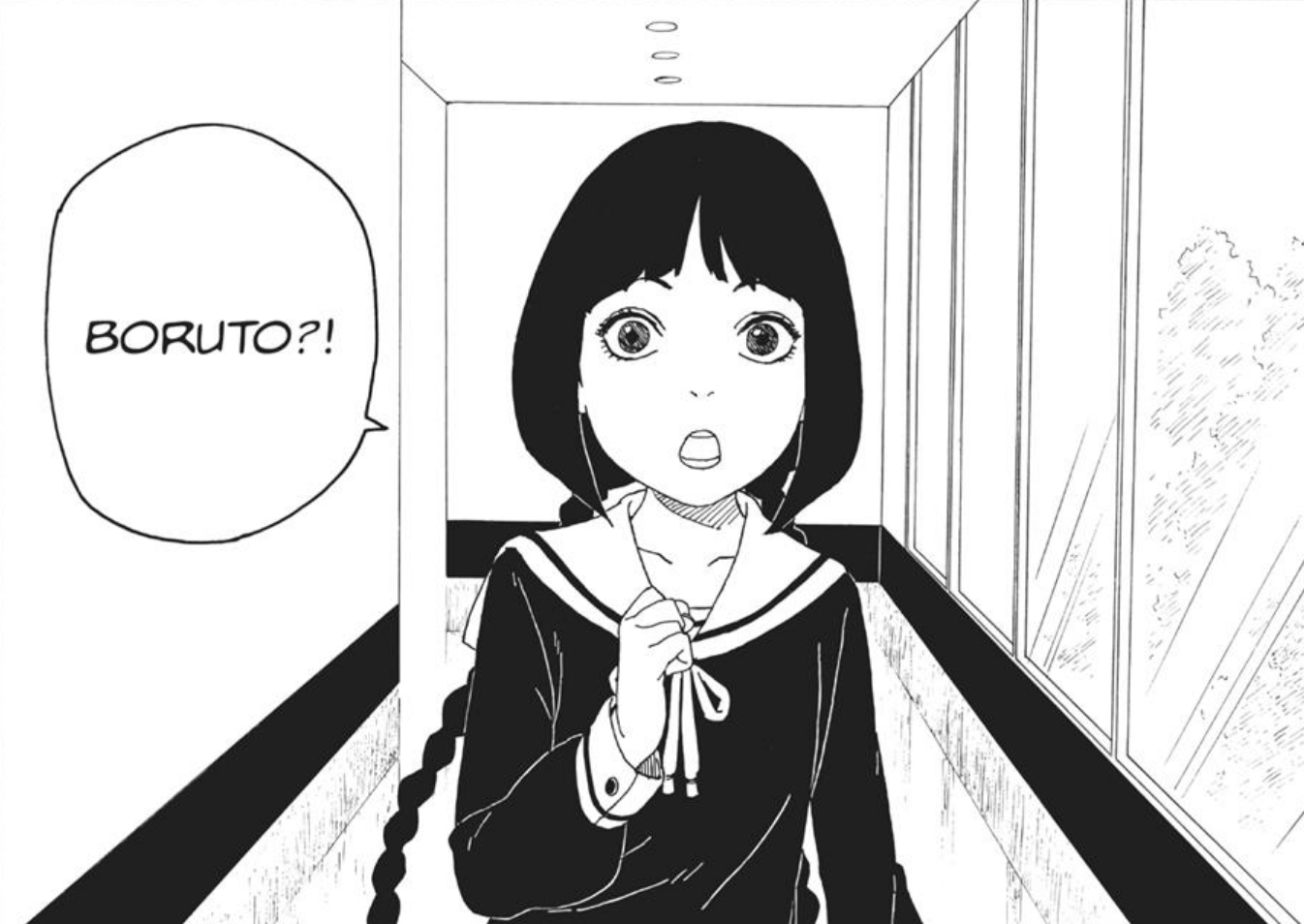
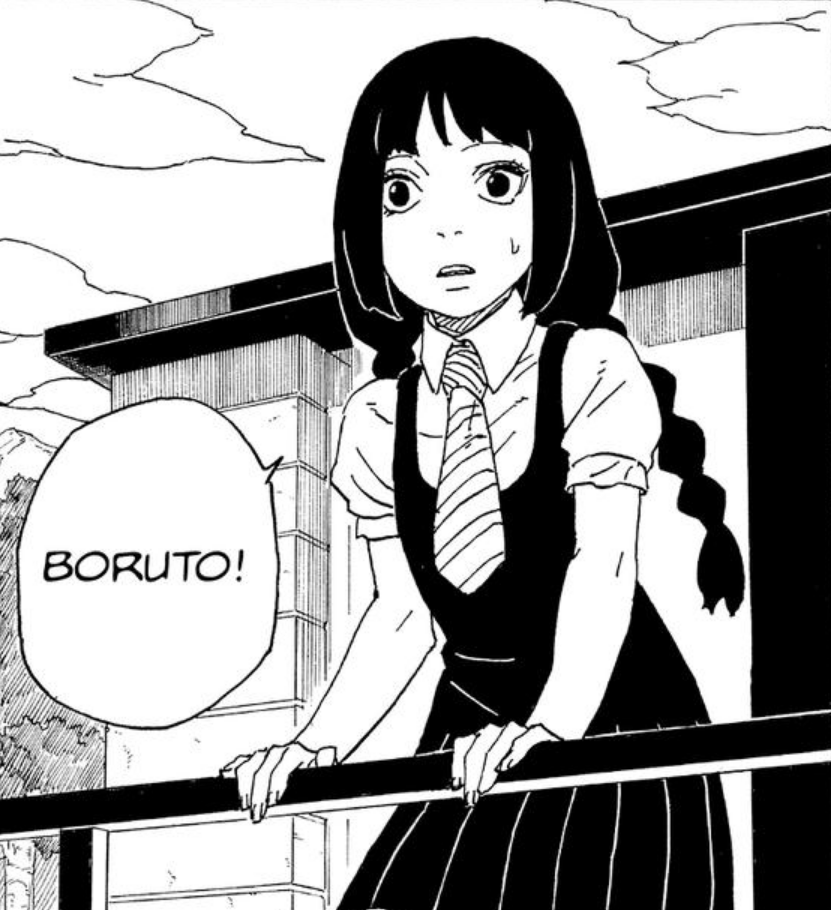
Two "Boruto!"s both alike in tonality, In fair Konoha where we lay our scene.
Along with the abrupt introduction of Sumire, we also meet Inuzuka Akita, Dr. Katasuke's attractive teammate, who joined the team after he created a prosthetic leg for one of her clan's fighting dogs. From their conversation about the prototype of Naruto's prosthetic hand and her later involvement in testing the scientific ninja tools, it's clear that she's also a scientist in her own right, but the story puts her into the position of assistant to a brilliant scientist rather than making her as an equal partner in their research. Similar to Sumire, her introduction frames her in relation to a male character.
After being forced to listen to Akita gush over his father's scientific ninja hand, Boruto is ready to hop onto the next train leaving for Konoha, but Sumire and Sarada are quick to tell him that his mission includes helping test an array of scientific ninja tools that the team is developing. What follows is a montage of different tools in action, but there are two things I want to point out.
Their first test involves two-against-one combat with Boruto and Mitsuki facing off against Sarada. As mentioned previously, instances of combat in series like Boruto provide us with a metric by which to measure character progress. Similar to the bout with his father that began this arc, Boruto promise not to hold back when he attacks. What we see that is in taijutsu, Sarada and Boruto are equally matched, with Boruto's side only gaining the upper hand when Mitsuki entraps her. With assistance from the Smoke Flash Bomb provided to her by Akita, Sarada manages with their match, a kunai to the throat of each of her team members.
The other remarkable insertion into chapter is introduced when Akita switches on a device that blocks all noise "by colliding specific phases of sound waves." Mitsuki remarks that "negating waves using other waves" is the "opposite principle of resonance [bolded in the text]." This inserts an explanation of resonance, the idea of matching frequencies amplifying an effect, before it comes into play with Boruto's and Kawaki's Karmas.
Boruto begins to loosen up through the next few tests, insisting not having fun until he's having the time of his life while strapped to a flying device, which then comedically crashes into the wall. (Little does he know he'll be flying on his own three years from now under much less enjoyable circumstances.)
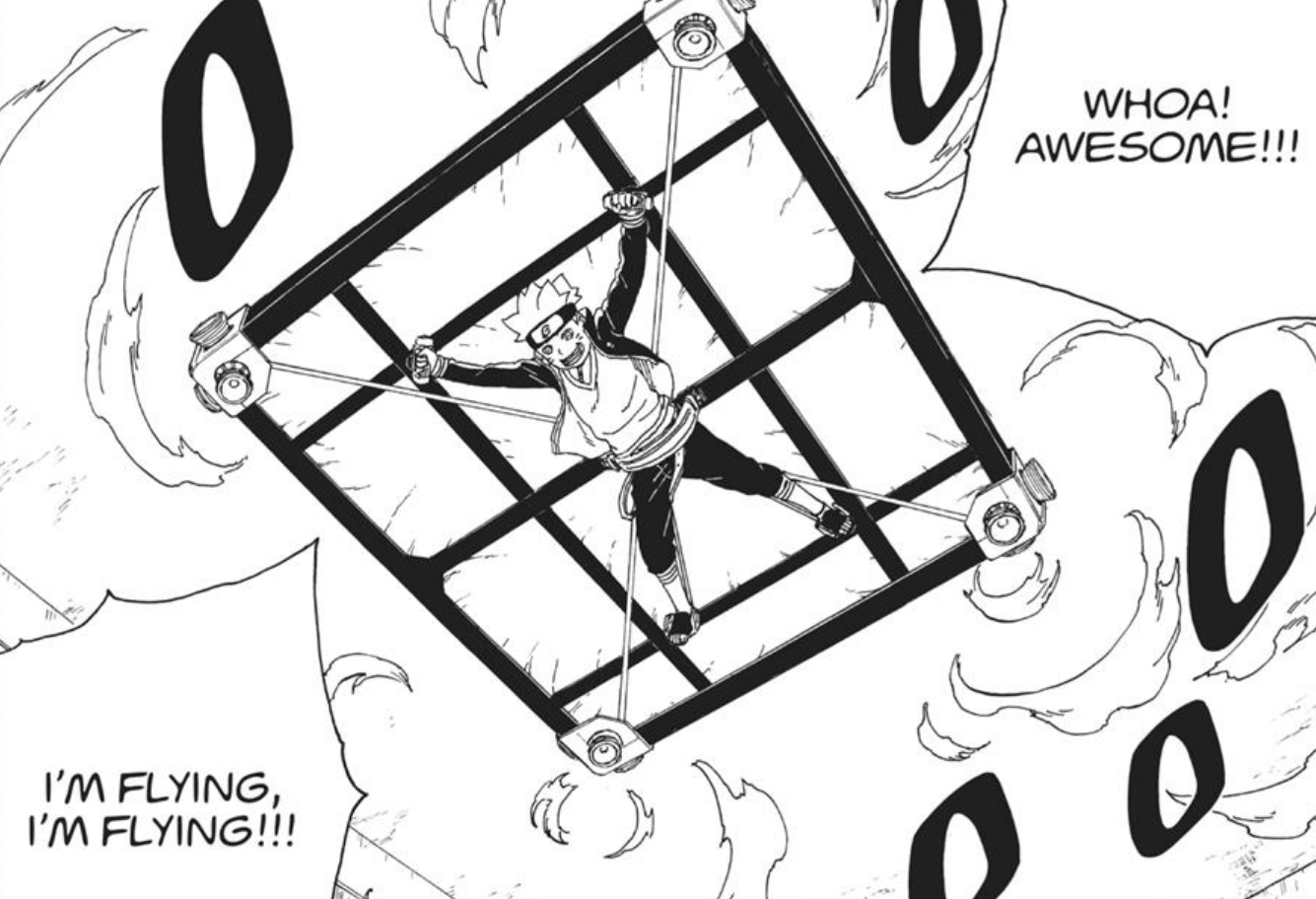
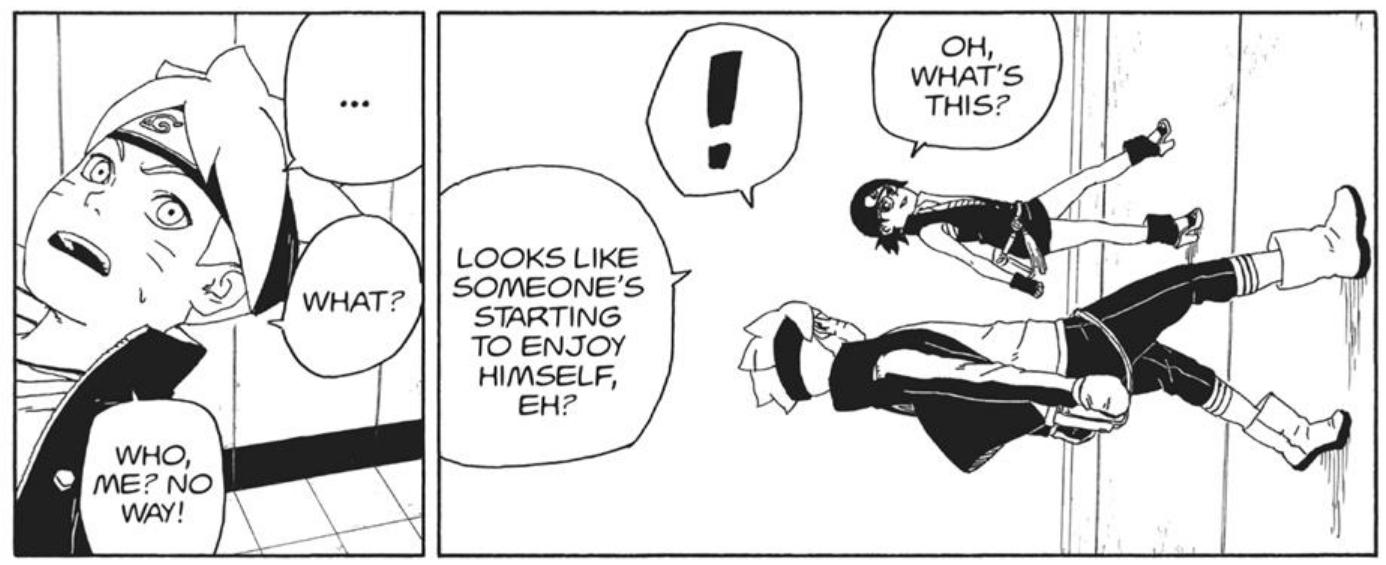
Read right to left for an example of a page flip used for comedic purposes.
While Sumire tends to his wounds using an accelerated healing spray developed by Dr. Katasuke, Boruto interrogates her opinion of the scientist and learns that she both trusts and respects him. Boruto silently stares at his picture on the wall, reading the quote beneath that reads: "In science, any and all things are pursued. Scientists, though such pursuits, exist to support any and all people." He focuses in on the line mentioning support, forcing the reader to reflect on Naruto's description of Dr. Katasuke as someone else whose work supports the Hokage.
His introspection is interrupted by the ninja dog, Chamaru, for whom Dr. Katasuke fashioned a prosthetic limb. Dr. Akita tells Boruto of Chamaru's past and how he was helped by scientific ninja tools, describing Dr. Katasuke's view of science as, "To give power to the powerless. And those who have lost something precious, a ray of hope that will return smiles to their faces."
While Boruto is considering whether his negative opinion of scientific ninja tools was myopic, Dr. Katasuke shows up with a new weapon prototype that could win the heart and mind of any teenage boy: a ninja lightsaber. (Sorry, my notes are telling me it's called a chakra blade that's impractical in battle due to its chakra expenditure.) After seeing scientific ninja tools in action and learning more about their utility, Boruto tells Dr. Katasuke that he should make his father's ninja hand, used to protect everyone in the village, as cool as the chakra blade.
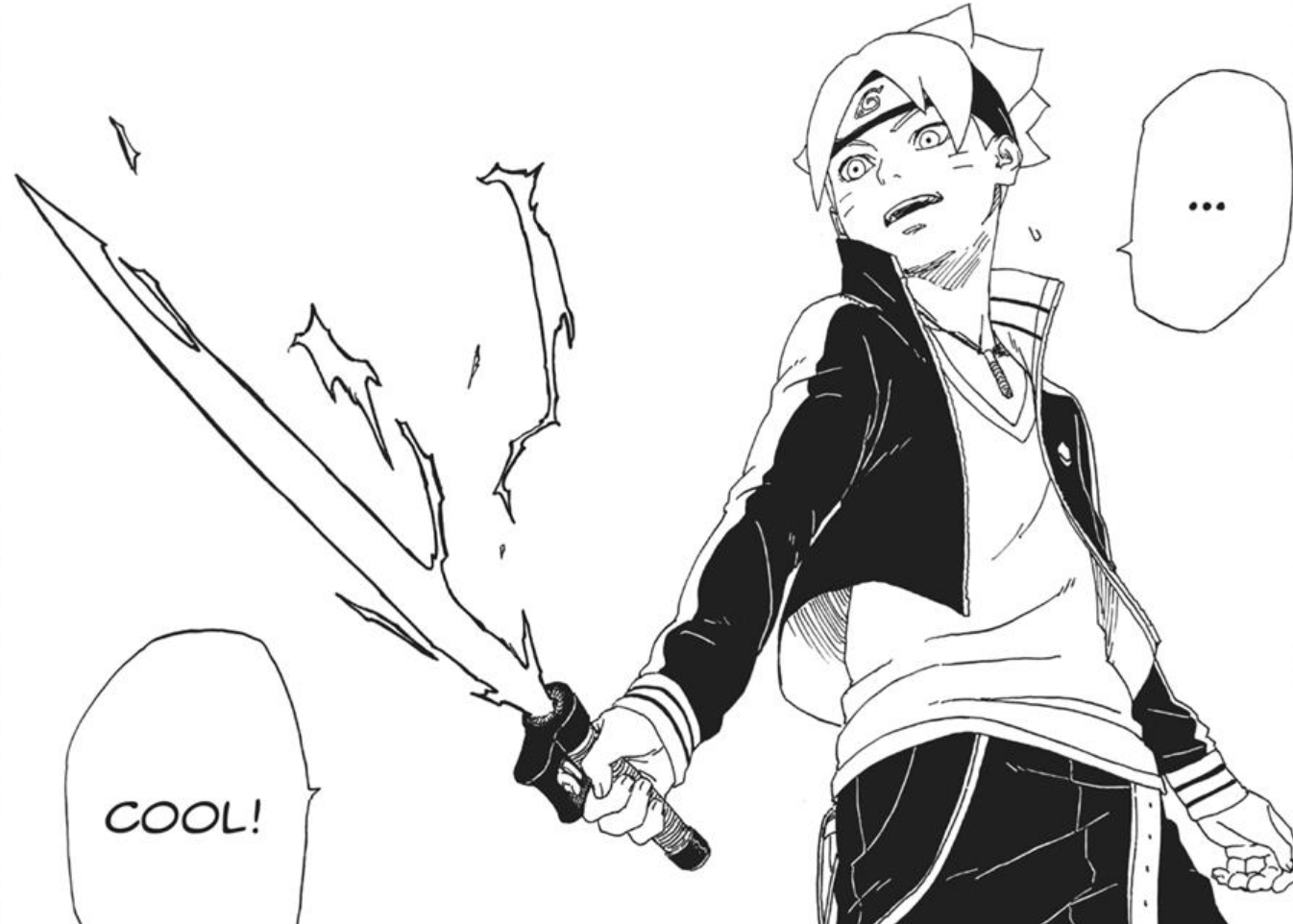
After undergoing another character growth spurt, Boruto receives a call from Naruto to abort their current mission and go in search of Konohamaru and Mugino after Hokage Tower lost contact with them. Afterwards, Naruto expresses concern to Sai and Shikamaru that it's likely he just sent his son's team to take on Kara.
Chapter 19: Puppets
As Team 7 prepares to embark on their new mission, Akita loads Boruto up with supplies (and manuals, as though one would have time to read a manual mid-mission?). Her concern is not only for the team, but for Dr. Kataske and Chamaru who are accompanying them as well. Cue the doctor emerging from the building clad in a prototype power suit originally designed to assist in caring for patients.
While Akita fusses over Boruto and Dr. Katasuke, Sumire asks Sarada if Boruto is popular back in Konoha. Thinking that she means in terms of friendship, Sarada responds that Boruto basically befriends everyone (an amusing statement considering his later reaction to Kawaki joining the Uzumaki household). Sumire clarifies that she's specifically referring to popularity with other girls and asks Sarada if it bothers her if they like him. When Sarada responds that it doesn't, Sumire reveals that does bother her, divulging her own feelings for Boruto. The conversation leaves Sarada unsettled, particularly after Boruto says goodbye to Sumire and "Let's talk again soon!"
Team 7, along with Chamaru and Dr. Katasuke, arrive at the crash site. Unlike when we last encountered the scene with Konohamaru and Mugino, the area surrounding the airship is littered with unmoving ninja puppets, no sign of either Leaf shinobi they're searching for. Feeling relatively safe due to the absence of a puppet master, Katasuke explores the inside of the airship, gushing over the technology and noting the empty container. Meanwhile, the puppets outside return to life, ambushing Team 7.
We've seen the new generation trio in action before when they successfully took on the Mujina Bandits gang. However, the same tactics that were effective against human shinobi fall short against their inhuman enemy. After they take cover from the fire-style attack shooting from the puppets' mouths, Dr. Katasuke confirms that the puppets they're up against are actually autonomous scientific ninja tools rather than weapons controlled by a shinobi, most likely put on the airship to guard its precious missing cargo.
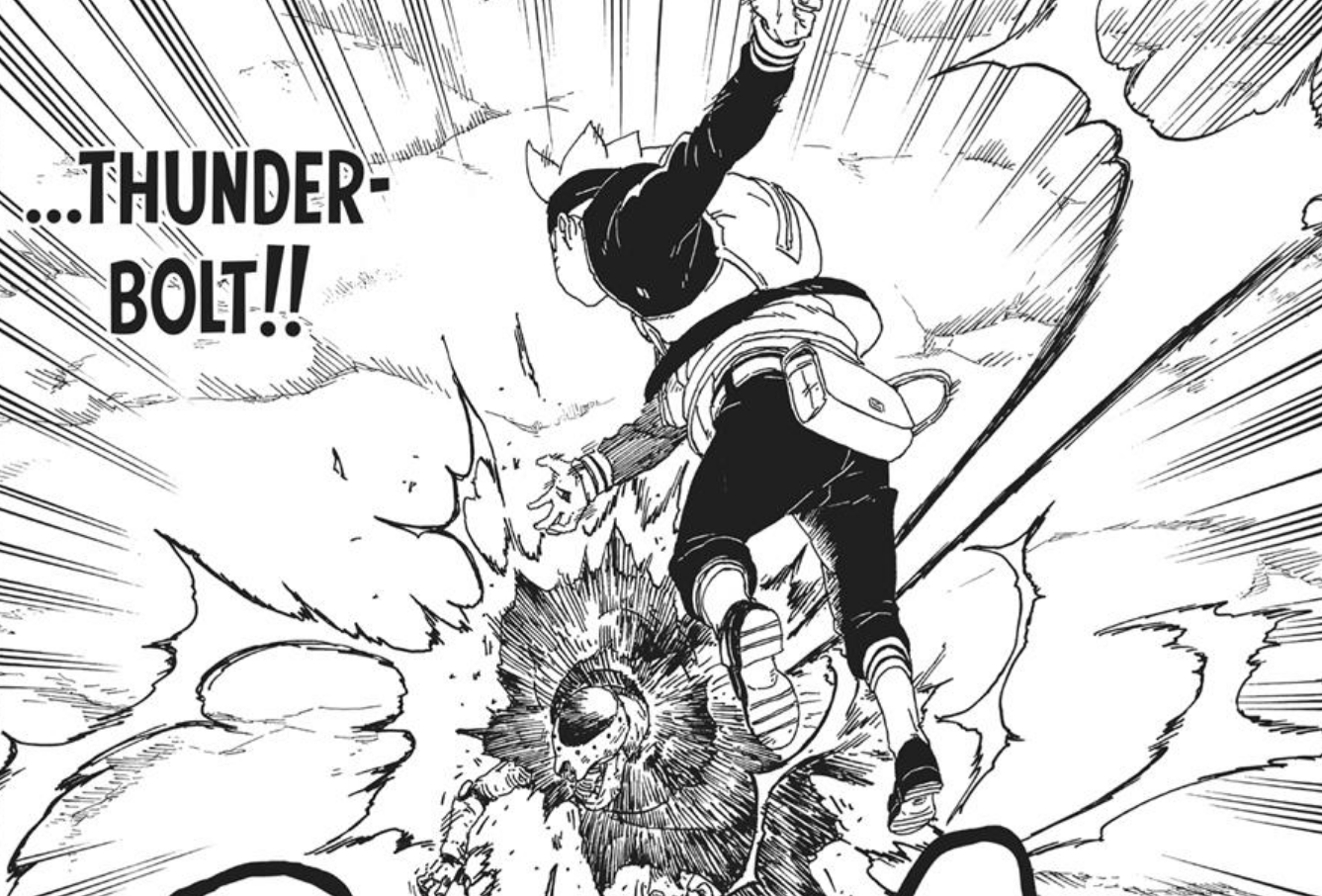
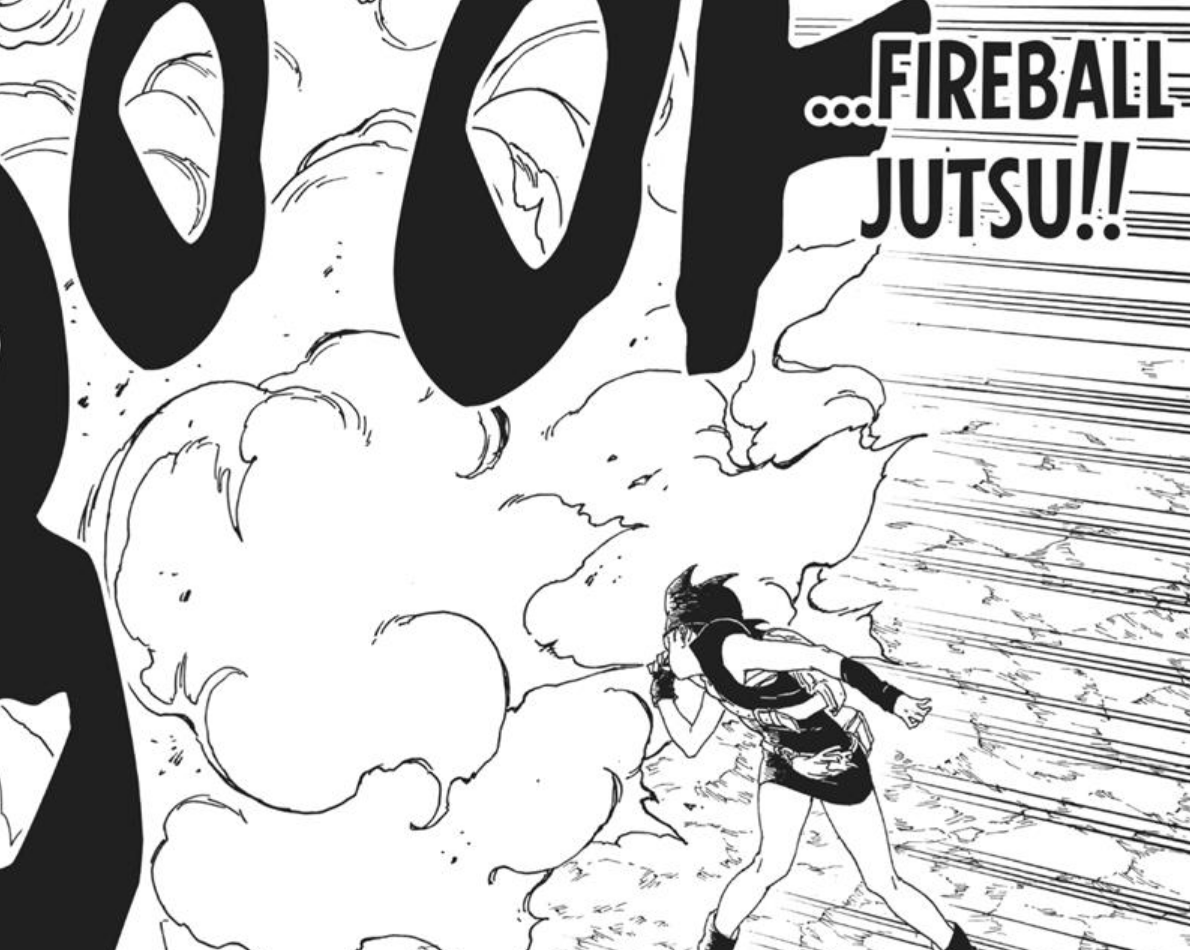
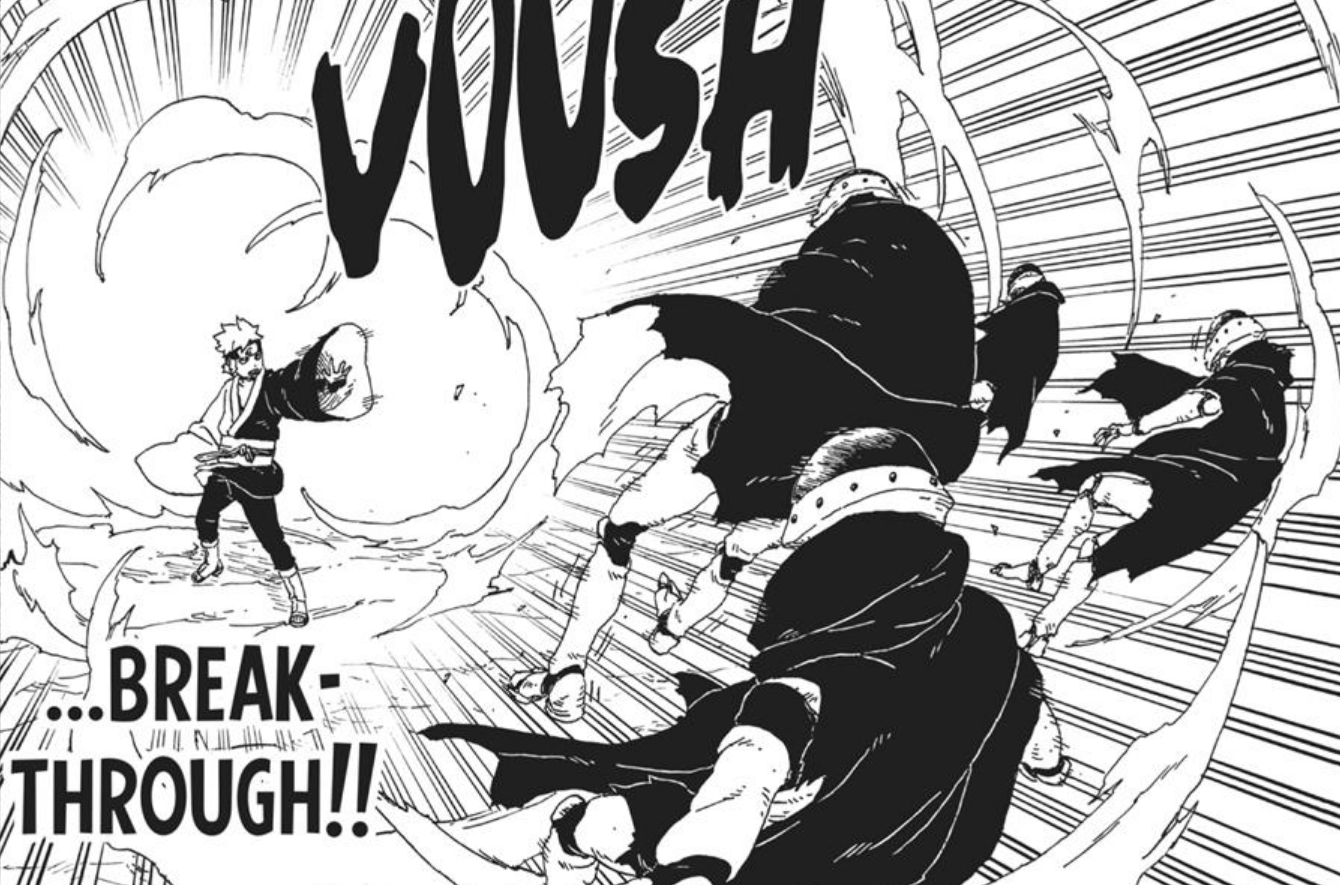
When going all out gets you nowhere.
With the young shinobi out of options, Dr. Katasuke deploys a "fight[ing] fire with fire" strategy, taking on the scientific ninja tool puppets with his own scientific ninja tool power suit. Using the same technology that was integrated into Naruto's prosthetic hand, he absorbs the onslaught of fire-style attacks until the puppets overheat. The scientist instructs Team 7 to search for chakra-imbued power sources inside of the puppets and destroy them before they have the chance to cool down. Sarada remarks that the field of scientific ninja tool research is something she thought was unique to Konoha, making Dr. Katasuke realize that the weapons they're now fighting are a direct result of the information he leaked while in a genjutsu.
Chapter 19 covers a lot of scientific ninja tool lore that will become relevant as the narrative transitions to fighting against Kara: Kawaki will overheat from pushing his body too far (both in a few chapters and in TBV). Naruto will defeat Delta by overexerting her technological capacities to absorb jutsu. Boro will be defeated by having the core that powers his cyborg body removed. All the elements that we need to understand how Amado's cyborgs work is introduced in this chapter up until the point that it's revealed he also modified their bodies with Otsutsuki DNA as well.
After they've dispatched with the puppets, Chamaru appears with one of Konohamaru's kunai, leading Team 7 to where he's taken shelter in a cave to care for Mugino's non-fatal wounds. Reunited at last, they discuss the overwhelming technological capacity of the enemy and the mysterious empty container inside of the airship. As Konohamaru hands off his thumb drive scroll to Dr. Katasuke for safekeeping, a mysterious voice echoes through the cave.
The next page flip reveals Ao standing between the Leaf shinobi and the exit, armed with a huge gun. Konohamaru identifies him as a retired shinobi, "... the Byakugan Killer, who was once... Mei's right-hand man! You were previously listed in Konoha's Bingo Book in gold letters..." Boruto stares in shock, realizing the kind old man he met on the train was once a wanted killer.
Konohamaru does what he does best in this arc, asking questions that don't get answers. Ao readies his gun, asking where the contents of the container are (which is a bit silly because they just said it was empty when they found the crash site as he walked in). Konohamaru refuses to share intel with "one such as you who is no longer a shinobi," which is fine with Ao, who takes aim at them with his massive gun as the volume concludes.
In all honesty, I don't remember the Ao arc being this dense on my earlier reads, the interplay between modernity and the past represented in a shinobi who becomes a scientific ninja tool, the comparisons between the capabilities of technology and the power of the gods, the sheer amount of future plot points introduced by Koji and the scientific ninja tool puppets. Elements from the Ao arc continue to bear fruit throughout all of NNG and into TBV as well.