Boruto: Naruto Next Generations - The Path Lit by the Full Moon Reread

Both The Seventh Hokage and the Scarlet Spring and The Path Lit by the Full Moon are stand-alone manga written and illustrated by Masashi Kishimoto that provide the other young members of new Team 7 with backstories to develop their pasts and motivations in the series. In a broad sense, both stories are quests for identity involving family. The former one focuses on Sarada seeking a father who she doesn't remember after a photograph from his past raises doubts about whether Sakura is truly her biological mother. Not only does Sarada find Sasuke and reaffirm love and connections within her family, but she also succeeds in finding her dream—to become Hokage. Despite being significantly shorter, one chapter rather than ten, Mitsuki's story is infinitely more confounding with themes that find different meanings as the Boruto manga progresses.
Plot Summary
Before we launch into themes, let's reacquaint ourselves with the story.
Young Mitsuki wakes up in a hospital bed, attended by Orochimaru and his former captive and current henchman, Suigetsu. Orochimaru gives Mitsuki a small cup full of medicine, claiming a final dose will make him better. Mitsuki drinks it, begins coughing, and drops it. Orochimaru picks the broken cup before leaving.
After he recovers, Suigetsu takes Mitsuki to see Orochimaru, telling Mitsuki on their way that he failed an important mission. When Mitsuki expresses that he can't remember what happened, Suigetsu attacks him to make sure his body still reacts as a shinobi's would. Orochimaru informs Mitsuki that he's his child, which he doesn't remember because a masked shinobi named Log stole his memories. Together, they'll go and retrieve Mitsuki's memories so he can find out who he is.
Dressed in matching armor, Mitsuki and Orochimaru embark on a mission to confront Log. After a brief battle, Orochimaru emerges victorious, having paralyzed Log with snake venom. He tells Mitsuki to stay outside the hideout while he goes inside to look for an unnamed object. Log challenges Mitsuki to remove his mask, revealing that he's an earlier clone of Mitsuki also made by Orochimaru. When Orochimaru returns, his brother and parent each try to manipulate him to their point of view on whether artificial beings deserve to exist in the world.
Ultimately, Mitsuki chooses to listen to neither of them, taking the key and case necessary for Orochimaru to create more beings like him. After he flees, Orochimaru and Log discuss that the entire mission was a charade meant to force Mitsuki to choose a third way rather than aligning himself with either of them. This sixth attempt was finally successful after multiple rounds of testing him and erasing his memory.
Mitsuki opens the case for himself, finding that his brother put a picture of Boruto inside of it, a "sun" who will shine upon him and help illuminate the dark.
Identity
The first words spoken by Mitsuki in The Path Lit by the Full Moon are: "Who am I?" Later, he repeats this question when speaking with Orochimaru about their relationship and is rebuffed, echoing the moment in The Seventh Hokage and the Scarlet Spring in which Sarada questions Sakura about her marriage to Sasuke. Both children are coming to their parent with a gap in their memory and a fundamental question about their place in the world.
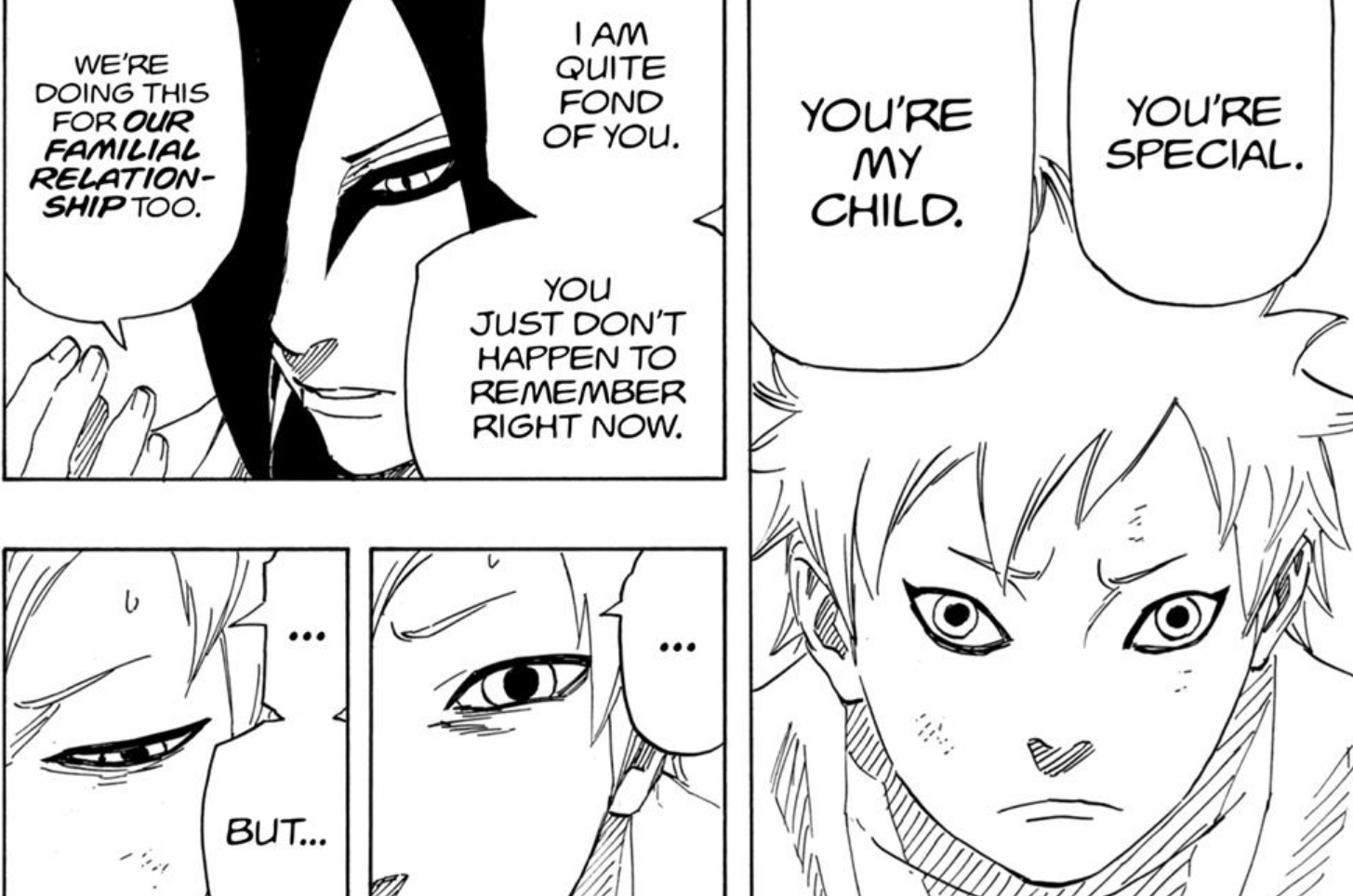
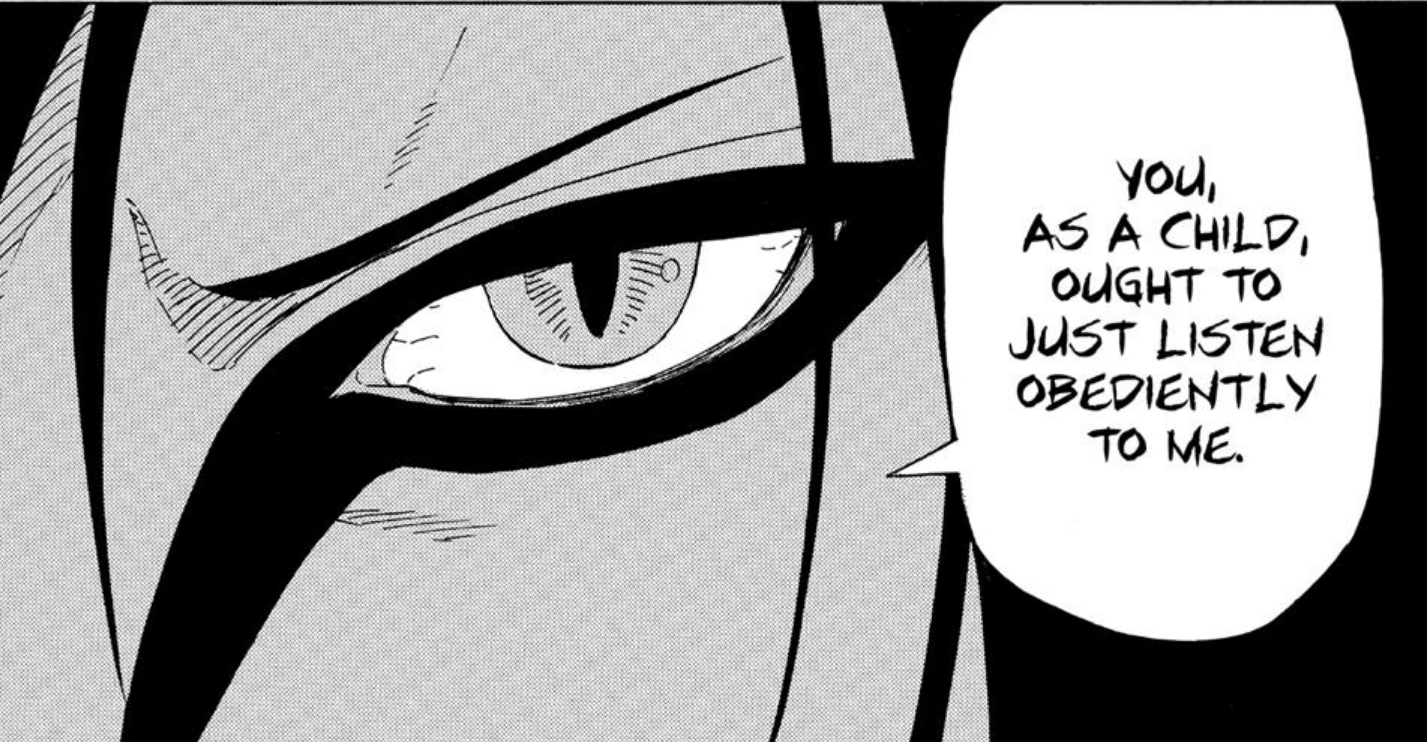
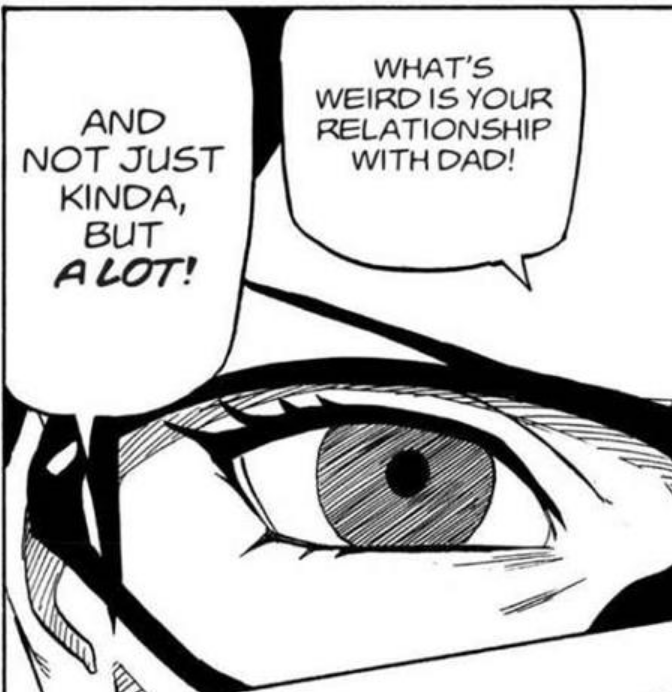
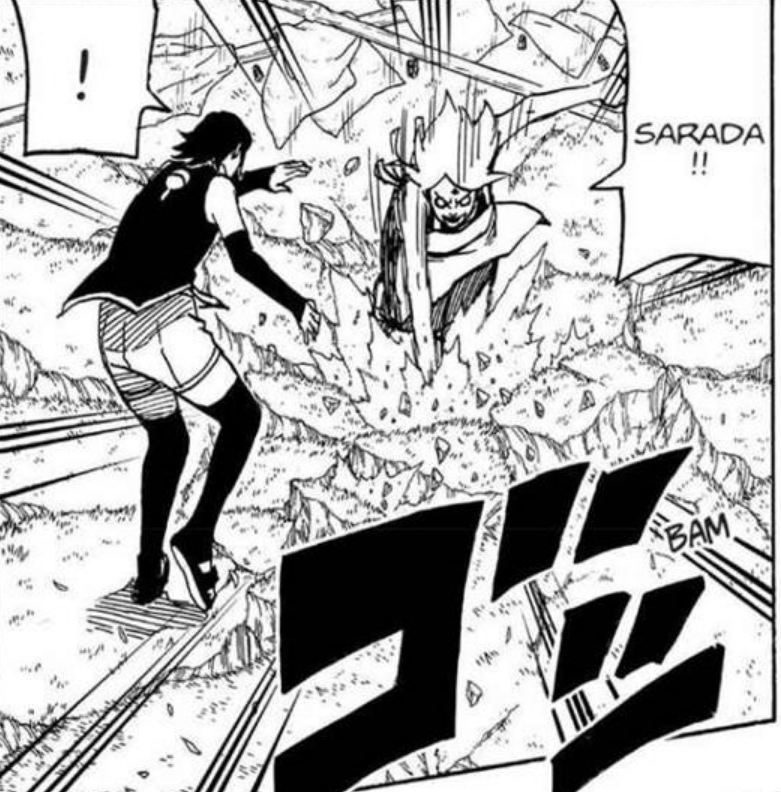
Mothers in the Naruto universe are scary.
In Boruto: Two Blue Vortex (TBV), the theme of family and identity emerges once again with the introduction of Hidari, a Shinju created from Sasuke's chakra. He's similar to Mitsuki, a lifeform produced in a nontraditional way with no memory of his past but an instinct to know who he is. For the other Shinju, their quest to consume their targets is an evolutionary drive, but for Hidari, his desire to consume Sarada also arises from the same question Mitsuki asks: Who am I?
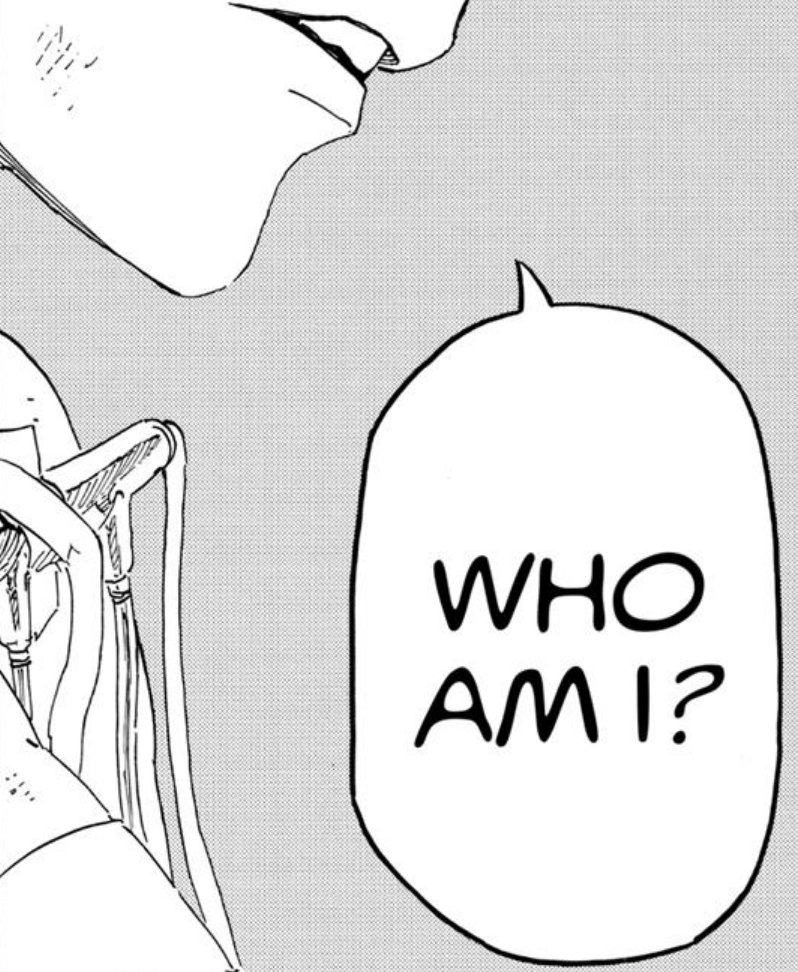
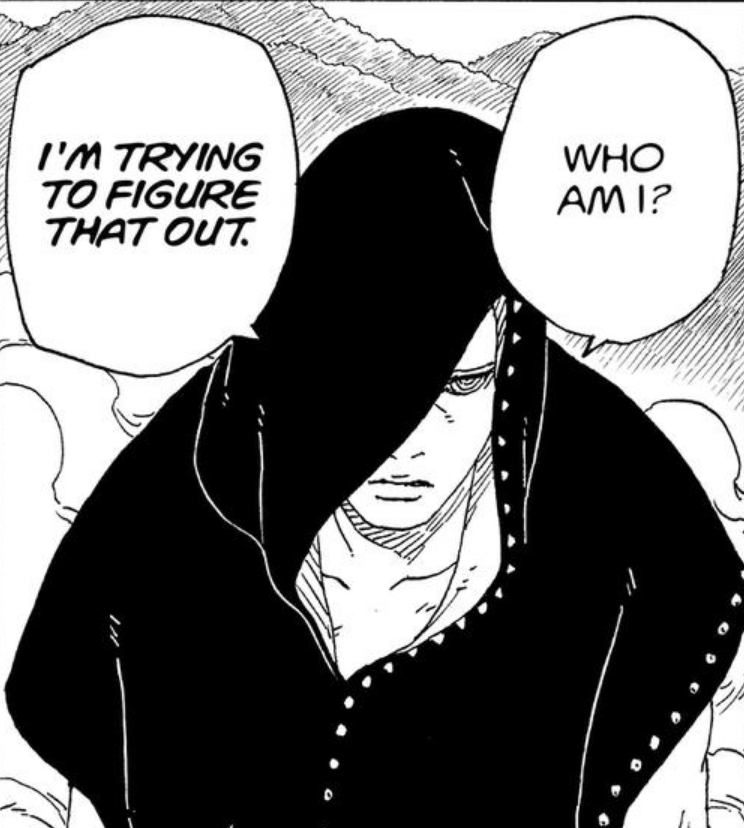
Who are they?
For both Sarada and Mitsuki, their questions of identity are not solved by knowledge alone. In The Path Lit by the Full Moon, Mitsuki asserts his agency, deciding to follow neither of the paths laid out by the adults trying to manipulate him. He says that he'll decide for himself, and, in doing so, discovers the sun who will light his path, Boruto.
Similarly, when Sarada believes erroneous proof that Karin is her mother rather than Sakura, she first lashes out at the adults around her for lying to her. Naruto offers her a third way, focusing on her love for her family instead of the biological relationship she might have with either woman. In speaking up for the importance of love and bonds, Naruto offers Sarada both a new way of looking at her family and a new goal in life—to become a Hokage like Naruto.
What this suggests for Hidari is that if he's going to become a being enlightened to his identity, consuming Sarada isn't sufficient. Knowledge of self comes not from information but from agency. However, this will also test Boruto's assertion that the Shinju will never be more than just trees as long as they perceive love as a weakness.
Memory
The theme of memory and the past plays a pivotal role throughout Boruto. During the first arc of Boruto: Naruto Next Generations (NNG), Sasuke tells Boruto that he should be studying who Naruto was in the past, which leads to the moment when Naruto shares his massive Rasengan with Boruto, the weight of all his past connections finally being felt by his son.
As the story progresses, two separate characters are introduced who can affect and alter memories: Eida and Amado. With her god-like ability to rewrite reality, Eida alters the memories of everyone in the world to believe that Kawaki was born as Naruto's son and that Boruto is the outsider who tried to kill him and was involved in Naruto and Hinata's disappearance. Through this swap, we learn that bonds are created through memories, a sentiment not unlike the one Naruto expresses in The Seventh Hokage and the Scarlet Spring. Similarly, we're reminded that the quality of a person's character can defy memories once Boruto returns to Konoha, gaining the trust of Shikamaru, Mitsuki, and Konohamaru through his actions despite them being under the influence of Omnipotence.
After the amoral genius scientist Amado is introduced, we get a deeper exploration into the role of memory in the series through his attempts to bring his daughter, Akebi, back to life through cloning. Despite inserting his daughter's memories into a clone, the individual that he created failed to be an exact replica of the daughter he desired. Here, it seems as though Amado is positing the theory that human life is governed by something akin to a soul, rejecting a materialist philosophical worldview that our humanity is predicated on nothing more than our physical selves and the functions which occur within our bodies.
Amado's view of memories surfaces again in TBV when he's talking to Sumire about his Omnipotence-altered memories conflicting with undeniable proof that Kawaki, the Hokage's son, holds the Karma necessary for Akebi's revival despite his own memories stating that he put her data into Boruto. "Not to mention that memories are no more than ambiguous figments of thought," he says, dismissing what he remembers in favor of indisputable proof that the boys' roles were flipped.
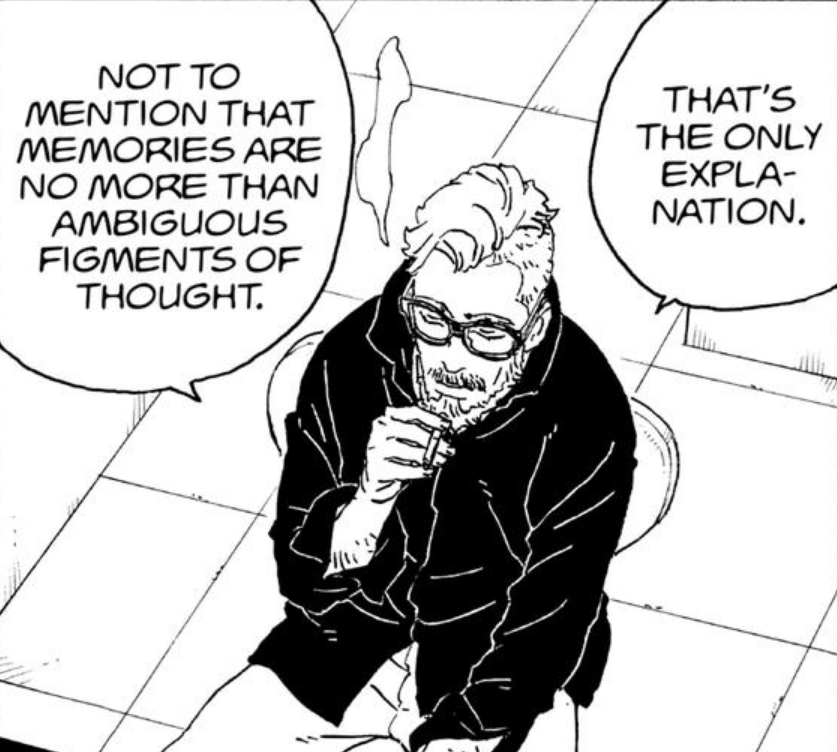
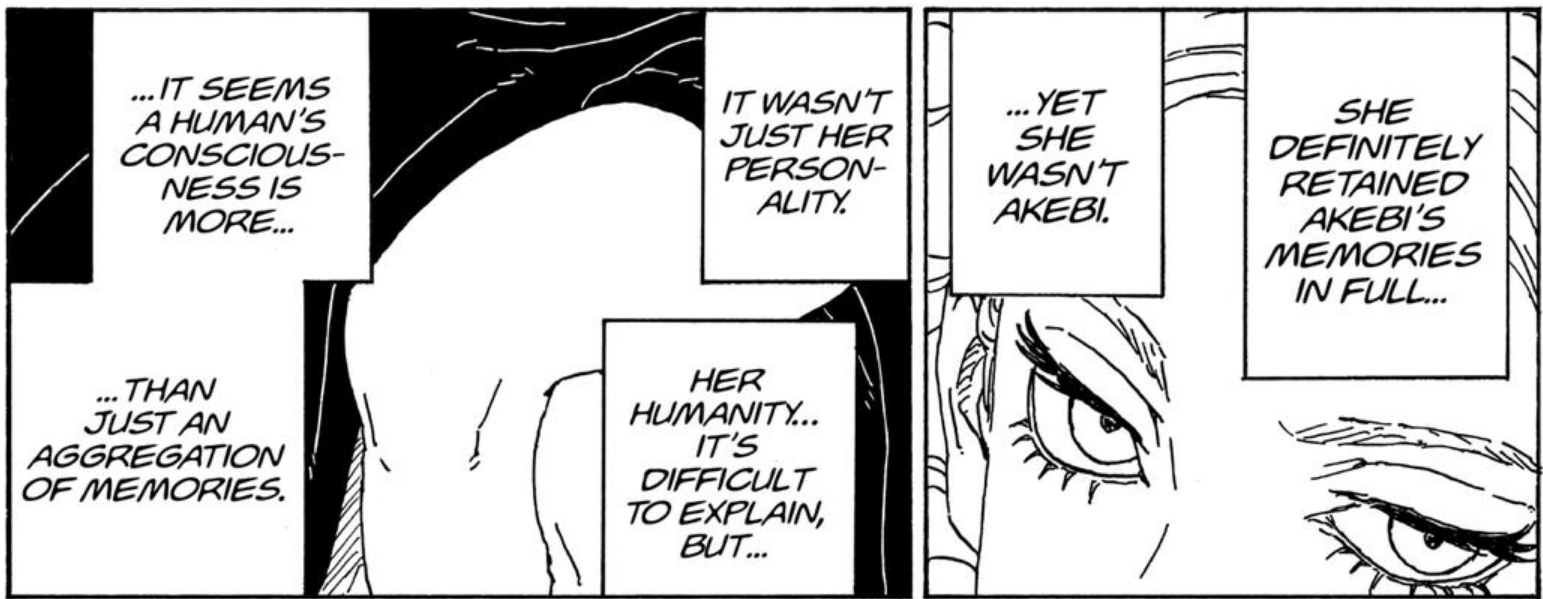
Read right to left.
While Amado continually proves to be an unreliable narrator, if we take him at his word, he's once again substantiating the ongoing theme that memories don't make us who we are. In The Path Lit by the Full Moon, Mitsuki feels lost due to his lack of memories, and retrieving those memories is the objective that Orochimaru dangles in front of him as the purpose of their mission to confront Log. However, instead of regaining his memories, Mitsuki gains Boruto as a source of light to illuminate his path. This scenario is replayed again in chapter seven of TBV when Mitsuki chases after the traitor, Boruto, wanting to kill him to protect his sun, Kawaki, but instead ends up being inspired by Boruto despite his memories of the past remaining the same.
Given the role that memory plays in Boruto, I'd be remiss if I didn't note that in The Path Lit by the Full Moon, we get our first exploration of artificially altered memories. Orochimaru erases Mitsuki's memories five times in the story, attempting to become an artificial being who can choose his own path. However, in the fictional narrative he weaves for Mitsuki about his stolen memories, Orochimaru also raises the potential for a shinobi to exist who can steal and collect memories, able to "manipulate people by implanting different memories or reinserting the very ones he stole in the first place." This portends the introduction of Eida, a character whose abilities can alter memories as well as Eida's suggestion to Sarada at the beginning of TBV that it might be easier to change everyone's memories again than undo Omnipotence.
Self-worth
When Orochimaru reveals to Mitsuki that he is his parent and also one of the legendary Sannin, Mitsuki responds with, "Then why'd you take someone as weak as me along on a mission?" expressing his lack of self-worth. Later, when they prepare invade Log's hideout, Mitsuki again denies having power when Orochimaru asks him to breach the barrier. In each of these moments, Orochimaru tells Mitsuki that he's special, yet Mitsuki is unable to believe in himself until he asserts his own agency.
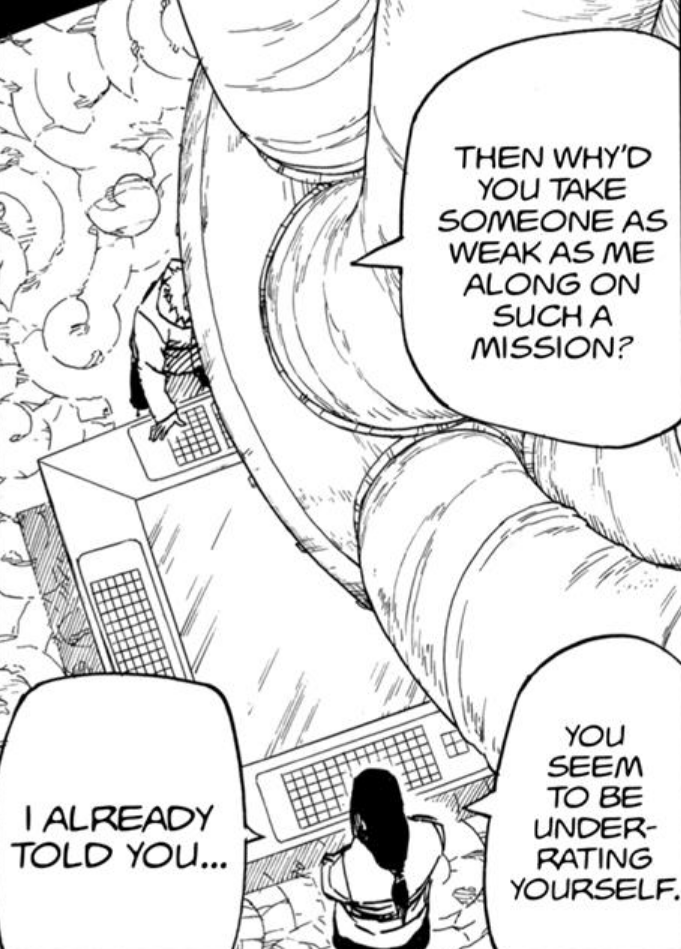
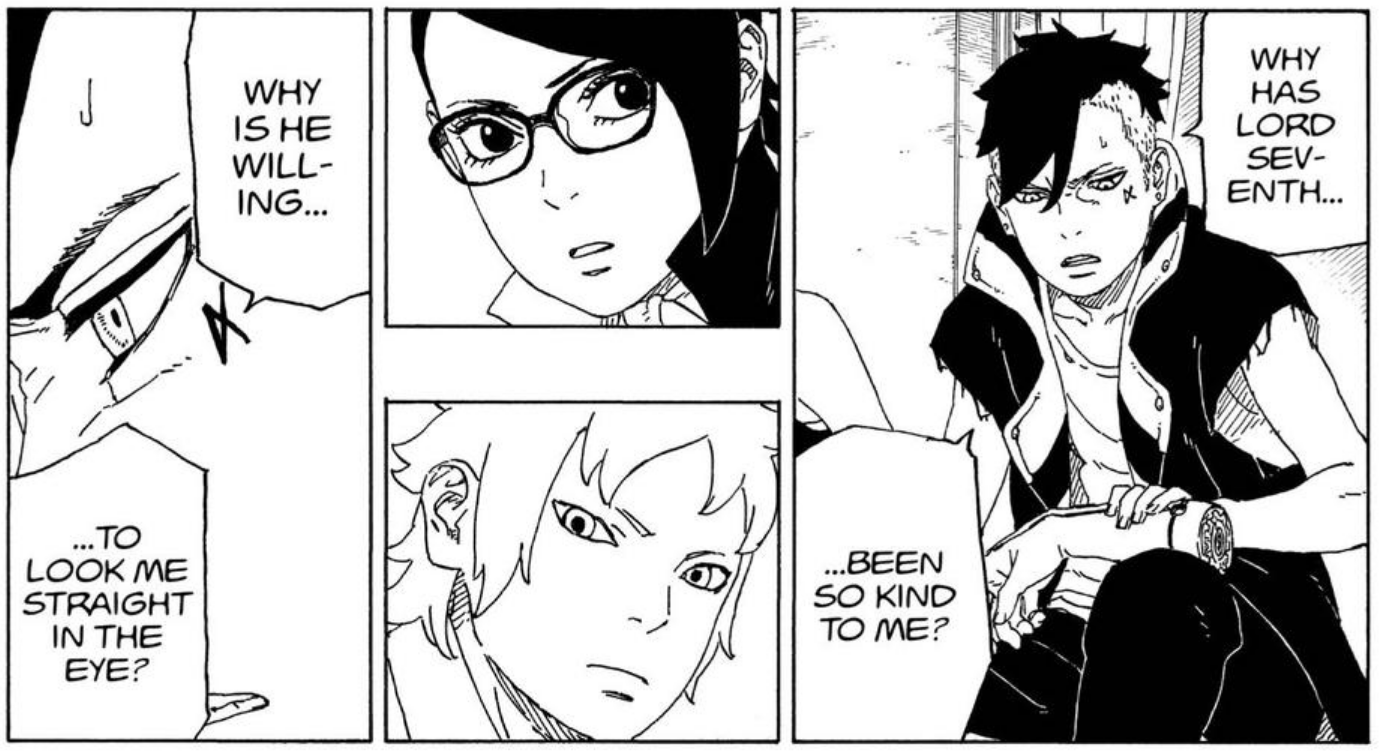
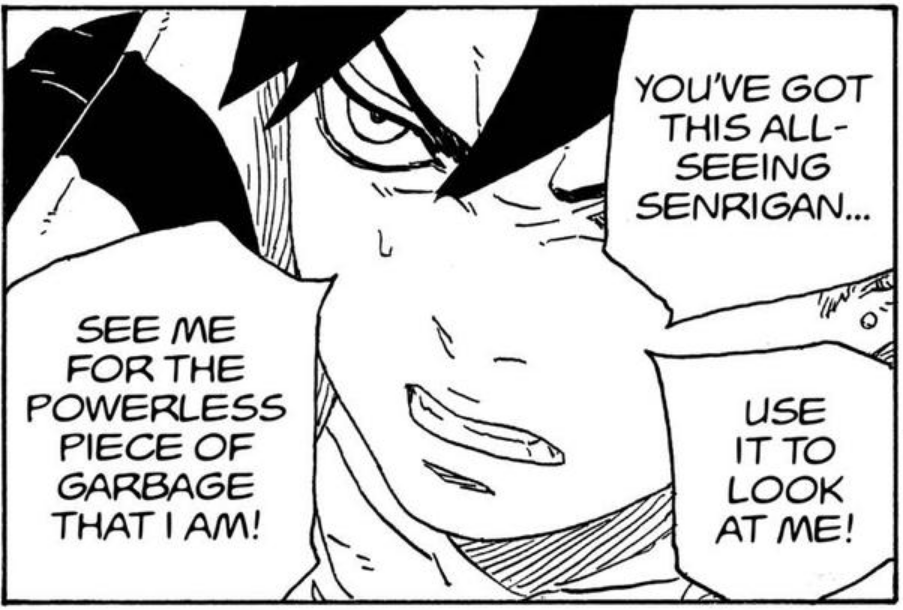
Expressions of weakness.
Like Mitsuki, Kawaki enters the story as a character who has been manipulated by those around him to meet their own goals. While Mitsuki's memories of his previous experiences with Orochimaru have been erased, Kawaki maintains memories of a childhood in which he was never loved. Both characters express feelings of powerlessness, not believing in their own value even when parental figures, Orochimaru and Naruto, speak of their worth. This contrasts with Boruto who grew up in a household full of love, despite its flaws, and is very certain of himself even when he loses everything.
Kawaki and Mitsuki are also similar in that they are inspired by others, Naruto and Boruto respectively. When they feel as though the lives of those who are most special to them are threatened, they're willing to kill to protect them. This reaction results from their mutual lack of self-worth, believing themselves and the world to be lost without their "suns."
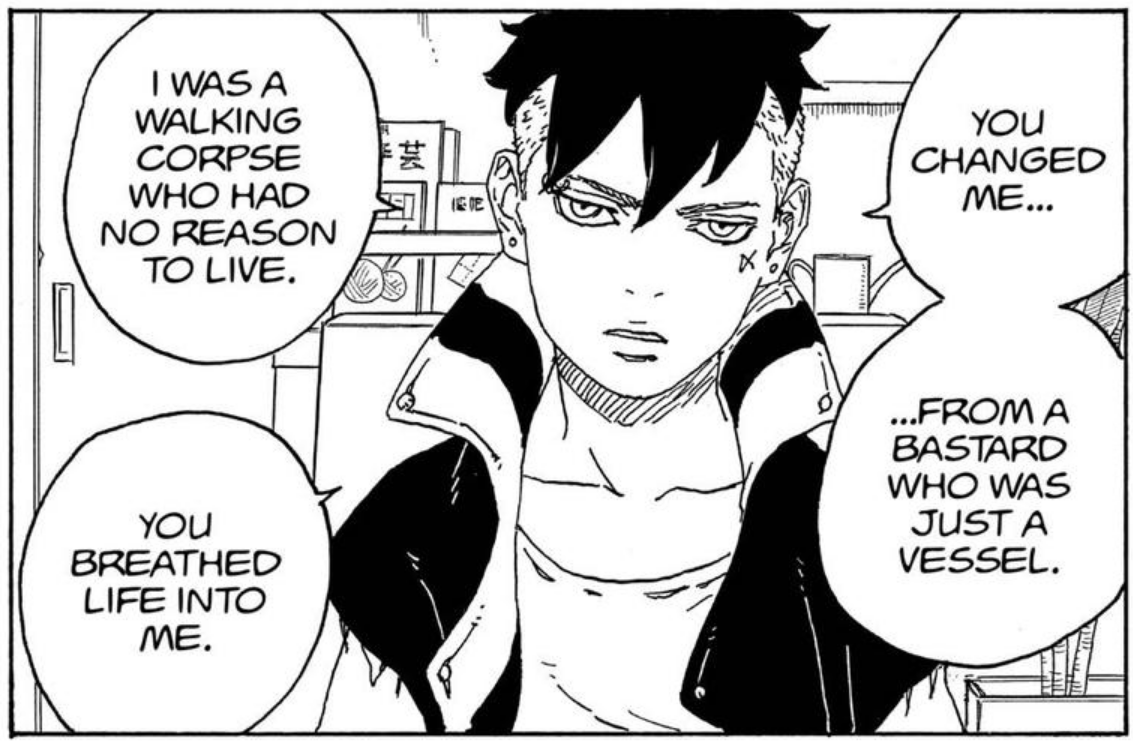
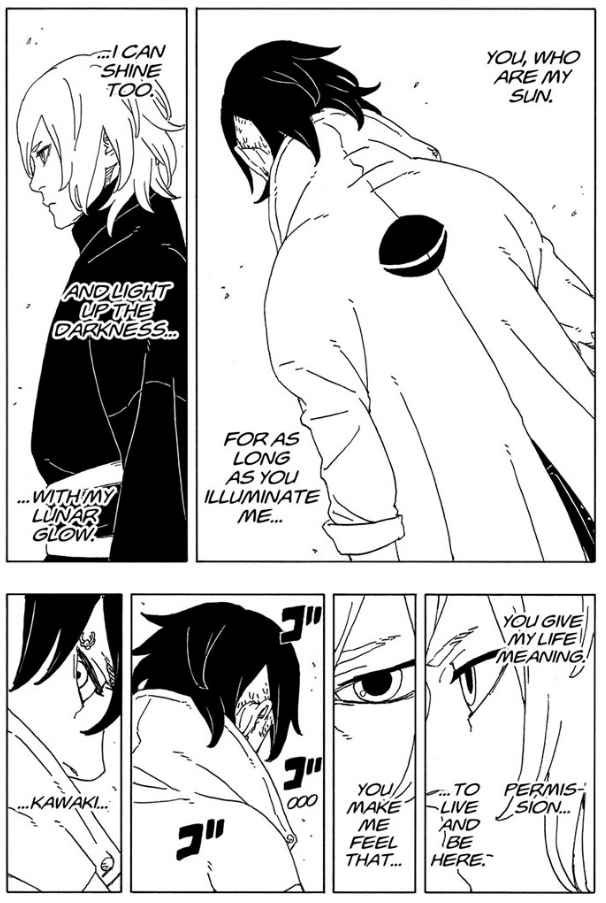
The suns who make them come alive.
Another parallel between Kawaki and Mitsuki is that they're both introduced as vessels, Kawaki a vessel for the Otsutsuki Isshiki to revive into, Mitsuki a vessel to fulfill Orochimaru's ambitions to create life. When Log reveals the original meaning of his given name, we learn that Mi is the sixth sign of the zodiac, the snake, while Tsuki is an archaic term for vessel. The imagery of a broken container to hold water is used for each of them as well, Mitsuki being compared to a broken cup while the imagery of a shattered vase being rebuilt but still leaking is used for Kawaki.
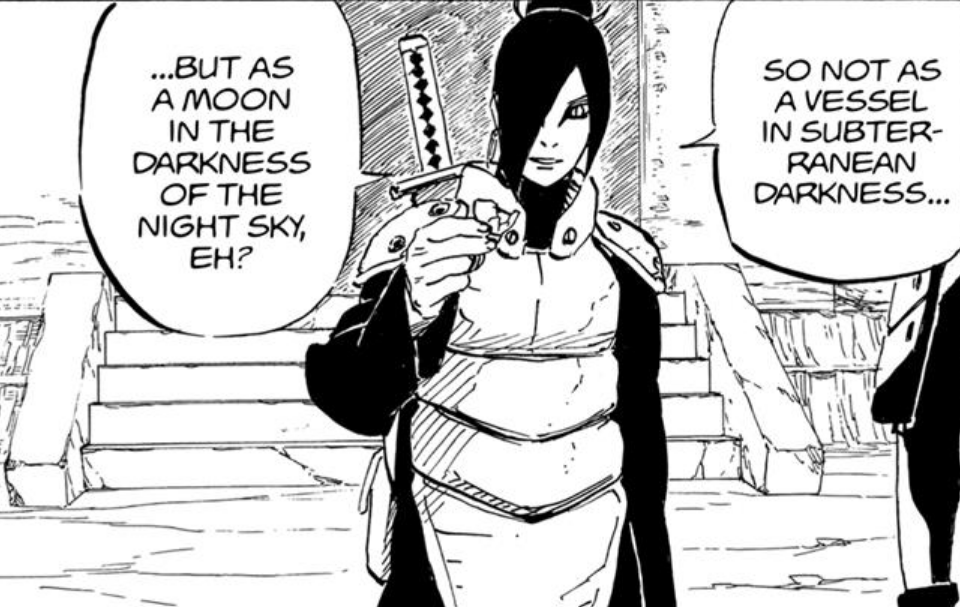
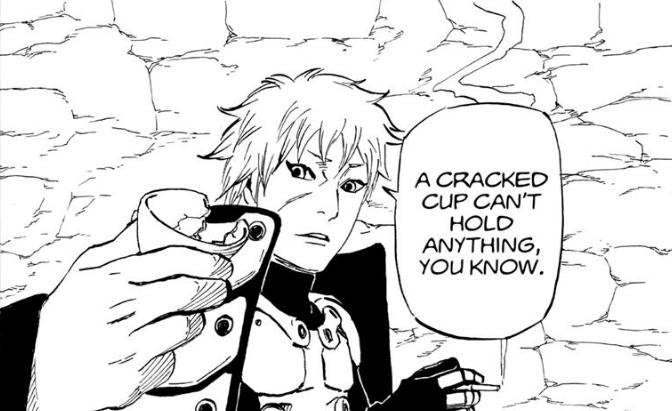
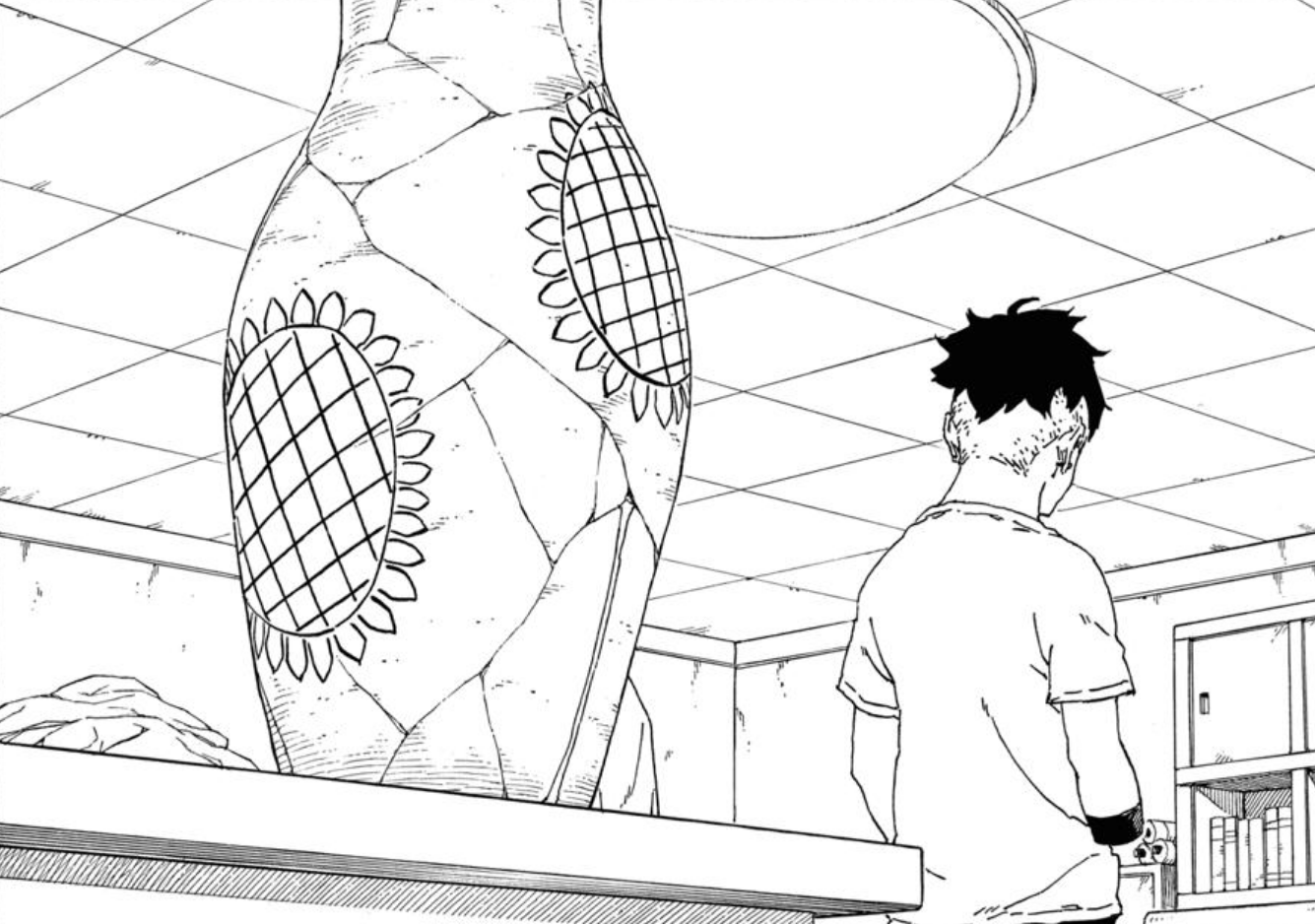
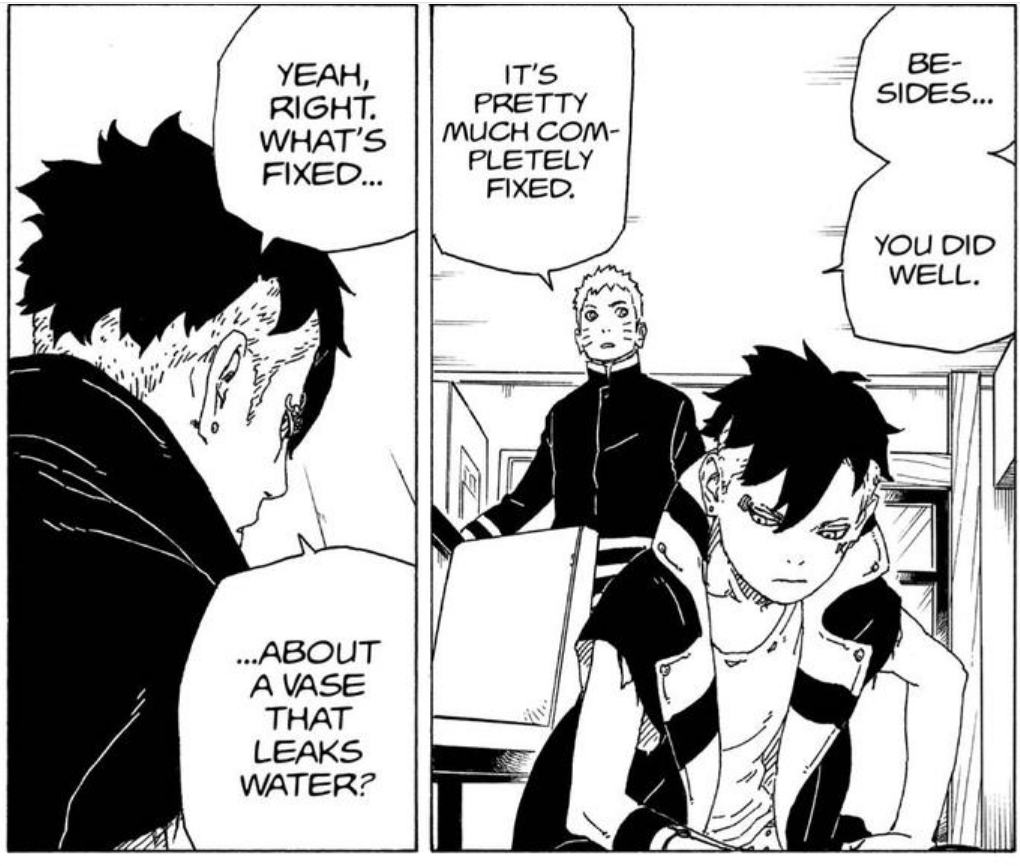
Broken cup, shattered vase.
In the conclusion of Mitsuki's story, he comes to the conclusion that he's not a vessel but a moon, echoed by the conversation that Log and Orochimaru have, agreeing that while "a cracked cup can't hold anything... a broken moon in the night will eventually wax full."
Moon, Sun, and Darkness
Boruto is rife with interstellar imagery and analogies: The sun pattern of Sarada's Mangekyo Sharingan, Boruto being Mitsuki's sun, Mitsuki as the moon, the moon being featured in both Eida and Daemon's eyes—and possibly Boruto's Jougan.
In The Path Lit by the Full Moon, Orochimaru and Log explicitly talk about Mitsuki being an artificial being who can illuminate the darkness, but only if he has a sun to "shine upon him." In this cryptic conversation, Orochimaru's desire for one of his children to "become the light" isn't specifically defined, but the implication is that an artificial being can illuminate the world in a way that a regular person cannot.
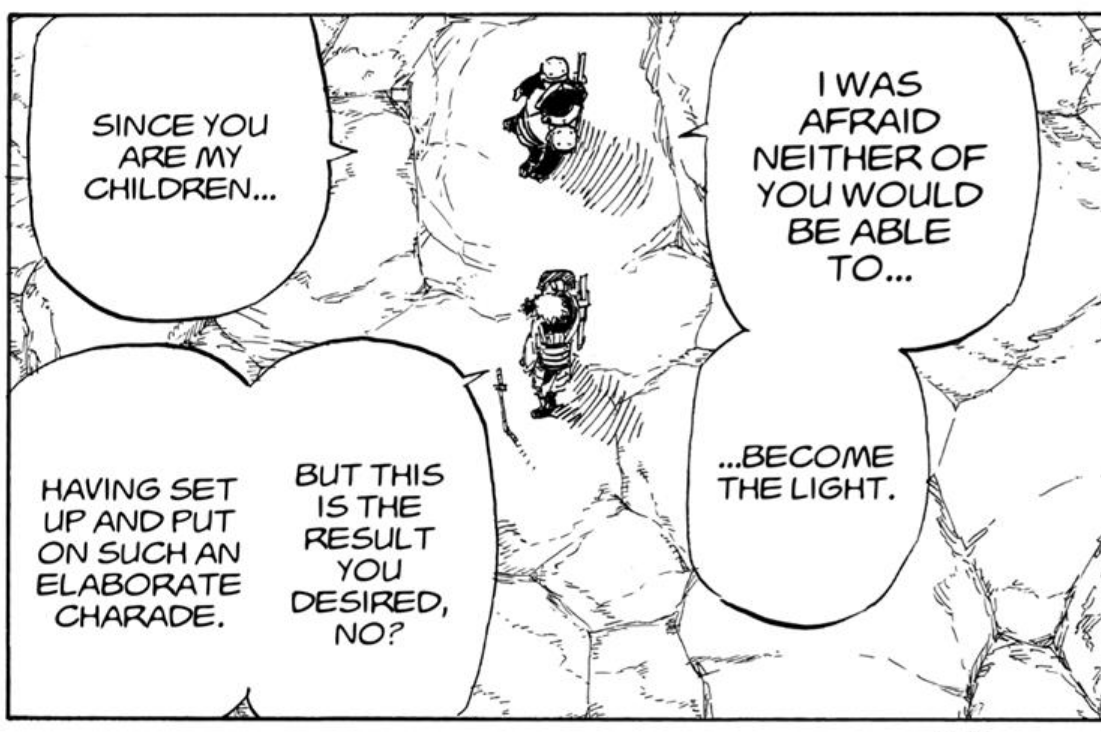
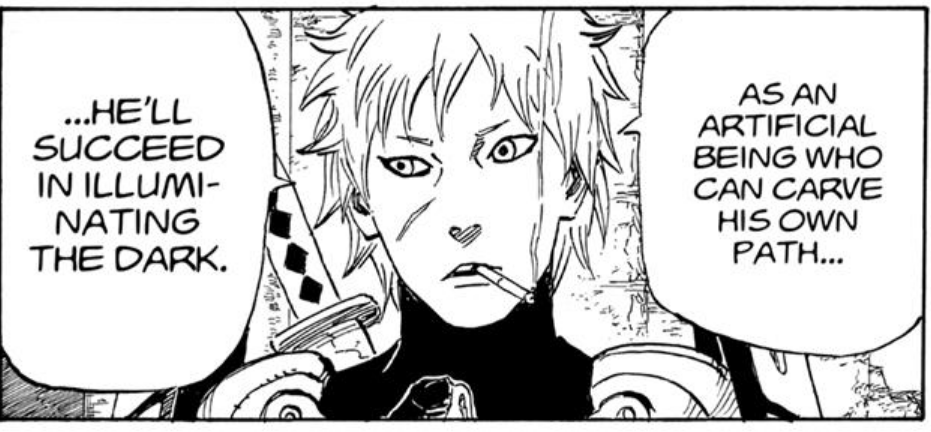
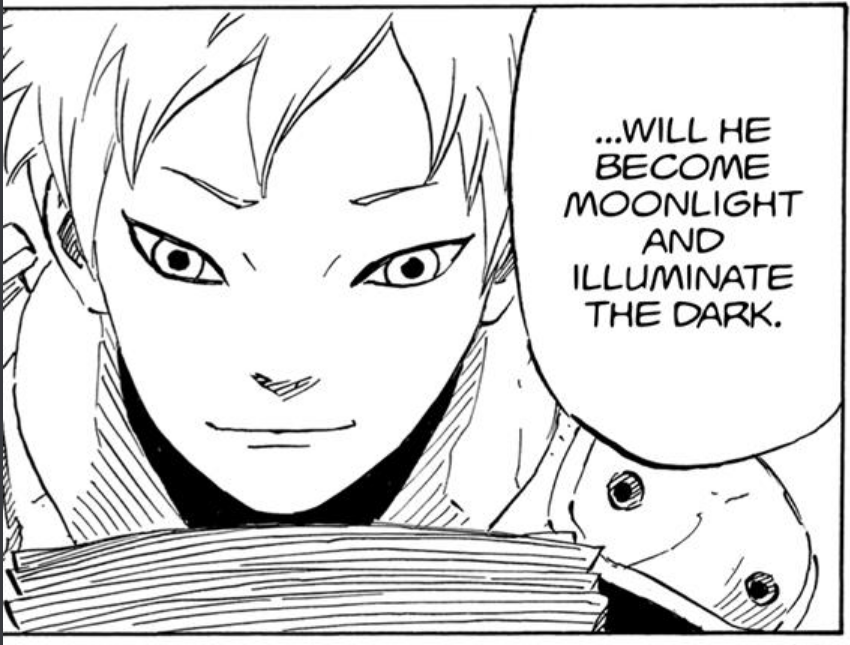
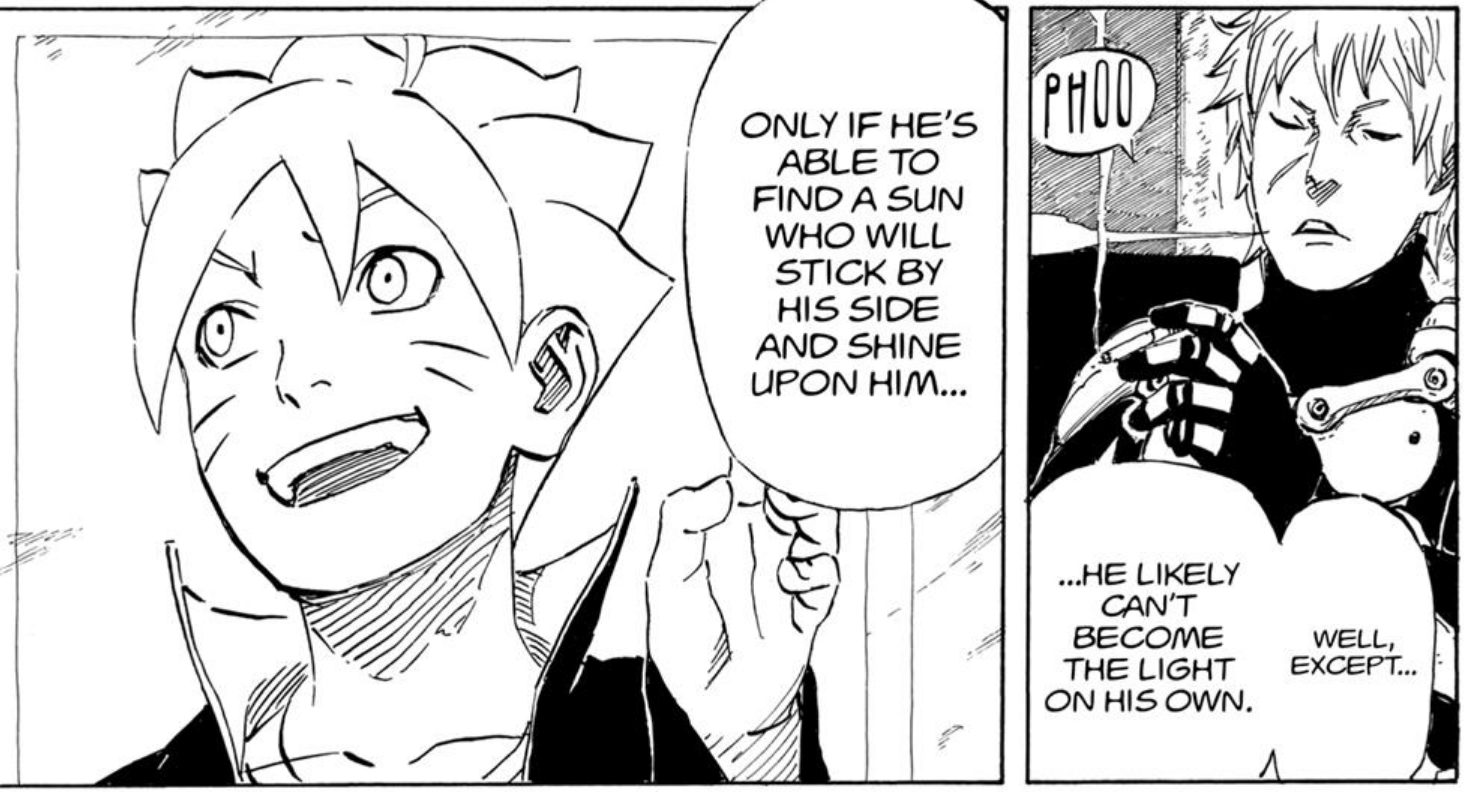
It's a good thing no one in this family eats because dinner conversations would be a trip. (Read right to left)
Log, also an artificial being, states that "he likely can't become the light on his own... [without] a sun who will stick by his side and shine upon him," which is the reason he puts an article about Boruto inside of the case Mitsuki claims for himself and opens.
In the beginning of TBV, Mitsuki appears desolate while believing Kawaki is his sun. He thinks that he requires Kawaki's presence to light up the darkness as the moon to his sun. However, it's his true sun, Boruto, who tells him that he's perfectly capable of shining on his own.
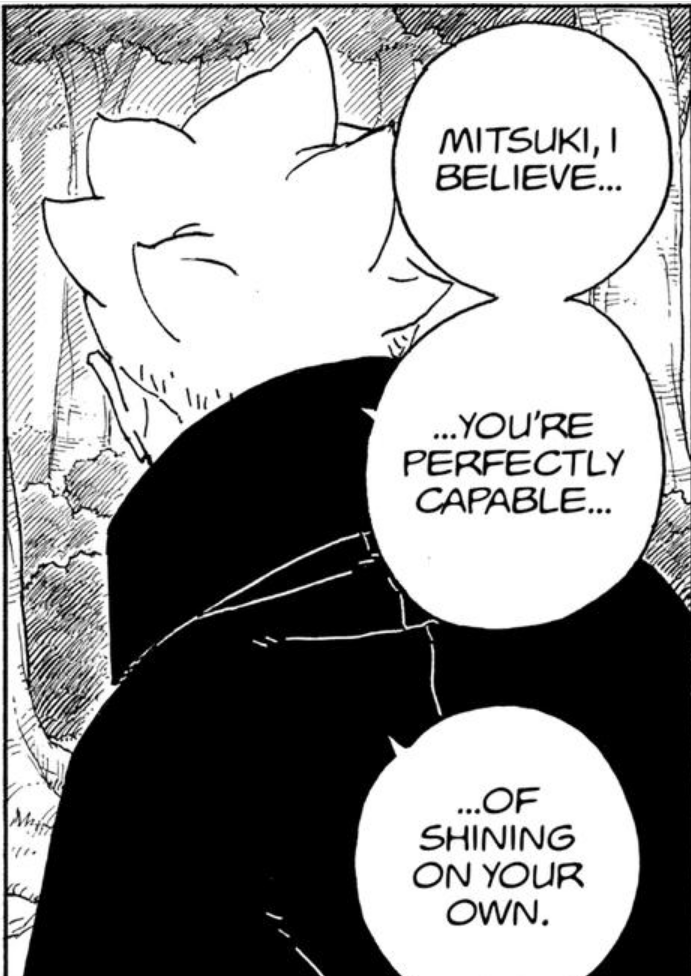
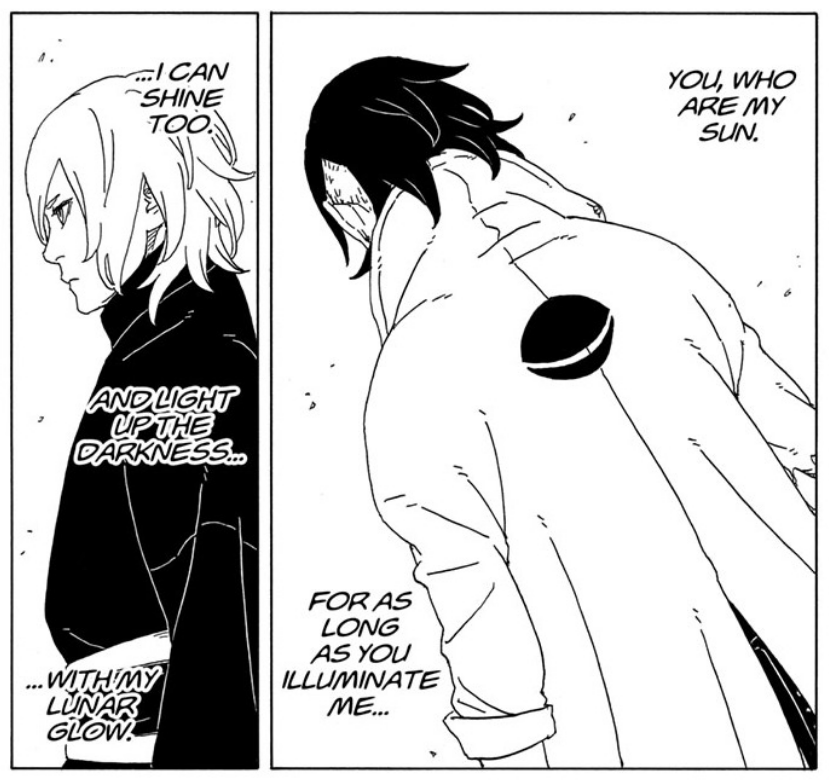
Read the transition right to left.
Given the nature of the moon's relationship with the sun, a moon actually shines brightest at night when the sun has set, being the primary body of light in the sky. If the analogy holds true, not only should Mitsuki be able to shine on his own, he can only illuminate the darkness caused by the sun's absence. While we can't be certain what Boruto is building towards, it seems that Mitsuki's ability to decide for himself rather than choosing an alliance with a single individual will play a pivotal role in the plot.
Artificial Beings
Mitsuki was the first cloned human introduced in Boruto, but he was far from the last. As we learn later, both Delta and Koji are also clones created by Amado instead of Orochimaru. We've already explored Amado's frustration with his clone child failing to be an exact replica the deceased daughter he remembers, almost as if the problem with Delta is that she's a unique individual like Mitsuki. The contrast between Orochimaru and Amado is clear: Amado is trying to recreate a dead child while Orochimaru is trying to create a unique being, rejoicing in his independence. While we've gotten little insight into Koji's experience of being Jiraiya's clone, Isshiki expressed that he draws inspiration from his progenitor.
This idea that clones may not be fully human, or that they have to meet certain criteria to overcome their artificial nature, is explored again with the Shinju, tree-like beings that emulate the individuals who sourced them while simply being a simulacrum of a human. Mitsuki exists as proof that life created through nonconventional means can become fully human by exhibiting free will.
Conclusions
I find The Path Lit by the Full Moon to be an unsettling story. Placed in the larger context of Boruto, Mitsuki is a character similar to Kawaki, modified in a lab to meet the goals of their creators, even though the scientists who create and modify them have different aims. The psychological elements of Mitsuki's backstory serve Orochimaru well as a character, but the repeated erased memories and failed violent missions to attain his ends are not addressed by Mitsuki's character. In the anime, he seems to have one of the healthiest relationships with his parent of any of the new generation characters.
When Log and Orochimaru are trying to convince Mitsuki to join one of them, Orochimaru states, "If there is one thing in the world that people are forgiven for, it is acts born and done for love," to which Log responds, "Don't you dare use that as the justification for your deeds of conceit. Do you really think you can control everything?" In the context of their conversation, they're discussing whether Orochimaru is playing a god by creating clones or using the powers granted to him by the gods. While this debate is explicitly pointing a finger at Amado's desire to save his dead daughter, it can also be expanded to encompass Kawaki's disappearance of Naruto and his insistence that the Otsutsuki deserve to die to preserve the person he loves.
By the end of Boruto, I suspect that the plot points hinted at in The Path Lit by the Full Moon will become even clearer with Mitsuki stepping up to fully become the moon that illuminates the darkness.
Want to get updates for the Boruto 10th anniversary reread, chapter analyses, and more? Sign up!