Boruto: Two Blue Vortex Chapter 39 Review
Boruto: Two Blue Vortex (TBV) - "Slaughter Him" review. Kawaki's omission, Jura's gender-bending fingernail covers, Code's vengeance, Boruto's demise, and why a bookseller poorly explaining why cats are cute might lead to the end of the world.

Cover
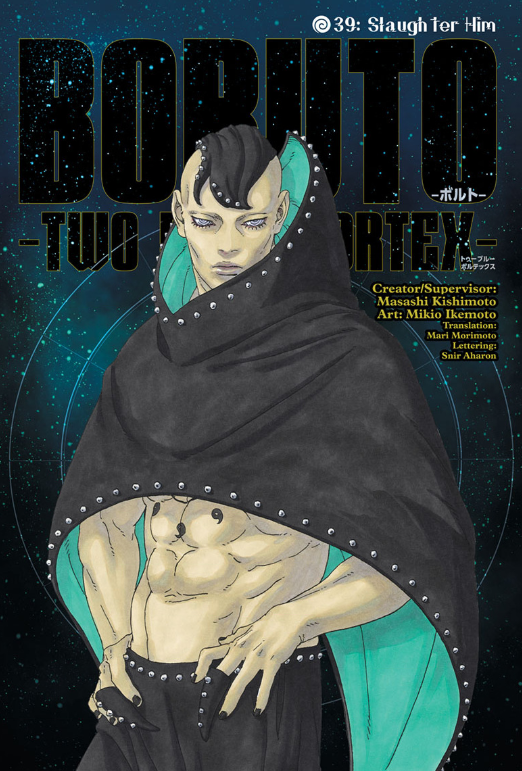
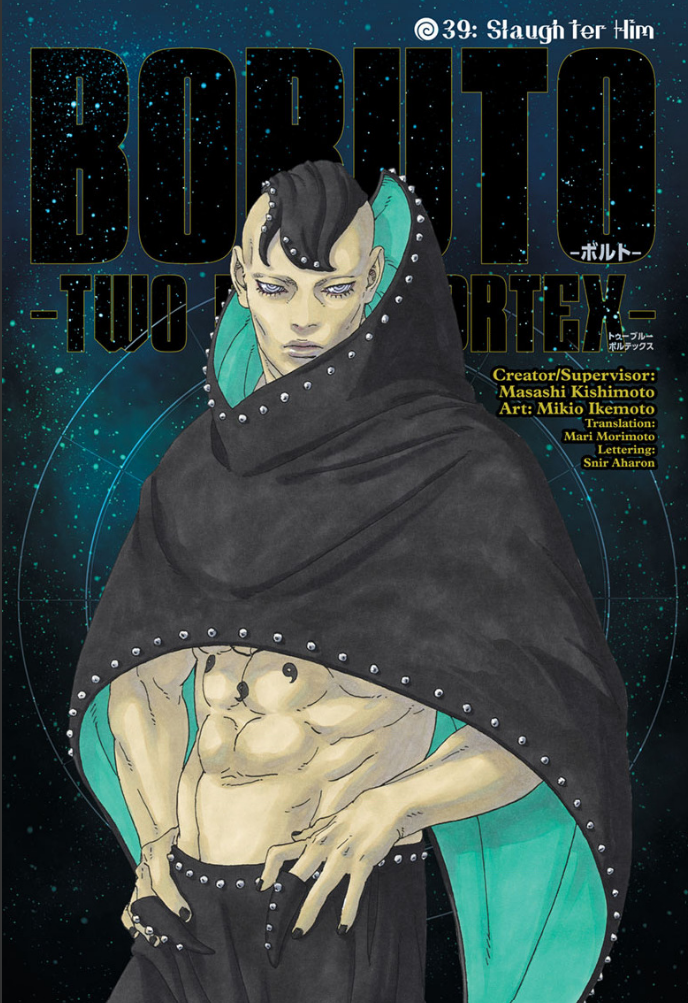
Move over, Kawaki. The Boruto: Two Blue Vortex (TBV) chapter 39, Slaughter Him, cover features the real number one threat to Boruto Otsutsuki's (née Uzumaki's) life—Jura.
Our current primary antagonist and Shinju ringleader stands with his hands on his hips in front of a cosmic background, a glowing nebula surrounded by outer space speckled with stars. Most interesting about this cover is the concentric rings behind Jura, reminiscent of both the rings of the Shinju's Rinnegan and the orbital paths of planets around a barycenter, usually a sun. A barycenter isn't so much an actual object as it is a point within a center of mass around which two or more objects orbit, and from how the cover is designed, Jura is centered as the gravitational point around which the plot is revolving.
Upon closer examination, a series of lines intersect the concentric circles, forming a polar grid chart. When used in physics and astronomy, these charts track polar coordinates and the trajectories of bodies in orbit around a central gravitational point. The fact that these bodies are tracked, though, implies that they can be subject to change, just as Koji's visions of the future shifts as different possibilities come into being. Last, it'd be remiss not to note that the lines in a polar grid chart are reminiscent of a wheel, a shape that appears in Kawaki's eye and is inverted in Sarada's Mangekyo Sharingan pattern.
A trio of Jura covers
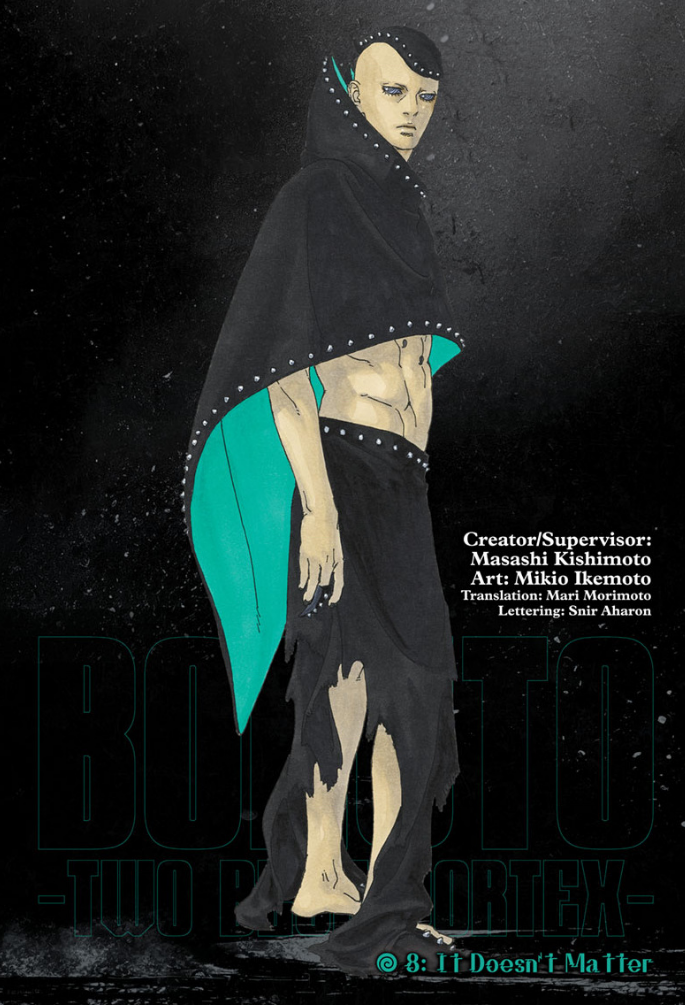
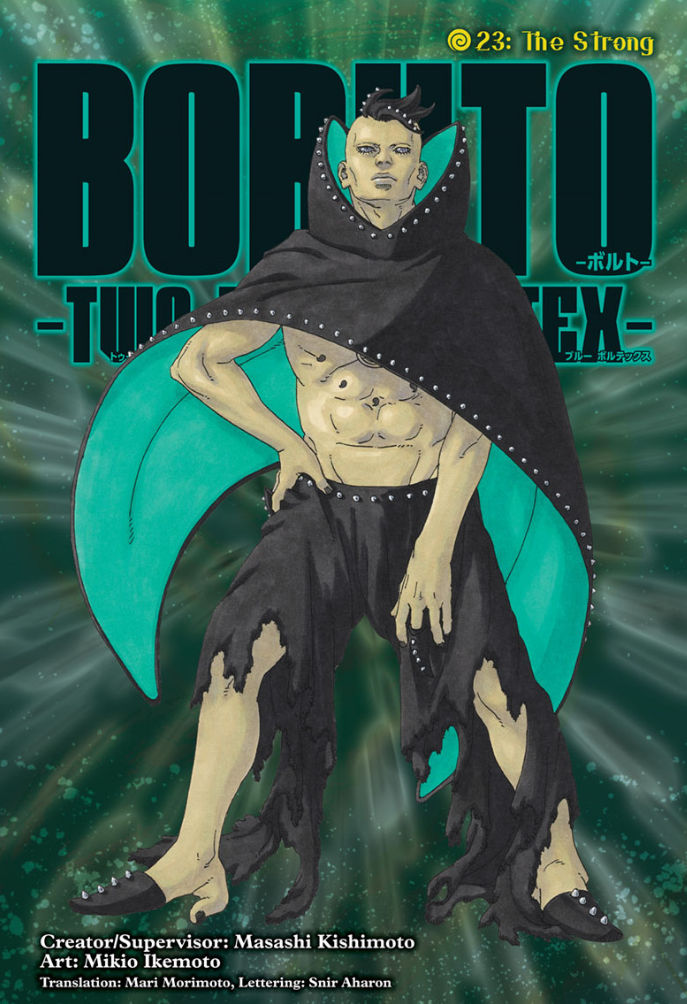
This is the third time Jura has appeared on a TBV cover, joining the ranks of Himawari, Sarada, and Boruto. Placed together, these covers seem to tell a story, Jura existing alone in a field of nothingness, backed by a celestial explosion (perhaps a Big Bang), and now at the center of the universe. He's closer to the viewer than he's been in the past, his role in the plot closing in.
We'll return to this cover and its potential meaning later in the chapter review.
Moving on to the title of the chapter, Slaughter Him. There are a surprising number of hims in need of slaughtering in this chapter: Kawaki's vow to kill Boruto (and Momoshiki), Sarada telling Boruto to finish Code, Code doing whatever the fuck he did to Boruto, Kobu closing in on Shikamaru, the bookseller, Furata, telling Jura to kill Boruto—and lastly what we all thought about Kawaki when we saw the existential crisis he sprang on Himawari over curry.
Stupid Good
As I've noted before with Ikemoto's writing, interpersonal moments between characters only occur when they're going to be relevant to the plot, which is why it's taken 39 chapters for us to see a scene of Kawaki and Himawari interacting for more than a panel or two. However, this scene delivers for readers in some incredible ways. On its surface, it's just a dinner between the two characters, but it reveals so much about both of them while simultaneously undermining both their philosophies.
The chapter opens with Himawari seeking Kawaki's approval of her cooking. Through her facial expressions, we see how Omnipotence has affected her in different ways from Mitsuki, though both of them loved Boruto and had that love and identity transferred onto Kawaki. While Mitsuki existed in a world of darkness after Kawaki became his sun, Himawari is as bright and bubbly as ever when interacting with her "big bro" Kawaki. Big eyes. Big smiles. Enthusiastically responding to his compliment. Her attitude towards Kawaki (understood in this context to be viewed as her older biological brother) is set by their relationship as family members rather than being an anchor for her identity.
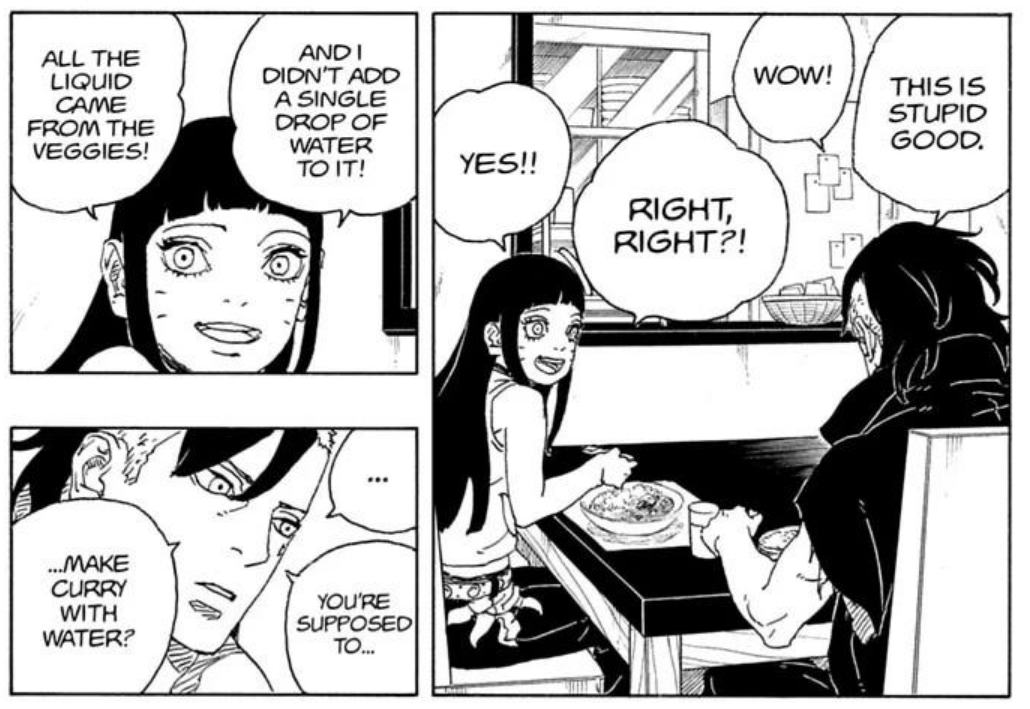
I want to break down this next page in a bit of detail because there's a whole bunch of interesting dynamics at play. While I feel as though Boruto's attitude in the manga and Kawaki's disposition are more aligned than they are in the anime, Kawaki's response of "Who cares, so long as it tastes good? I'm an expert at eating" is a very Kawaki-like statement, showing the way in which his personality mismatch with Boruto is dismissed due to the effect of Omnipotence. However, this response is a callback to his love of food and eating, something he only discovered after coming to Konoha and experiencing life in the Uzumaki household. This is the child who was unaware of the existence of chocolate or snacks until Naruto bought him a taiyaki in chapter 28 of Boruto: Naruto Next Generations (NNG) after already having eaten breakfast. The meaning of that exchange sets the stage for the transition in their conversation.
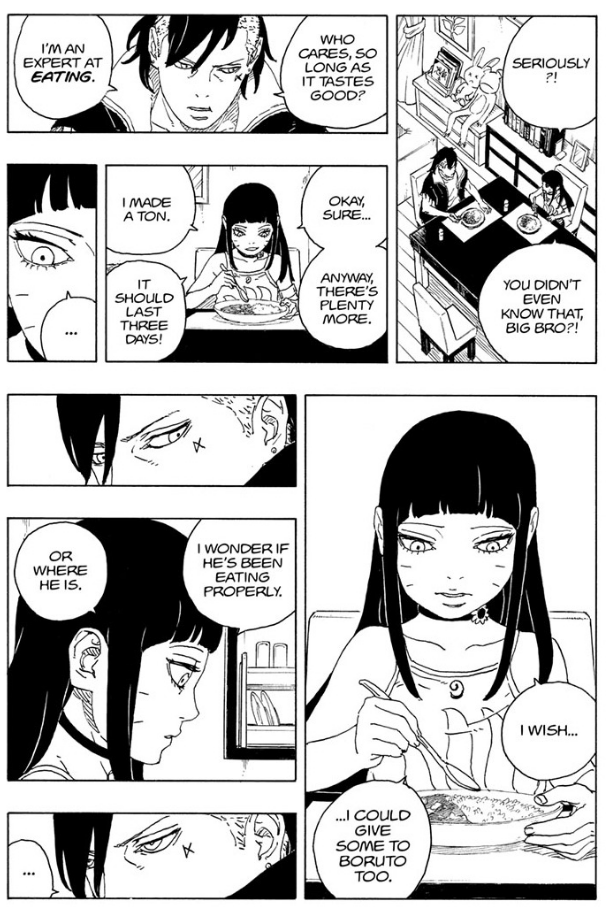
After a moment, Himawari says, "I wish I could give some to Boruto. I wonder if he's been eating properly. Or where he is." I think the final panel is meant to be a part comedic and part guilt, Kawaki realizing that the person she's thinking of is actually sitting across the table from her, eating quite well. For both Kawaki and readers, this is also a callback to the times when Kara members encountered Kawaki after coming into the Uzumaki household and remarked on him looking well, becoming soft, or being well-fed, implying that he was being pampered in Konoha rather than subject to the harsh treatment they thought he deserved. It reminds both him and us that he's been living the good life in Konoha while Boruto has taken on deprivation in his place due to the Omnipotence swap.
The dinner conversation goes downhill from there, with Kawaki asking her, "Do you still believe in him as foolishly as ever?" This is a double-edged question for him to be asking. She's expressing faith in Boruto, someone Kawaki has determined to be an enemy of Konoha due to being an Otsutsuki (determined by Kawaki) and having Momoshiki inside of him (an actual threat). However, Kawaki is also aware that she's expressing faith in him, the outsider who came into Konoha and was adopted into her household. She's not thinking of Boruto, her big bro, but of Kawaki, who saved both her and Naruto from Delta, who defied Shikamaru to save Naruto from Boro, whom she watched painstakingly piecing a shattered vase back together even though she told him he didn't have to.
Himawari's defense of Boruto is actually a defense of Kawaki, or who she knew him to be when living in their household. She rightfully notes that the crimes laid at Boruto's feet (killing her parents, betraying Konoha) are not things Kawaki would have done, bolstered by her second sense that her parents are actually alive rather than dead—something Kawaki doesn't dispute. Her conclusion from this is that "Boruto must have gotten mixed up in something. I know it. And if I'm right, I want to be there to help him."
Himawari is correct on all accounts in her belief. Boruto, her biological brother, got mixed up in Omnipotence and he is in trouble, blamed for her parents' death and exiled from their home, on account of it. At the same time, she is also right that Kawaki has gotten himself involved in a much larger issue, that of Momoshiki's threat and Amado's manipulations, and trying to shoulder it alone is part of what's led to so much disaster. Kawaki's eyes do a lot of work during her exposition, looking towards her during some moments, away during others, but his ultimate answer is to tell her, "What do you want me to do? I ain't changing my mind. No matter what anyone says."
Kawaki then redirects the conversation from an exploration of his motivations and Boruto's culpability to his driving philosophy, returning to his philosophy that all Otsutsuki need to die, and Boruto is one of them. He acknowledges the current alliance between them, but tells her that their deal is off the moment Momoshiki emerges, which would lead to a situation in which he'll have to kill both the evil alien inside of Boruto and his host. He challenges Himawari's faith in Boruto, saying, "What will you do then... Will you face off against him as Konoha's defender or keep saying such absurd things and stand with him? You better figure that out while you can for your own sake."
The question he's asking her is very real: Kawaki watched Borushiki take Sasuke's Rinnegan, was almost kidnapped by him twice, lit himself on fire once to save Boruto, and witnessed Naruto almost killed for being unable to defend himself against the monster in Boruto's body, stopped only by Kawaki's intervention. He's trying to prepare her to view Boruto controlled by Momoshiki as the enemy because he is very much the enemy. When asking if she still has faith in Boruto, Kawaki is talking about himself. But when he's telling her she needs to decide what to do if she ends up facing Borushiki, he's telling her the choice that he himself faced and the decision he had to make. He's challenging her belief that if she just helps Boruto, everything might turn out well in the end.
However, this conversation also challenges Kawaki's convictions in one very important way. Throughout TBV, Kawaki has claimed over and over that his intention is to kill Boruto, then kill himself. He's said it to Sarada in front of Shikamaru, to Delta, to Amado and Sumire, to Boruto. He's willing to tell everyone that he's going to kill himself—except Himawari. He excludes that part of his plan from their conversation, unable to actually say to her that he's going to end the life of the person she perceives as being her big bro. There's no "I'm going to eradicate all Otsutsuki, including myself," statement in this scene because he knows he can't say it to her.
When he states his suicidal intent to other characters, it's an excuse for his own actions. To Sarada, it's justice. "Don't worry, I'll die, too." To Boruto, it's justification. "We'll both die in the end." To Delta, it's permission for bad behavior. "Don't worry about killing me, I'll kill myself first." To Amado, it's leverage. "I plan on dying anyway, so if you want your daughter brought back, you'll do as I say." In the case of Himawari, though, she's already expressed faith in him, both in the role of her biological big bro and in the role of the outsider, so his death would be entirely unable to address any of her grievances. All it would do is leave a hole, and, thus, he can't address it.
Kawaki abruptly leaves afterwards, only to encounter one of Koji's toad, waiting outside with one of Boruto's symbols—a four-leaf clover. Through the toad, Koji tells Kawaki that, "Your gut instinct of impending crisis isn't mistaken. Time is running out and we need to take action. Kawaki, I need your help."
Sasuke believed he needed to kill Naruto to sever all connections in his life to achieve his goals while Boruto has vowed to never let his clash with Kawaki result in brother killing brother. Similarly, while Naruto's conviction was that he needed to save Sasuke in order to become Hokage, Kawaki believes he needs to kill Boruto, then kill himself. Because of this, readers should view Kawaki's monologues about eradicating Boruto and the Otsutsuki as serving the same narrative purpose as Naruto's oft-stated conviction that he was going to save Sasuke and bring him back to the village, which was his unwavering goal throughout the series.
Boruto, Wait!
We return to the Shinju's hideout and Code's recently extended smile. Our resident Otsutsuki simp disappears into a claw mark when Boruto's sword slashes at him again. Code is quickly able to address the wound by affixing a new belt to it, but switching locations allows Boruto to grab Sarada, flying into the maze of roots surrounding the main room and hiding symbols inside of it. With their main objective completed, Boruto informs Koji that he's ready to teleport out of the hideout. Koji replies, "Let's return to Konoha. I want Sarada's injuries healed, to teleport close to Himawari. Fix on the four-leaf clover. Start now."
Before we move on, I think it's worth interrogating what Koji says. The toad with the four-leaf clover just enlisted Kawaki's help, noting an "impending crisis" and that "time is running out." By telling Boruto to teleport to Himawari, he'd also be putting Boruto in proximity to Kawaki and whatever plan he's shared with him. When Sarada tries to stop Boruto, telling him that she saved using Ohirume for him to show up so they can take down Code, Koji makes it sound as though there are only two futures that he's witnessed: one in which Jura shows up in the Shinju hideout and kills Boruto and another in which they "make it back to Konoha safely." He doesn't mention the possibility of Momoshiki's appearance or why he needed Kawaki's help. Thus, we should assume that Koji has multiple spinning plates of fate at the moment, having Boruto return Sarada to Konoha to be healed while we also know that it's her rescue that brings about Momoshiki's emergence.
Realizing there's a toad walkie-talkie in Boruto's collar, Sarada asks Koji about Hidari saving her eyes from having to be listed as yet another shinobi ocular work-place injury. Koji admits that this is a future he hasn't seen before, which means the futures he has seen are already wildly shifting. This seems to be what convinces the three of them that they should take the chance to end the threat of Code while they can, even though the possibility of Jura's return and Boruto's extermination hangs over them.
Predatory Evolution
We return to Furuta, the bookseller, and his attempt to occupy Jura per a direct request from the village's Hokage, Shikamaru. To do this, he's indulged Jura's curiosity about cats, trying to help him understand why Hidari finds them cute.
This is one of the most packed exchanges in this chapter, and I think it's going to have some huge plot ramifications going forward, so we're going to break it down in detail.
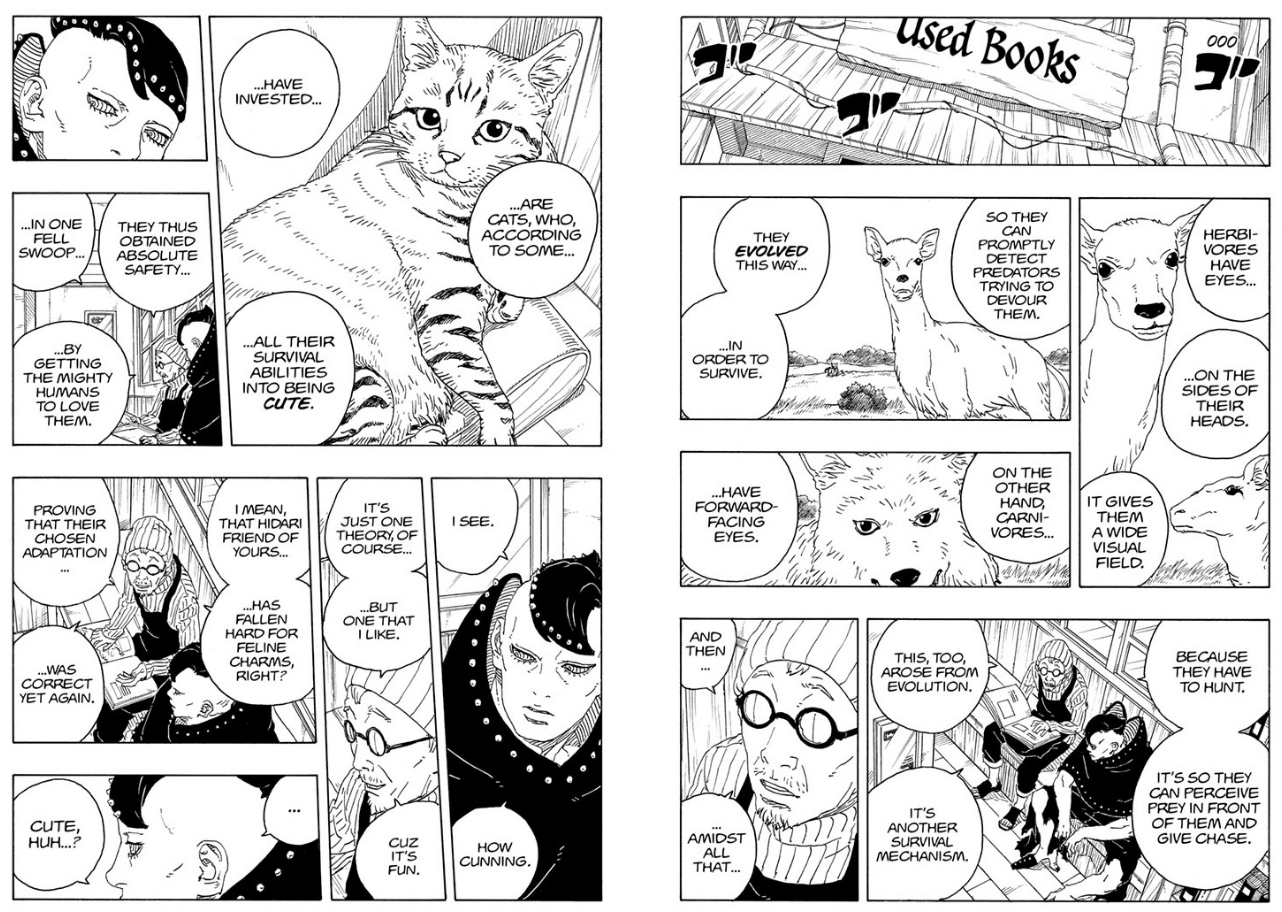
In order to explain cats, Furuta begins by explaining the evolutionary differences between predators and prey animals through the location of eyes on their heads, which give herbivores a wide range of vision to spot danger while carnivores can see directly in front of them to hunt—both of which are survival mechanisms.
I think it's important to pause here to tie this conversation to the larger theme of evolution and survival that has been brought up with the Shinju. Screenshots incoming.
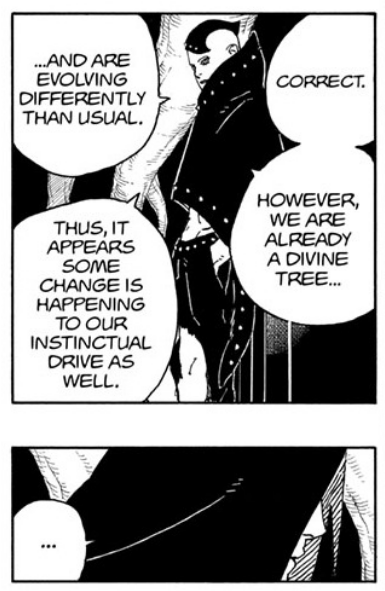
In chapter 5, when Jura is holding court with the newly born Shinju for the first time, he states that as Divine Trees, their driving goal is to devour Otsutsuki to evolve into their final form. For them, evolution isn't a slow change that happens over generations; it's literally the goal of their existence. However, he acknowledges that due to the changes Code made to them, they're evolving differently from a typical Divine Tree and have developed their own individual instinctual drives to consume specific targets in addition to Otsutsuki.
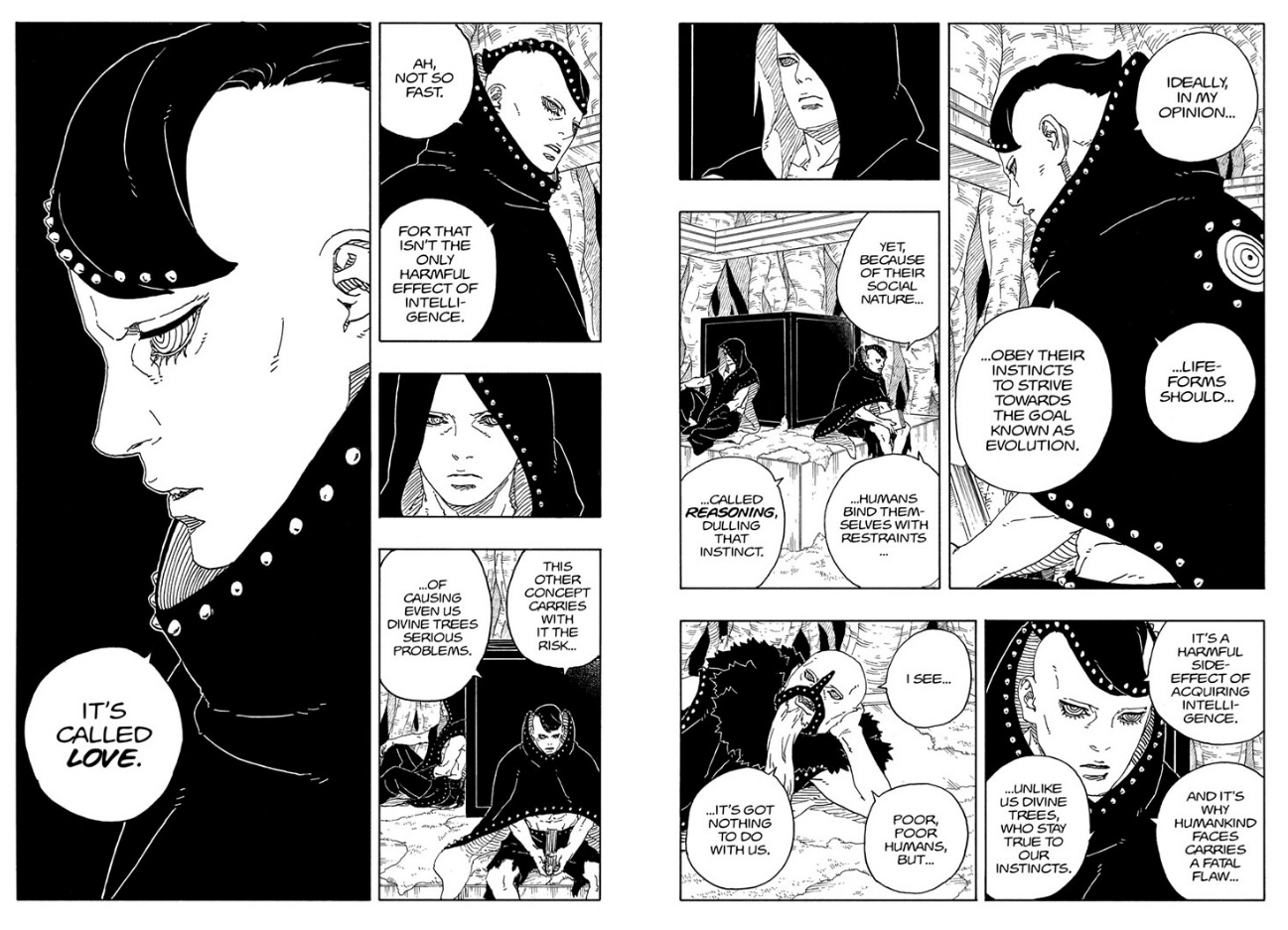
We return to this conversation again in chapter 19, when Jura is first discussing love as a source of both weakness and strength to humans—and a direct threat to the survival of the Shinju themselves. Jura believes that "life forms should obey their instincts and strive towards the goal known as evolution," but love undermines that instinct, causing humans to act outside of their instincts. Jura states that, in order to survive, the Shinju must understand and overcome the concept of love.
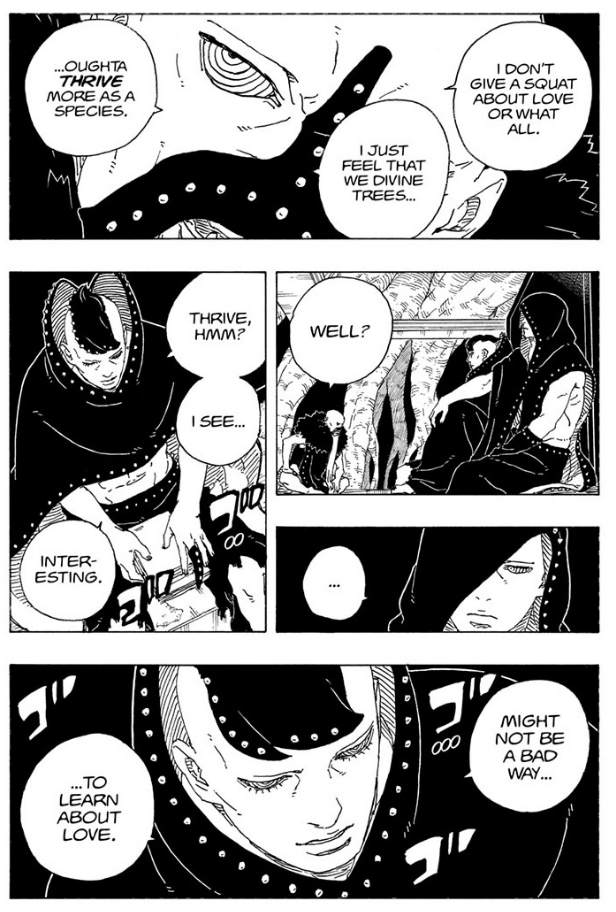
Evolution comes up again as a theme in the Eida arc when Mamushi realizes why he'd chosen Eida to be a target. He states, "I want to make her superior genetic information mine... I just feel that we Divine Trees oughta thrive more as a species." In this way, Mamushi is invoking the actual result of evolution being survival of a species and pointing out that his instinctual desire to consume Eida is meant to improve the Shinju's genetic material. This is the closest the Shinju have gotten to aligning their vision of what evolution is with its scientific definition of being a process of genetic mutation that benefits a species' survival.
Let's bring this back to Furuta and Jura's conversation. As a Shinju, Jura believes it is his purpose to evolve and sees love as a dangerous threat to the Shinju species. The very first thing that Furuta tells him in this conversation is that carnivores have forward-facing eyes because they are meant to see their prey and chase them, which is necessary for their survival. What Jura has just learned is that both humans and Shinju alike are predators, evolved to kill.
What Furuta proposes next, something that he later dismisses as "just one theory... that I like. Cuz it's fun," is that cats "have invested all their survival instincts into being cute. Thus they obtained absolute safety in one fell swoop by getting the mighty humans to love them."
As readers, we know that the theory Furuta posits is flawed because it states that cats are responsible for their own evolution, that they purposefully designed themselves to be cute and loveable to get the protection of humans. For Jura, who believes that life forms logically must pursue their own survival, this makes sense, which is why he views the explanation as logical and the adaptation as "cunning." We know, however, that humans are attracted to cuteness because of the biological imperative to take care of our young and things that look like our young, and cats didn't develop to purposefully be cute. Rather, humans who found cats cute (or found their dispositions appealing) purposely chose the cutest (and kindest) among them to raise and protect, which over time led to domestic cats looking much cuter (and more docile) than their feral cousins.
What Furuta has inadvertently proposed to Jura, though, is that cuteness is a tool to evoke feelings of love—which Jura has previously stated is a threat to the Shinju. Essentially, Jura now has reason to believe that love can be purposefully created and used to manipulate the hearts of both human and Shinju alike. In his attraction to cats, Hidari isn't understanding love; he's feeling love, which is dangerous.
I think this scene could end up affecting the plot in multiple ways. If we return to the cover of this chapter, we see Jura now positioned at the center of the universe, as though he just now understands his place in it. One possible interpretation is that he now understands more about love and how it functions, but I think it's equally likely that Furuta's speech made Jura realize that his evolutionary purpose, and the purpose of humans, is to pursue prey. In cats, we see that predators are capable of evoking feelings of love from others while remaining dangerous hunters.
Enough about evolution, though. The story moves on with Hidari communicating with Jura through their black areas, informing him that Boruto, Sarada, and Code are all in their hideout. In Hidari's telling of events, there's some ambiguous pronoun usage. When Jura asks about Boruto's motive, Hidari responds, "To retrieve Sarada, it seems. While Code was using Sarada to lure Boruto. He showed disrespect." While the "he" could refer to either Boruto or Code, we see a flashback to Hidari's memory of events, depicting Sarada on the ground and in pain, so I think it's likely that the person showing disrespect is Code. This is important in the context of the Shinju-Code alliance.
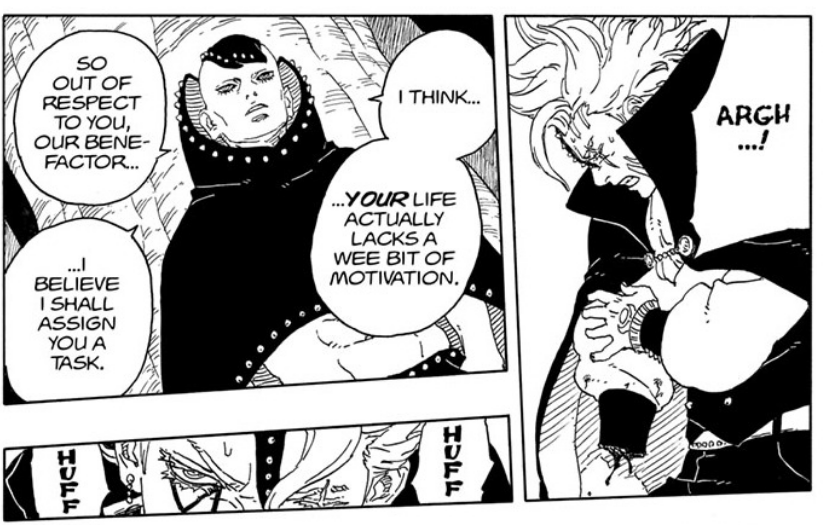
After Code attacks Jura and Jura obliterates his right hand, he tells him, "...out of respect to you as our benefactor, I believe I shall assign you a task." Jura believes they owe respect to Code as the person who enabled their sentience, and Jura decides to let him live based on that respect. However, Hidari interprets Code's interactions in the hideout and his treatment of Sarada as disrespect, which could lead the Shinju to rescind the grace they previously extended to him.
Piece of Trash
We return to Boruto and Sarada standing in the Shinju hideout, Boruto supporting his injured teammate while the Uzuhiko effect begins to form around his feet. Having experienced this before, Code embeds the ground beneath them with claw marks and attacks, forcing Boruto upwards and stopping him from building up enough contact with the ground to activate Uzuhiko.
Code's internal thoughts in this scene showcase how his mind works and how his twisted perspective is what leads to his defeat in this fight. To him, Boruto fighting while carrying Sarada is a burden and the act of doing so is mockery. This is the classic case of a character who is no seeing the hidden meanings within hidden meanings. It's Sarada who has insisted they should fight him now, and even in her injured state, she's as asset rather than a restriction. He's unable to understand her value, and thus is led into their trap by his own flawed view of their relationship. Even when Boruto drops Sarada, Code interprets this as "reveal[ing] your true colors" and relishes in the fact that he can finally declare that Boruto is "no better than the rest [of us]." He sees Boruto's action as saving his own hide, what Code would have done if their roles had been reversed, and thus is unable to escape before he's caught in the effect of Sarada's Mangekyo Ohirume.
I think this entire scene deserves some major props. I've often noted that when Ikemoto improved his character design and human proportions in TBV, his fight scenes lost some of the dynamism they had early in the series, such as during the Shojoji and Ao fights. In this chapter, he's finally combining his two strengths of elaborate character design and fluid fight choreography into a single scene, and the results are stunning. I think it's notable that it's happening during this fight as well, one in which we're supposed to be seeing the battle chemistry between Boruto and Sarada, the unspoken bond that they have when fighting alongside one another, their implicit trust in each other and their skills. The smooth paneling, seamless, unspoken action, is both an example of Ikemoto's skills, and of the dynamic Boruto and Sarada share. Sarada simultaneously delivers an attack and a distraction, using one of her black spheres positioned behind Boruto to draw their foe directly into his prepared Uzuhiko.
Though I try to avoid most fandom chatter, I know there's a bit of a kerfuffle about why they chose Uzuhiko as their final move instead of Sarada blowing him to bits as she did with Ryu or Boruto turning him into a sword shish kabob. I'll address this briefly:
- Given her failing eyesight, it's logical for Sarada to utilize her Mangekyo abilities in short bursts rather than in drawn-out effects as she did with Ryu and in the Mamushi arc.
- We actually haven't seen Boruto fatally use his sword against his fellow man before, and he even went so far as to save Lord Kobu—though the next scene of this chapter will make us wish the assassination attempt had succeeded. I think resorting to Uzuhiko is more in line with the behavior we've seen from him in the series, and a brutal decapitation of a human would be out of character.
- Given that we've seen Code repeatedly handle wounds with the application of belts, I'm not sure how effective slicing and dicing him would be. He's fixed a slashed mouth and a hand stump with them. There's no guarantee that cutting his throat wouldn't result in a new fashionable choker (and we don't know if his white Karma has some fantastic healing abilities as well).
- As Boruto's closing salvo to Code states, he wants Code to experience regret as he dies. The first time he landed Uzuhiko on Code, Boruto said that Uzuhiko is "a biting counterattack from this planet that you were trying to destroy." Code's actions led to the loss of his master, the creation of the Shinju, and, most recently, brutalized Sarada. Boruto wants him to suffer as he dies and reflect upon all of the chances he squandered to walk another path.
- I think my last point is that the scene itself is fun. It relies on shinobi abilities, showcasing jutsu that have been developed in the course of TBV. It's a good action scene in a fun manga. Humans themselves don't always do the most logical thing, and I don't think it's necessary for a story to do that, either, especially when the ramifications of the choice will be good for the story.
Big Trouble in Little Konoha
Lord Kobu is in rare form back in Konoha, trying to work out a deal with Mitsuki to be granted immunity in exchange for his cooperation in taking down Shikamaru. Mitsuki continues to be a much better liar than his genin sensei, to the point that Konohamaru should really be taking notes. Shikamaru puts an end to the interrogation by walking in and dismissing Mitsuki against his protests.
In another part of the village, Jura has decided it's time to head back home to deal with the sudden teenage intrusion into his hideout. When Furuta asks what association Jura has with Boruto, the traitor who murdered Lord Seventh, he learns that he people of Konoha and the Shinju share a common enemy, one that Jura hopes to kill if he returns home in time.
The bookseller quickly puts together that it's very possible that what Shikamaru asked him to do—distracting Jura—was to aid the traitor, Boruto. Realizing he played a part in protecting such a heinous criminal, Furuta asks that Jura slaughter Boruto.
There are two interesting things to note from this scene. If we return to the first chapter of TBV, Shikamaru already warned Sarada that rescinding the order to kill Boruto extends beyond simply being a legal matter. "Many of those living here are still angry about his betrayal. So even if I lift my order, people will stay unconvinced."
With Furuta, we're seeing this statement in action: even though the bookseller recognizes that the order to delay Jura (to aid Boruto) came directly from the Hokage, he refuses to give either Shikamaru or Boruto the benefit of the doubt, directing Jura to "Please slaughter him! He's a stain on Konoha's name!"
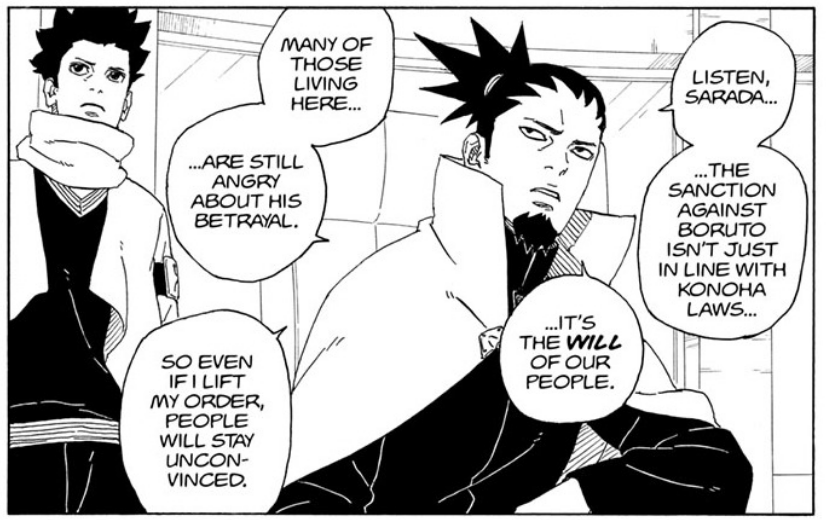
During the above conversation, Shikamaru warned Sarada that she was risking her dream of being Hokage and even endangering the possibility that she'd remain as a shinobi in Konoha if she continued to advocate for Boruto. Now, Shikamaru is risking his position as well to help him.
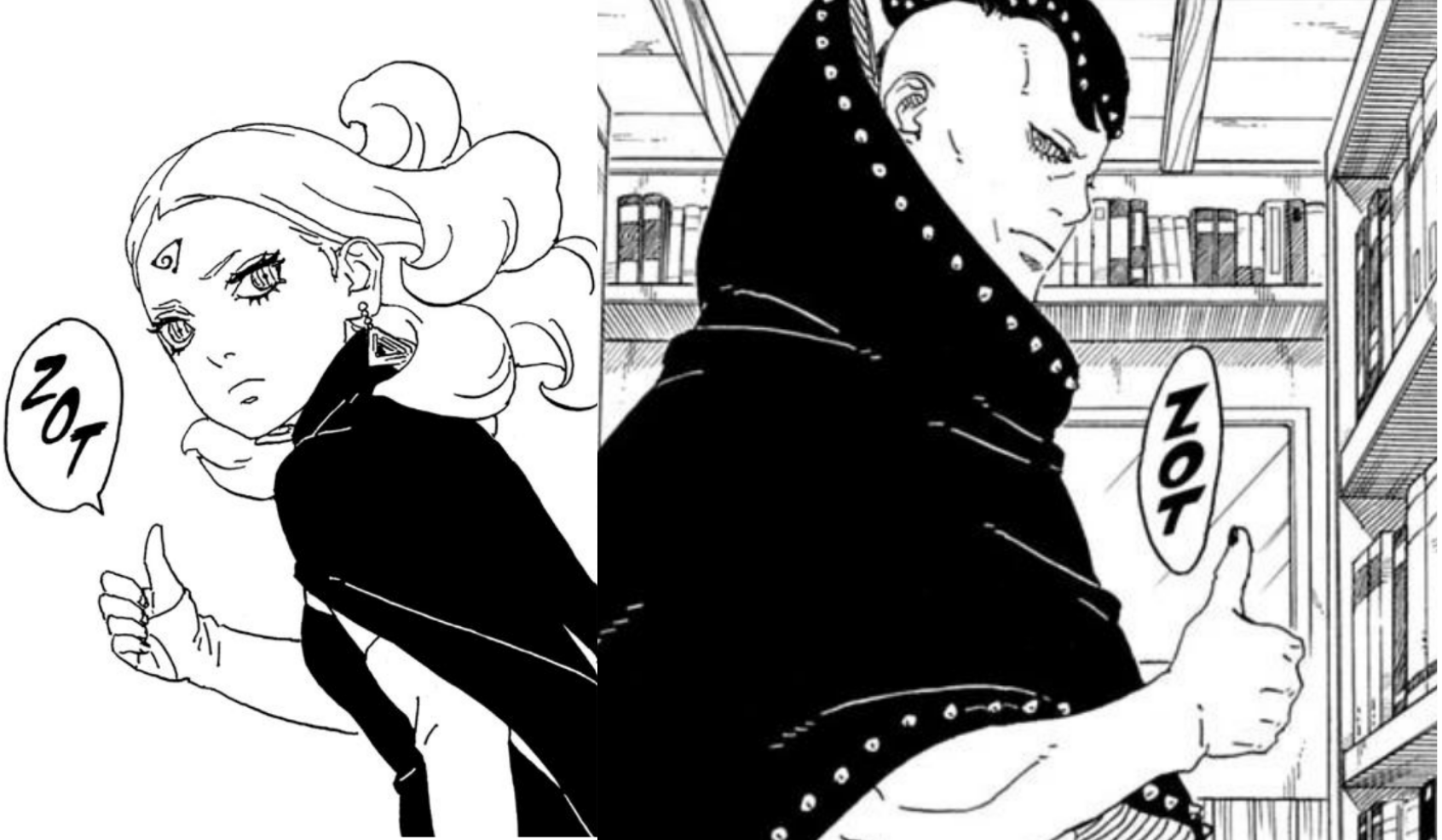
I also want to just take a second to appreciate the two zots in TBV thus far, Delta's in response to Eida telling her to take care of Kawaki and Jura's in response to Furuta telling him to slaughter Boruto. There's something interesting about these not-quite-human characters using a thumb's-up sign to acknowledge their commitment to carrying out an assigned task.
Code's Revenge?
On the last two pages of the chapter, we see Boruto teleporting out of the hideout with Sarada, successfully avoiding an encounter with Jura. However, as Code lies suffering on the ground, we're treated to a flashback of the moment Boruto landed Uzuhiko on him, a glowing field surrounding Code's claw-like appendage making contact with Boruto's shoulder.
During their last clash in chapter 34, Boruto taunted Code for not attacking. "How do you intend to kill me if you're so scared?" he asked. Code replied, "How, you ask? You'll see soon enough," with a panel focusing on his newly formed bone hand, the same one he used to sense Boruto's chakra on Sarada and remove the symbols she was carrying.
Even while he lies on the ground, being ripped apart from within, Code seems sure that he's exacted his revenge upon Boruto.
Questions, Conclusions, Corrections, Speculation
- What the hell did Code do to my son? And how does it relate to Momoshiki's emergence?
- What is Koji's plan with Kawaki, and what's going to happen when they return to Konoha?
- What role will Hima play in the likely event that Kawaki emerges?
- I'm expecting that we're going to get a lot of Kobu and Shikamaru next chapter.
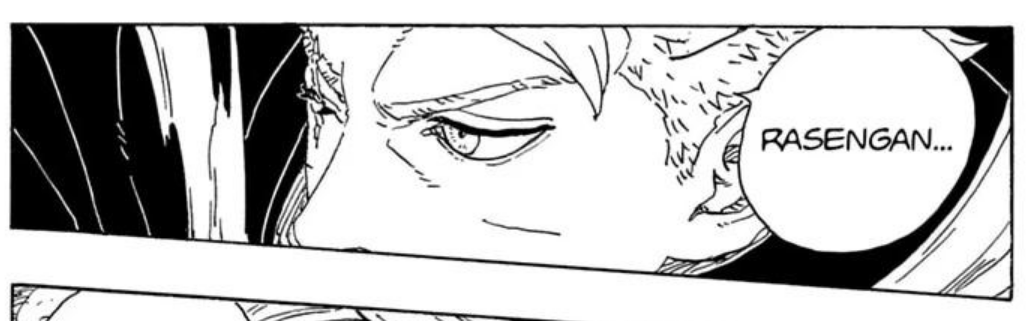
- Um... Why does Boruto's eye look like a Jougan in the panel below? I know it's probably just a curled eyelash, but I'd be remiss if I didn't note it, particularly when I haven't seen Boruto's lashes drawn that way before.
- On the subject of eyes, a mutual on Bluesky noted that Koji's eyes take on the toad-like appearance when he's using his scientific ninja tool toads. Now, that's not always the case because he communicates with Eida while his eyes look like human eyes, but the speculation is that it's when he's seeing through the eyes of the toad that they look similar. I'm going to be skimming the manga in the future to test this theory, but I want to throw the likelihood out there that my speculation about Sage Mode was wrong.
- The next chapter is a volume-ender, so I expect it to have some resolution to the Shinju hideout incursion with a gut-wrenching twist at the end.
- How is Code going to survive? It's very possible that this isn't going to be the end of him, but now that he's in Hidari's disfavor, I don't know if Jura would use his knowledge of the Rasengan to save him. Could we be in for a Shinju Code that maintains his personality as he's already part of them?
- Are we going to learn more about why Hidari saved Sarada in the next chapter? Is there going to be a tree heart-to-heart talk about what was going through his mind when he stopped Code from hurting her?
- Is Himawari going to heal Sarada immediately, or are we going to get to see Sakura dealing with the consequences of telling her daughter to follow her heart and help Boruto?
- I keep returning to Sumire's prediction that Sarada is going to just blurt out her feelings for Boruto given their proximity in this chapter. Combined with Koji's vision that rescuing Sarada is what would bring out Momoshiki, is it possible that a love confession is what actually leads to Boruto losing control?
All in all, I'm extremely pleased with how the three chapters we have so far are turning out, and I'm looking forward to the narrative conclusion of this arc as the volume ends.